► 4WD option in this class is rare
► Comfortable, well-equipped but sluggish infotainment
► Modest range and small boot
Firsts don’t come around that often in the car industry these days, but – for Suzuki – this is one of them. Say hello to the new eVitara – the brand’s first ever electric production car.
Our first time behind the wheel of this new-to-Suzuki powertrain was a 90-ish per cent ready prototype at the UK’s UTAC Millbrook facility. But now we’ve driven the fully finished version on real roads. If you’re curious about the process behind our verdict, head to our how we test page. Otherwise, read on to discover how the Suzuki’s debut EV stacks up.
At a glance
Pros: Easy drive, tidy handling, well-thought-out interior
Cons: Slow infotainment, boot is small, underwhelming efficiency
What’s new?
It’s probably faster to say what isn’t new. Ummm… oh! The name! Yes – Vitara has been part of Suzuki’s line up for more than 35 years, going from tough ‘n’ ready utility vehicle to beach bum ferryer to family-friendly urban-ish runabout and everywhere in between.
As we’ve mentioned, this is the first Suzuki to go on sale with an electric powertrain, with the brand being deliberately slow and considered as to when to launch EVs across its markets. Unfortunately, the ZEV Mandate for the UK has thoroughly kicked Suzuki up the backside, so it’s keen to get some new models on stream so the brand isn’t punished by increasingly tough rules from now on. The eVitara is the first, with Suzuki planning four more electric cars by 2030.
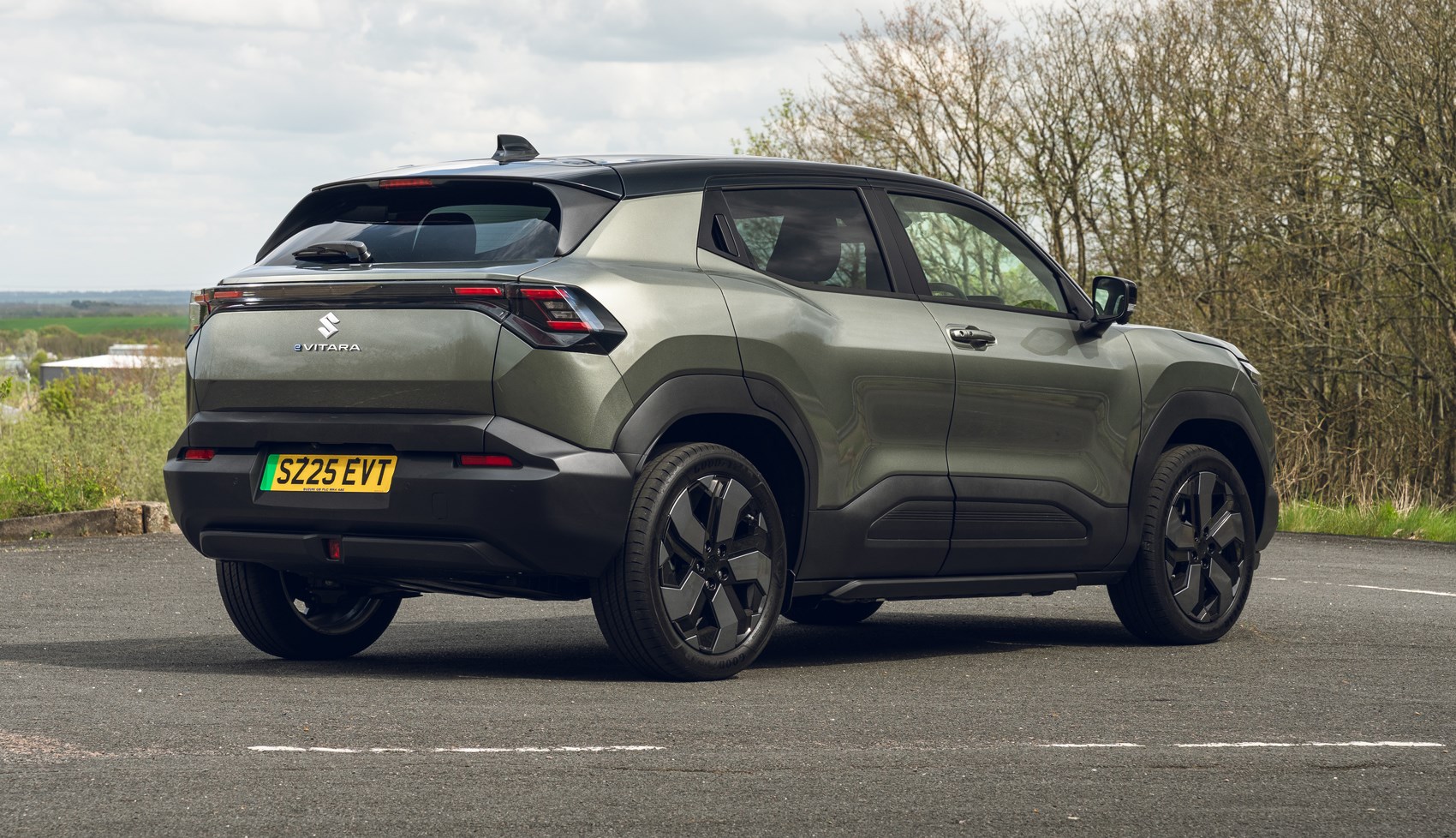
The look is full of familiar Suzuki chunkiness, with the eVitara’s design striving to be a not-too-distant companion to the regular combustion Vitara that will remain on sale. Its dinky dimensions are placing it in an extremely competitive segment, with new rivals like the Kia EV3, Renault 4, Ford Puma Gen-E and Skoda Elroq to name a few coming out of the woodwork alongside more established rivals.
Under the bodywork is an entirely new architecture that has been developed by Suzuki itself. The eVitara shares almost everything bar a few design differences with the Toyota Urban Cruiser but – unlike with other cars where Suzuki has simply rebadged Toyota models and called it a day – development of this platform and tech has been led by Suzuki.

What are the specs?
There are 49kWh and 61kWh battery options and, by default, your eVitara will be front-wheel drive with a single 142bhp electric motor. A twin-motor setup – nicknamed Allgrip-e – adds a second electric motor that notches power up to 181bhp.
Suzuki is proud to offer an all-wheel drive version when many cars in this sector don’t. As well as the eVitara offering a smidge more ground clearance than many rivals, the Allgrip-e version features a limited-slip differential to manage power. CAR also understands that, while a Toyota Urban Cruiser can be had with all-wheel drive, that model won’t make it to the UK.
As for range, the WLTP claimed figures are as follows:
49kWh 2WD: 214 miles
61kWh 2WD: 267 miles
61kWh 4WD: 246 miles
Driven on a combination of motorway and low-speed urban cruising the 61kWh 2WD model’s efficiency hovered around a disappointing 2.8 miles per kWh. With the battery brimmed, that means only around 170 miles of range.
Both battery packs feature 11kW AC charging and 150kW DC charging capabilities and, regardless of spec, your eVitara will come with a heat pump as standard.
Two trim variants are offered: Motion and Ultra. Motion models are strictly front-wheel drive but available with either battery size; Ultra versions always have the larger 61kWh pack, but you can choose from front- or all-wheel drive.
What’s it like to drive?
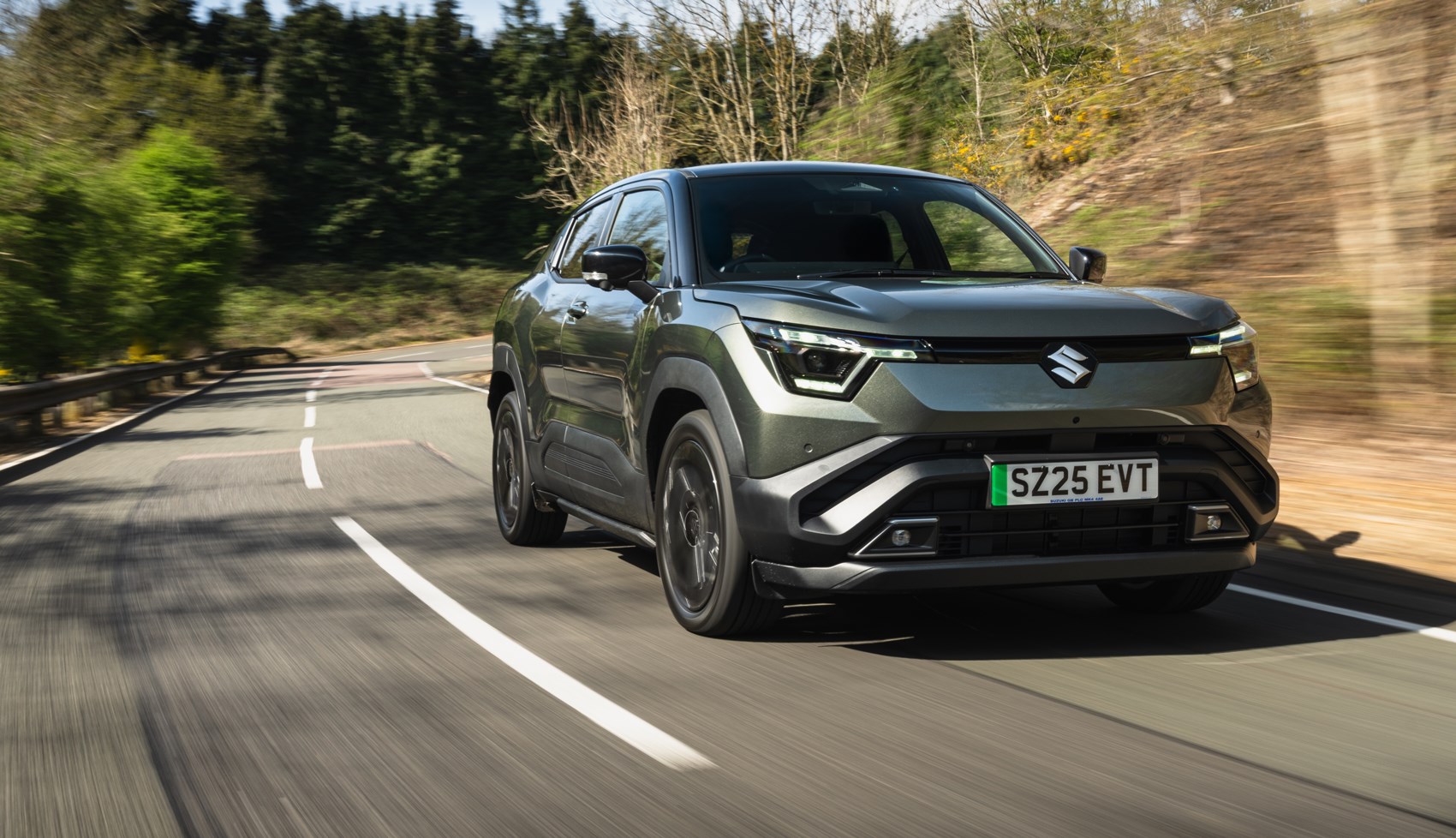
It’s docile and easy to live with. In Normal and Eco modes the steering is light and lacks feel, but given the eVitara will likely spend most of its time nipping around town, it feels right at home. Switch to Sport mode and the steering gains a satisfying weight, something many rivals don’t offer. Grip onto that hexagonal steering wheel and you settle into the eVitara’s rhythms quickly.

It’s also a tidy handler. Zippy and sure-footed. Properly thrilling? No – this is a fairly sensible baby crossover, remember, but there are some very sweet dynamics at play here. That squat stance allows for a good amount of grip, with the Allgrip-e model naturally feeling particularly glued to the road. Body roll is also kept under control – no swaying heads when changing direction – and the ride is plump enough to feel balanced.
Head to some rougher B-roads and a more unsettled side emerges, getting upset over larger undulations at speed. The damping could do with a little tweaking, particularly on the rear, where it bucks over sharp speed bumps and potholes. But overall, the Suzuki strikes a good balance between comfort and control.
Is it fast? Not really, but it’s perfectly fine. There doesn’t seem to be much difference between Normal and Sport modes from our time with it, but Eco will dull down the throttle. There’s also a button that switches on the regenerative braking when you lift off the throttle; in its heaviest setting, it significantly slows the car down but not to a full stop.

Noise-wise, the eVitara keeps tyre roar to a reasonable level, even on rough motorway tarmac. At higher speeds, however, wind rushing around the mirrors and windows gives the cabin a noticeably blustery feel.
What’s the interior like?
Neat and tidy to drive. Neat and tidy interior. Thankfully there are a few physical buttons that remain for key bits and pieces like climate control and driving functions – and they’re set into an interior that is of decent quality. Yes, there is a big hulking slab of gloss black in the centre console but, overall, materials used elsewhere feel good. No tinny-ness witnessed in some Suzukis of old to be found here.
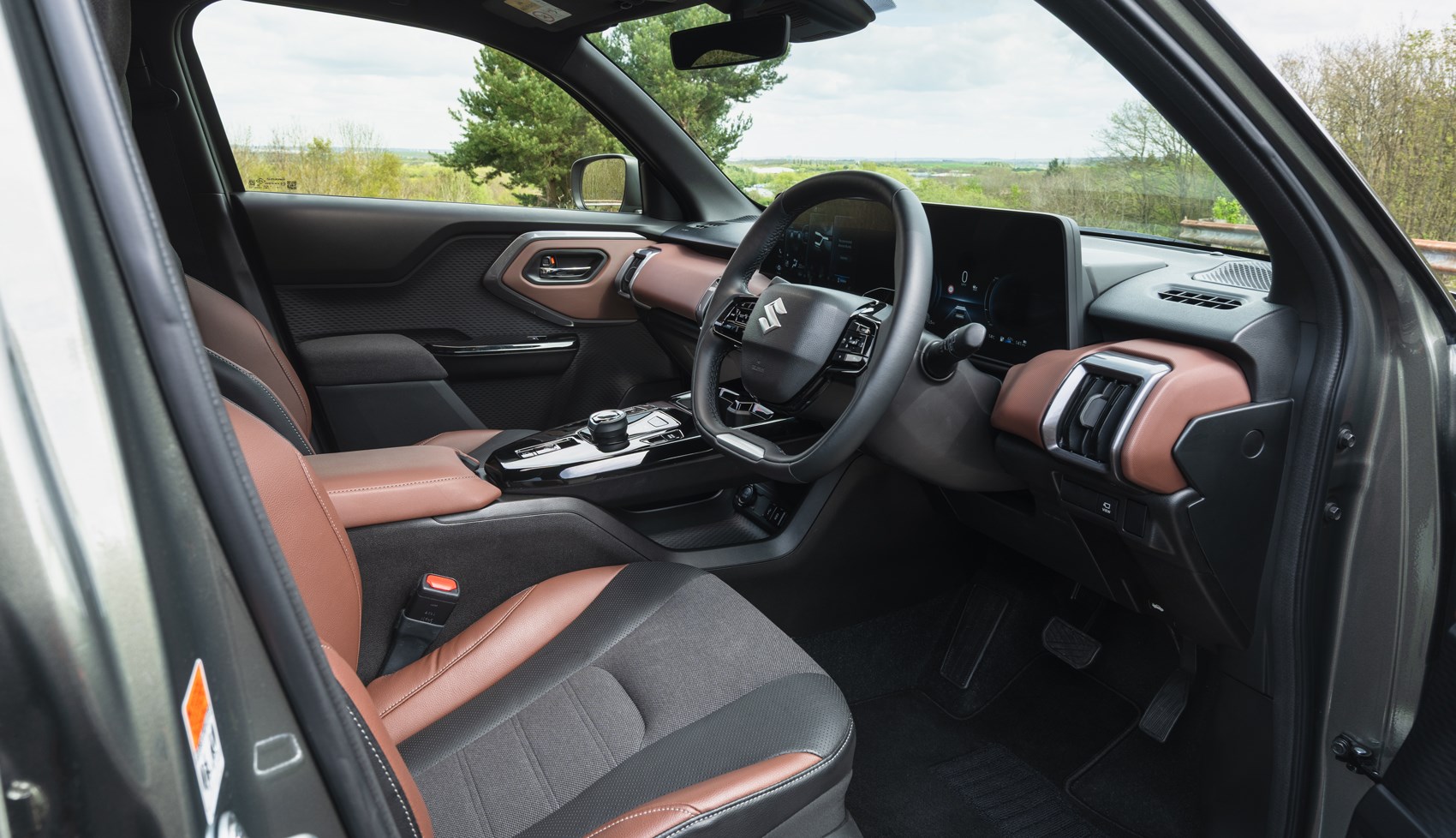
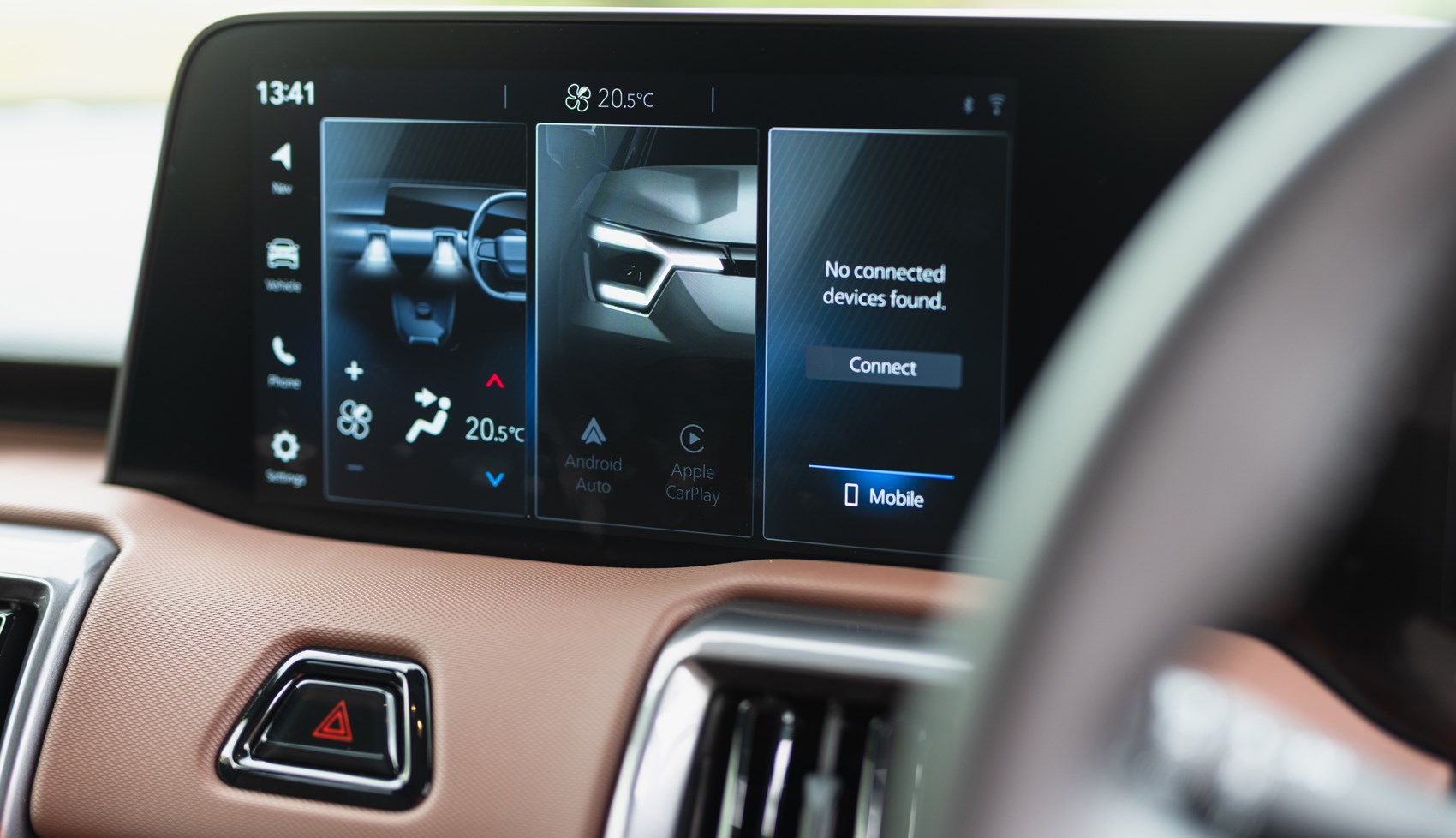
The infotainment and digital screens use new software, with crisp enough graphics that provide good info. The problem is it’s a very slow system by modern standards; a tap of the screen usually takes a full second or more to register. In some instances, the lag is masked by decorative animations. Tap the seat heater button and a twirling seat graphic appears, lingering before the controls are ready. While the menu layout isn’t too complicated, we’d like easier accessibility to the driving assistance menu.
Rear space and boot space can be traded off between one another, as the eVitara features 40:20:40 split fold and sliding rear seats that can boost legroom or expand the luggage area for your needs. With the rear seat slid to its furthest back point, my 6’2” self can sit behind me with good legroom. Headroom is tighter, although there is a divot in the ceiling that’s designed to make taller folk more comfortable.
Even so, the flexible boot isn’t amazing space-wise. At its smallest, you’re looking at 244/238 litres (Motion/Ultra respectively, due to extra subwoofer in the Ultra model) or 310/306 litres at its biggest.
Before you buy
The eVitara in base Motion trim starts at £26,249 for the 2WD model, rising to £31,249 for 4WD. An extra £3k steps both versions up to Ultra trim and brings a panoramic roof, heated electric front seats, a heated steering wheel, 360-degree camera and an Inifinity sound system.
For the price point, the eVitara one of the more attainable ways into family-sized electric motoring but it has a lot to contend with. The Renault 4 is cheaper, boasts a much slicker infotainment and interior, and has bags of charm. The Puma Gen-E drives well, has a much bigger boot and is aggressively priced for leasing. If space is the clincher, then a Vauxhall Frontera Electric or Citroen e-C3 Aircross will serve you better for less money.
One thing that stands the Suzuki in good stead is its customer assurance. A huge 10-year warranty on the car itself (albeit one that is main dealer service activated) and class-leading 10-year battery warranty are backed up by Suzuki regularly topping customer satisfaction surveys. All of which suggest the eVitara should make for pain-free ownership.
Verdict: Suzuki eVitara prototype
Overall, it’s a good first effort at a BEV and proof that Suzuki still knows how to make a resolutely normal car handle well and offer a bit of charm. It’s comfortable and reasonably practical too.
The problem is that there are few outstanding features. Its main USP is the option of four-wheel drive, but at £31k it’s a hard sell. You’d have to really need power to all four wheels to justify choosing this over the hot competition.
And while Suzuki deserves credit for taking a stab at battery technology, the underwhelming efficiency makes us think it was probably best to borrow it from Toyota. If the eVitara was cheaper we could overlook the sluggish touchscreen as well. Suzuki should have started its EV journey sooner, in some instances the competition feels a generation or two ahead.
Specs are for eVitara Ultra Allgrip-e