► Official: new Renault Twingo is here
► Cute design, seats four, 163-mile range
► Price starts at under £20k in the UK
Finally! It feels like forever since Renault showed us the first concept of the new Renault Twingo city car. It’s arrived in production form as a right-sized, four-seat electric city car that’s designed to be ‘a third Musketeer’ to the R5 and R4.
It’s a new city car that’s been developed in rapid time, resurrecting another one of Renault’s icons from its past. This new Twingo takes heavy inspiration from the 1992 original but remixes it for 2025 and beyond. ‘We’re calling it a game changer because we don’t think there’s anything else like it on the market,’ says head of Renault Group design, Laurens van den Acker.
Renault has also largely kept its promise of making the Twingo accessible to as many people as possible, launching it in the UK with a sub-£20k asking price.
Wanna know more? Keep on reading for the full debrief on the new Renault Twingo, and watch our video on Instagram below.
Look at that design!
To my eye, the new Twingo looks absolutely adorable. Renault is seeing this as its third reborn icon alongside the R5 supermini and the R4 crossover, with van den Acker calling it ‘extremely recognisable,’ as he walks us around the new city car. ‘It’s just really easy going and it’ll put a smile on your face when you see one.’
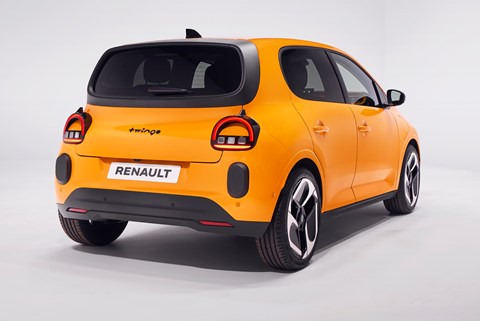
Many of the exterior design details haven’t changed much from the concept we saw in 2023 when then-CEO Luca De Meo dropped it as a surprise during that year’s Ampere Capital Markets Day.
The overall silhouette hasn’t really changed, with many of the same and details like the headlights and rear lights being carried over almost entirely from the show car. Like the concept alluded to, the production-spec Twingo is a four-door model – a departure from the two-door configuration the first couple of generations had but later ones did. Van den Acker points out the lack of visible seals on the side window that help add a bit of extra cleanliness to the design, and that the oval-shaped rear window ‘kind of reminds me of an old TV.’ Notice those plastic ovals on the corners of the bumpers? They’re designed to offer an extra layer of padding ‘because drivers in Paris aren’t the most gentle,’ smirks van den Acker.
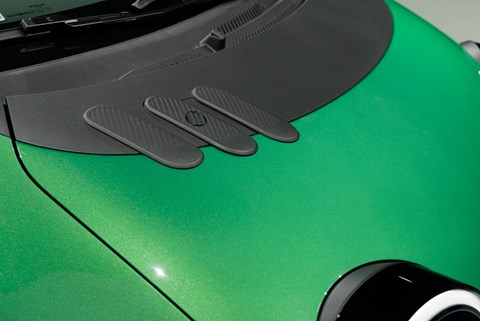
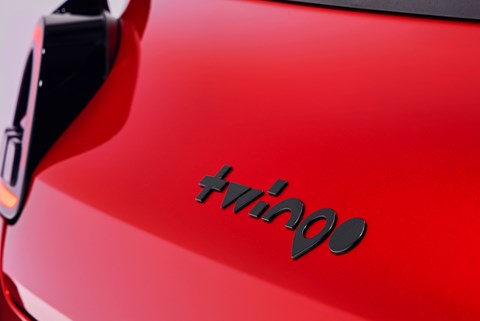
Base Evolution ones have 16-inch wheels while the upper Techno spec (pictured) uses 18s. The ‘vents’ that showed battery charge on the concept have been replaced with plastic trim elements on the bonnet as a nod to the 1992 original, while aerodynamic fins are attached to the rear lights to help guide airflow. The new Twingo script has been inspired by the X, square, triangle and circle elements from the Sony PlayStation. As well as black, Renault will be selling the Twingo in red, yellow and green.
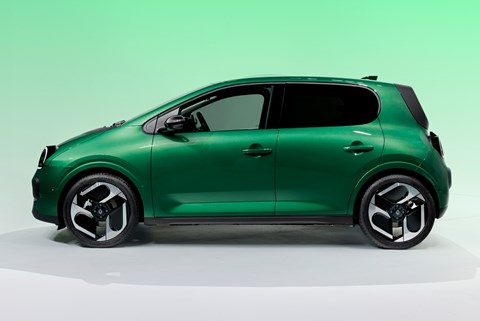
Tired of the retro-ness? Renault knows it can’t lean on that forever, but van den Acker says it’s a ‘reservoir’ the brand can tap into to offer an alternative the Chinese brands launching in Europe. ‘I think design and treating our icons the way we have is one card that we can play to stay unique and authentic,’ van den Acker says. ‘It’s to keep a connection with our brand and our customers, and that’s a card no one else can play.’ But van den Acker knows not to merely ‘play’ that card; ‘I think that’s why we have this strategy based on two areas: Future [for cars like Clio and Scenic] and Imaginary. I think if we only played this [heritage] card it would get tired.’
Is the interior funky, too?
Less than we’d like it to be, but there are still plenty of interesting details. To keep costs down, many common Renault Group parts are used including physical climate dials seen in other Renault and Dacia models, a steering wheel very similar to that seen on the Sandero and what looks suspiciously like the same infotainment screen used by Dacia, too.
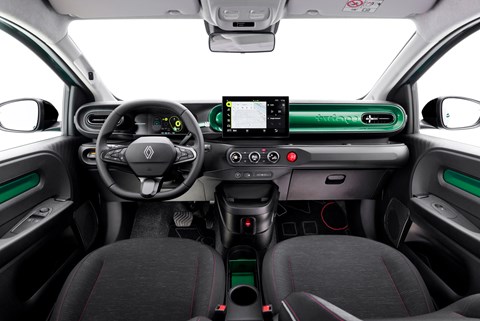
Other elements are more bespoke; the bulbous hazard light button, for example, has been inspired by the original Twingo’s button on the top of the dashboard. You can also brighten the dashboard up (on upper Techno spec) with colour-matching dashboard inserts, with Twingo lettering embossed on the panel.
Base ones come with a straightforward infotainment system, with upper Techno models using the same Google-based OpenR OS seen on the Clio, Megane and Scenic. That means Google Maps navigation and Renault’s ChatGPT-backed ‘Reno’ voice assistant.
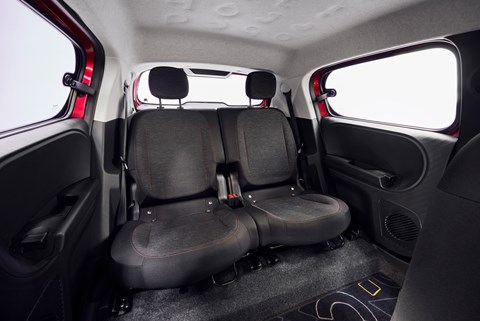
If we had one grumble, it’s largely directed at the plain black seat upholstery. The concept car showed off bright and colourful patterns as a nod to the original, but the production car ditches that for a neutral (and likely much cheaper) fabric. Still, though, the seats have good adjustment in them – even for tall people to get comfy in – and adults in the back two seats can just about wedge themselves in. Like older Twingos, the two rear seats can slide fore and aft to boost either legroom or boot space.
Renault has also gone ham on the accessories list, too. The list includes small things like customisable drive shift stalk handles as well as Twingo-themed cupholders for the centre console and hangers that loop around the headrests so you can hang a bag or coat without needing to stuff it in the footwell. The smartest, though, is a structured storage area that slots in between the front seats that works as an armrest.
Got any official performance specs?
The Twingo has just one powertrain to keep things simple, consisting of a 27.5kwh LFP battery pack and an 80bhp electric motor driving the front wheels. Renault says the Twingo can sprint to a leisurely 12.1sec 0-62mph time and tops out at 81mph – perfectly fine for urban use. WLTP range is claimed at 163 miles.
For reference, that claimed range figure is better than a base BYD Dolphin Surf that’s priced similarly to a base Twingo, but about the same as a cheaper Leapmotor T03. The equally characterful electric Fiat Grande Panda is the biggest thorn in the Twingo’s side, though, offering more interior space and a near-200-mile range for just over £20k.
What was that about fast development?
The Twingo has been one of the quickest cars to be developed by Renault Group in recent history, which has found myriad methods to cut down on unnecessary time-wasting when it comes to creating a new car from scratch. So much so that the new Twingo has been created from the ground up in just under two years; for reference, the Renault 5 took at least double that.
Part of that development is down to Renault Group’s new R&D centre in China, and the fact that the Twingo uses a lot of common Renault Group parts. As well as those interior bits, the AmpR Small architecture used here is the same as the R5 and R4, albeit shortened. And, while the R5 and R4 benefit from multi-link rear suspension, the Twingo uses a torsion beam that’s been adapted from the Captur crossover.
And, while the LFP battery is manufactured in China, the new model will be assembled in Renault’s Novo Mesto plant in Slovenia – the factory that’s been manufacturing the Twingo since 2007.
Going electric instead of using a combustion engine enables better design choices, too, says Vittorio D’Arienzo, head of AmpR Small development. ‘You’d need smaller wheels to keep the turning radius because there’d be no space [as the engine would be in the way] and you’d need at least 10cm extra overhangs,’ he says. ‘The result would not be nostalgia but something a bit grotesque.’
When can I have one, and how much is it?
Renault says the Twingo will launch in Europe in 2026, but it’s sadly not expected to hit the UK market until the start of 2027.
When it finally does arrive, Renault confirms that the entry-level version will start at under £20,000, while the Techno model ‘will sell for an attractive price.’ For the UK market, that’s before any possible Government grant is applied.
Happily, there shouldn’t be too much of a difference between the Evolution and Techno models in terms of trim; D’Arienzo confirms the only visual differences will be smaller 16-inch wheels and plain black trim on the dashboard.