► First pricing info for new Nissan Leaf
► British-built EV gets full grant discount
► 386-mile from £32,249 after savings
The first official pricing info for the new, third-generation Nissan Leaf electric car has now been confirmed, starting with the longer-range 75kWh model. Built in Britain at Nissan’s Sunderland factory, the new Leaf secures the full UK electric car grant, which means a starting price of £32,249. It’s on sale now, with first deliveries scheduled for February 2026.
The £3750 discount takes the bigger-battery Leaf below the anticipated £33,000 entry-level cost of the smaller 52kWh battery variant – which is yet to get its own official pricing. Assuming no unexpected oddities, when the grant is applied to the smaller battery Leaf it could/should take the price of that below £30,000.
You read our initial Nissan Leaf review based on a prototype drive, or carry on here for more spec and pricing details.
Why should we be excited about the 2026 Nissan Leaf?
There aren’t any other electric cars on sale entering their third generation. Nissan has been building EVs (electric vehicles) for 15 years now, and the new Leaf will soon be one of five in the firm’s line-up. That’s in addition to an evolving range of increasingly impressive hybrids. The Ariya, Leaf and Micra will be joined by a new electric-only Juke next year, then a smaller EV too.
It’s quite a contrast to when the first Leaf arrived in the UK in 2011, and almost single-handedly established the mainstream compact family EV as a viable choice for eco-minded buyers. Over the two previous generations it’s sold 290,000 units in Europe and 700,000 worldwide.
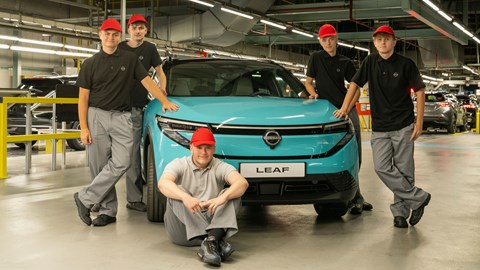
The new car sits on a version of the CMF-EV platform used in the larger Nissan Ariya. The new Leaf’s overall length is 14cm shorter than the previous Leaf, and it’s slightly taller and wider. The aerodynamically sleek five-door body features a ‘wheel at each corner’ look that helps increase boot and cabin space. The boot capacity is now 437 litres, and it has an underfloor compartment for the first time.
Also contributing to the space-efficiency of the layout is a compact new heating/ventilation unit, which moves forward out of the cabin. The single electric motor, at the rear of the car, is also more compact than before.
Tech specs: battery choices
The new 2025 Nissan Leaf will be available with a choice of battery sizes: 52kWh (Standard) and 75kWh (Extended), the larger one giving up to 386 miles of driving range and efficiency of 4.4 miles per kWh. With charging capability up to 150kW, and what Nissan claims is a near-flat charging curve, it can gain up to 273 miles in 30 minutes.
The small-battery version has a WLTP range of 271 miles, and makes 174bhp and 254lb ft of torque, with a top speed of 99mph and 0-62mph time of 8.6sec. The big-battery Leaf trumps it with 215bhp, 262lb ft and 62mph in 7.6sec (but the same limited top speed).

Nissan claims that in its own tests at the Millbrook proving ground in Bedfordshire the Extended version could circulate at 80mph for 205 miles, while the Standard model reached 270 miles.
A lot of attention during the creation of the Mk3 Leaf was put into aerodynamics (including an automatically shuttering and opening grille) and thermal management (so the heating and cooling of battery, cabin air, seat and steering wheel is fully integrated and ultra efficient). The front door handles are flush, automatically emerging when you approach the car, while the underbody is sealed, contributing to the drag coefficient of a slippery 0.25.
New Nissan Leaf trim levels
There are four trim levels: Engage from £32,249, Engage+ from £33,149, Advance from £34,249 and Evolve from £36,249 – all prices are after the electric car grant discount.
Basic Engage is aimed at fleets and commuters. Even so, it includes a heat pump as standard (part of that intelligent thermal management and efficiency drive), Nissan’s own Propilot with Navi-link software, 18-inch alloy wheels, twin 12.3-inch screens, and an 11kW AC charger.
Upgrade to Engage+ and you get a ‘Google built-in’ infotainment package, heated front seats and steering wheel, twin 14.3-inch screens and a 15W wireless phone charger.
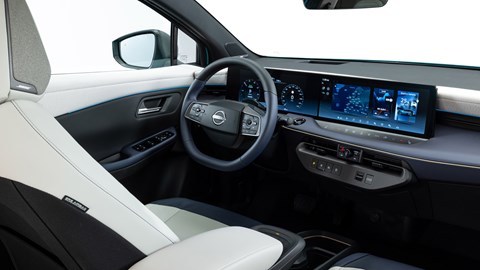
Advance gets a dimmable panoramic roof, head-up display, electric tailgate, upgraded exterior lighting and fancier interior upholstery. It’s probably the key value-for-money point in the new Leaf line-up.
Tempting Evolve buyers, however, is vehicle-to-load (V2L) connectivity so you can use the car to power electrical items, 19-inch alloys, nine-speaker Bose audio, keyless entry and start, and eight-way power adjustable front seats with massaging function for the driver.
Vehicle-to-grid tech is set to follow in time.
It looks good…
Nissan Design Europe vice president, Giovanny Arroba, told us the design was intended to combine efficiency and practicality with an embrace of Japanese style and a dose of Nissan DNA.
‘We did a lot of soul searching: what is Nissan? It’s not just performance. We’re also adventure, we’re also charm, and balance. We tend to pioneer these cars that have a lot of character, and they become almost a brand themselves – Qashqai, Juke, GT-R, Z. What is Nissan, what is the DNA? Hopefully you’ll see that reflected in cars like this and the Micra.’
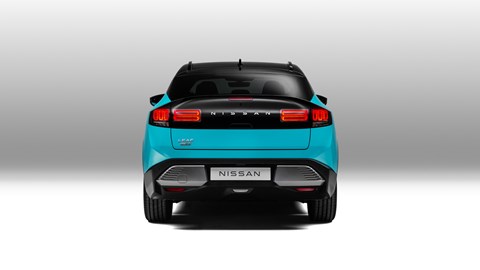
He’s also very pleased with the new recurring motif, representing a two (Ni in Japanese) and a three (San). It started with the rear lights, which have an eye-catching combination of two horizontal lines and three vertical, but it also appears on the charger flap and elsewhere.
‘It’s very easy to do a horizontal light bar. I like it – it’s cool – but we wanted to do something more memorable. That’s where the two-three came from. We wanted to make the brand more appealing, more lifestyle-oriented, not just a commodity for mobility, but a desirable Japanese-themed design product.
‘We try to see through the customer’s eyes. But as designers we also have to trust our intuition. Say something new – but at the same time be accessible and approachable.’