► Land Rover’s ultimate Defender takes on Ariel
► On and off-road test of two mega machines
► Which is the ultimate wilderness weapon?
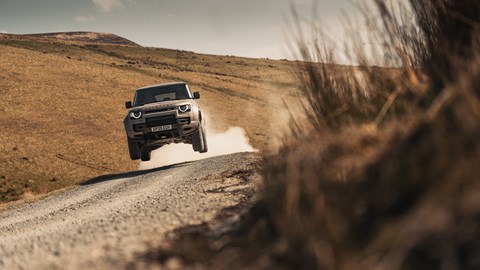
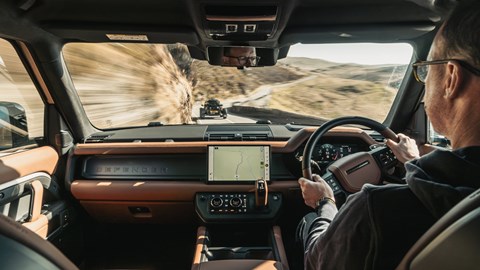
As I take off, I realise this could be the longest jump I’ve ever done. I know I’m airborne because of the silence – the harsh, gravelly hiss of stones has stopped battering the floor. But I feel calm, like I’m in a slow-motion Dukes of Hazzard jump. I reach into the centre console and take out a mint humbug. The wrapper proves a little fiddly. Best check how the flight is going – as any Hazzard fan will tell you, it’s always the landing that splits the General Lee in half. But I’m not worried. With my parabolic trajectory almost complete, the windscreen is now filled with my landing spot, a patch of gravel several metres down the road. I pop the sweet in my mouth, straighten the steering and – with a small, dusty ‘skiddoosh’ – land on all four wheels. No drama, no fuss – and proof that this Defender Octa is simply in a different league.
Jumping is all part of the fun when you’re driving fast off road – jumping, sliding, scattering stones in your wheel-spinning wake. And when I say ‘off road’, I’m not talking about getting winched out of a bog or crawling over a boulder. I’m mean Baja-style, foot-to-the-floor rally driving, the kind of off-road that’s inspired a whole raft of new performance cars like the Lamborghini Huracán Sterrato and 911 Dakar.
And now two more join the gang – both British, both magnificently engineered, both ludicrously expensive. Neither is a car you need, but I’m just going to park that consideration for now, and focus on the way they’re built, the way they drive.
Of course, the new Defender Octa is the more conventional of the pair, but in the metal it has much more presence than you might imagine if, like me, you’ve only seen photos. When I first stand next to it, it’s impossible not to be impressed with its stance, those bulging wheelarches and the detailing around the grille in that big, blunt nose. Referring not to The Octonauts kids’ TV programme, nor to an octopus, the new top of-the-range Defender is named after the octahedron shape of a diamond – ‘a rare combination of extreme toughness and luxury’, the marketing blurb purrs.
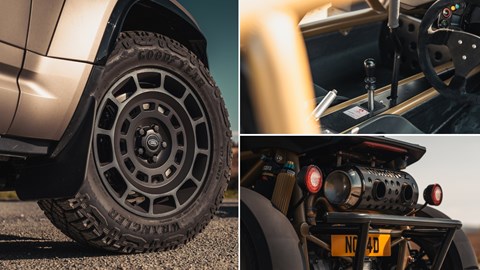
This example – with its Petra Copper paint, a £4000 protective matte coating and the rally-inspired 20-inch wheels and knobbly tyres (a £5000 option) – looks absolutely brutal parked on my street, part gangster, part Operation Desert Storm. My neighbours are in shock and awe. This example costs a staggering £155k, more than double the standard Defender’s starting price.
The justification for that hike is hidden under the skin. The Octa is powered by a BMW-derived 626bhp 4.4‑litre twin-turbo V8 and it has dramatically revised suspension, featuring height-adjustable air suspension but now with hydraulically linked, semi‑active dampers, similar to the system found in a McLaren 750S. With longer and tougher wishbones, it sits 28mm higher and 68mm wider than other Defenders. It has uprated front brake discs, new Brembo calipers and a faster steering rack.
Next to this warrior SUV you’ll find a spidery looking insect called the Nomad 2. This goggle-eyed dune buggy is a bizarre slice of British eccentricity that would take me all day to explain, so I’m going to assume you know the back story. Let me summarise: first there was the Ariel Atom, then came the Nomad, now there’s a Nomad 2. Simple. No, wait, I missed an important step: first came Atoms 1, 2 and 3 and then (insert choir of angels singing from the heavens) there came the Atom 4 in 2018, a transformational step forward for this tiny Somerset-based company. How did they do it? I don’t know, but the Atom 4 is automotive voodoo, sensationally fast and so sophisticated in its ride and handling that it is *supernaturally* good over a bumpy British back road. Now, after years of waiting, the Nomad has been subjected to the same black magic.
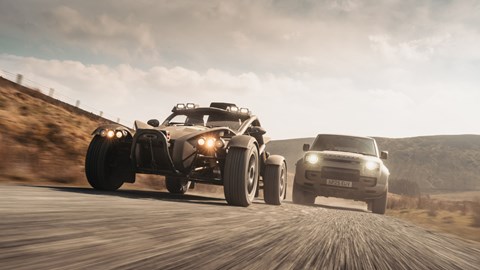
Ignore what your eyes tell you – even though it looks the same as the original of 2015, the 2 is completely new from the ground up. It’s bigger and wider, it has a new tubular spaceframe, new suspension, a new engine, new gearbox, new bodywork, new everything. The original 2.4-litre Honda engine is replaced by a turbocharged 2.3-litre Ford EcoBoost engine, like the one you’d find in a Focus ST. It drives the rear wheels through Ford’s six-speed gearbox and a limited-slip diff, and with some remapping of the ECU it offers a maximum of 305bhp.
The example you see here is optioned up the eyeballs, with a winch, 18-inch alloys, spotlights and a new ‘bikini’ soft-top, stretched over your head behind the now standard windscreen. This car also has some serious Bilstein dampers, based around shortened Trophy Truck units and developed specially with Ariel. The Nomad 2 is sold with three damper options: non-adjustable K-Tech units; some adjustable Öhlins – all-rounders if you want to do off-road days and trackdays; and these bad boys, the max-attack, four-way adjustable Baja choice. Nobody’s driven the Nomad 2 on these Bilsteins yet – it’s a first for CAR. And the price? Starting from a base of £68k, this example would set you back around £105,000.
We start on the road, heading west to mid-Wales and Sweet Lamb, the legendary rally stage and WRC test facility. I set off in the Defender and the first thing I notice are the Octa’s new Performance seats, deeply bolstered but with a curved, seamless appearance, so they look like tan-leather armchairs rather than racing buckets. They’re comfortable and supportive, and they help elevate what would otherwise be a standard looking Defender cabin. In fact, in motorway traffic, my first impressions are that the Octa does everything like a regular Defender – the same road manners, the same visibility, the same wind noise, only with added drone from those knobbly tyres on the road.
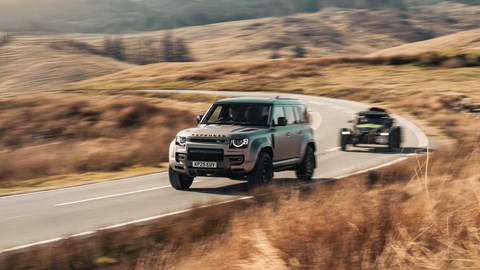
But then we peel off the motorway onto a back road and the Octa starts doing things that no other SUV can do. This BMW engine is less thunderous than JLR’s old 5.0-litre V8, emitting more of a motorsport snarl than a Wagnerian bellow, but it is fantastically on-point when you need it to step up. Delve into the Defender’s Terrain Response system – which includes the usual settings for grass, snow, Waitrose car park, etc – there’s a new Octa mode that sharpens everything from the throttle to the steering. On a twisty road, where you’re on and off the power, this M-power V8 is magnificently responsive, punching this 2.5-tonne behemoth out of corners like a sports saloon half its size.
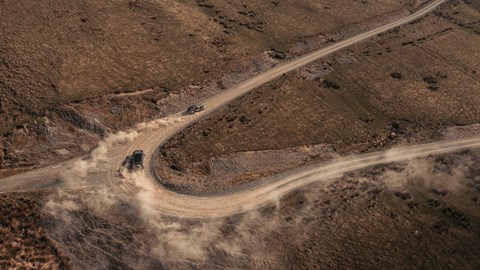
And that’s not even the best bit. More astonishing is the stability and control of the chassis. Frankly, it’s mind-blowing, a blend of bump absorption and solidity – a firmness that keeps every body movement in check but with a suppleness that feels athletic and agile. Arrive hard into a bend and the front turns in sharply and willingly at the first jink of the steering wheel, then you feel the body hunker down until it meets this muscular resistance to the cornering forces. Then the Octa just drives through, without any of the sway or axle shimmy you might expect of a fast SUV. Instead there’s just a sweet steering precision and crazy chuckability that makes it a genuine pleasure – a thrill – to drive quickly. The Octa is the best SUV I’ve ever driven – more engaging than a Range Rover SV, more communicative than a Mercedes G. A new benchmark.
Arriving high on the Welsh moors I climb out of the Octa to start raving about it to anyone who’ll listen. In fact, no one is listening, because they’re all staring at the Nomad instead.
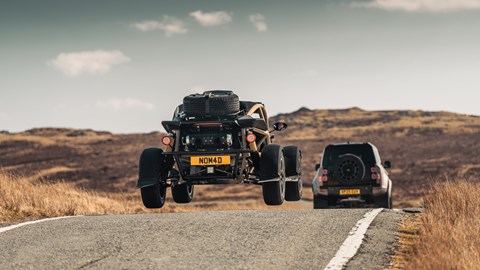
Parked up side by side, there’s a weird visual rapport between these two cars. They’re chalk and cheese, of course, but there’s also a common theme, a shared ‘tactical’ look, that suggests you might find both in the same SAS convoy, spearing across a desert.
The Nomad is also so arresting because it’s ugly like an amphibious creature you’d find at the bottom of a garden pond, but also strangely beautiful, in its its exposed functionality and welded geometry.
It’s also a nightmare to climb into. In CAR’s first road test of the Nomad 2, Tim Pollard resorted to climbing onto the roof and dropping into the driver’s seat from above, but with the optional soft-top in place I have to clamber through the door. By which I mean ‘the door’. I hold my weight using the upper rail and slide my bum onto the tube that forms the door sill. Then – like a contortionist squeezing into a suitcase – I grunt and gasp and twist to poke my legs down the footwell, then drop into the hard plastic seat. Even when you’re in, the grunting isn’t over because you need to dig down to pull out the four-point harness and get strapped up. The consolation is, once you’re in, it’s worth it: the hard seats are unbelievably comfy and supportive and the driving position is excellent. The interior is spartan, sharing the same rubberised buttons as the Atom, plus this example has a tall, rally-style fly-off handbrake to lock the rear wheels on gravel – I’ll play with that later.
The Ford engine starts on the button and a fizzy snarl vibrates your body like there’s an angry bumble bee trapped in your pants. With a bootful of revs, I clunk it into first gear, drop the clutch and the Nomad launches like a flyweight boxer out of his corner.
Every sensation is utterly different to the Octa: where the Defender offers luxurious isolation, the Nomad is like wearing the weather on your face; where the Land Rover is studiously calibrated, the Ariel is unprocessed and raw. The unassisted steering, wriggling in your hand, is so direct and alive, and the turbo-whistling acceleration is raucous fun. It’s like eating a packet of Hobnobs – once you’ve had a bite, you just can’t stop, it’s so utterly morish.
The Nomad chassis is livelier than the Octa too. Where the Defender has everything rigorously tied down, the 715kg Nomad feels lighter and looser on these off-road springs and dampers. The pitch and roll are vastly improved over the original Nomad – which moved around so much, I remember at the time describing it as feeling like you’ve got a flat tyre or a couple of loose bolts. But the 2 still squats when you accelerate and sways in the corners, giving it a fluid, squishy gait that’s unlike any conventional sports car. You have to dial yourself into it, learn to play with it and trust the direct steering to help scoop things up when you inevitably get out of shape.
There are some similarities to the Octa. The Nomad absorbs bumps and potholes so confidently, I’m soon flying down the road – literally – getting air over the bigger humps. The Nomad lands flat and square with no secondary bounce or scary yaw. Like the Defender, it just settles – soaking up everything a winding British B-road can throw at it.
But what about a bit of winding British off-road? And so we arrive at Sweet Lamb, a gigantic playground of moors, sheep and gravel tracks. I’m absolutely itching to go out in the Ariel first, so I don my helmet and head for the hills.
This car has the optional three-stage ECU fitted, which I switch from Level 3 (the maximum 305bhp and 382lb ft) down to Level 2 (302bhp and 333lb ft) to help manage the wheelspin. There’s also an adjustable traction control, which I turn completely off.
Straight away, on this loose surface, the Nomad is just a bundle of sliding, skating, gravel-spitting joy. Press the throttle hard and the revs will surge and peak like a chainsaw as the rear wheels scrabble for grip, the raucous exhaust shattering the air of these peaceful Welsh hills. Despite the wheelspin, the car still launches up these tracks with a mad intensity, so hard and fast it’s almost scary with the grass banks and steep drops around you. You have to re-learn that trust, and let the suspension do its work. Because we’re not talking cambers and potholes any more, there are rocks in the road, ruts and gulleys and mounds of gravel, corners that have been swept clean to bare rock. But what felt floaty on the road is now your best friend, soaking up everything and allowing you to focus on the steering and the throttle.
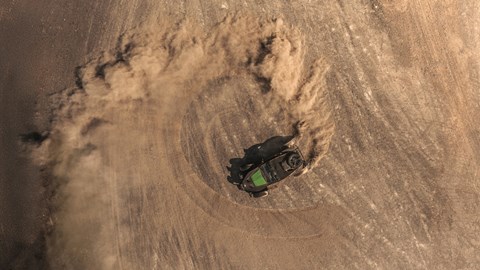
The Nomad now feels sensitive to every movement, and backing off mid-corner will cause the tail to swing out easily. Jab back on the throttle and you can power-slide through the corner with an armful of opposite lock, living out all of your Colin McRae dreams. In a hairpin you dip the clutch, tug on that tall handbrake lever and then nail it in second gear, and the car will arc round like a pendulum. It’s such stupid fun, I’m laughing out loud, eating dust and gravel in my helmet – though after a few minutes my forearms are screaming because I’m putting so much effort into that steering. What a car, what an experience.
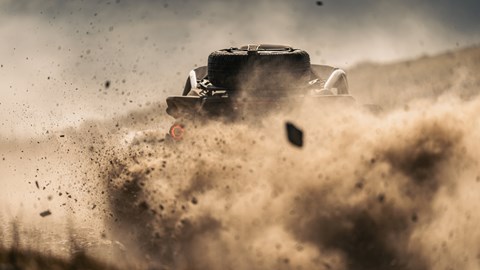
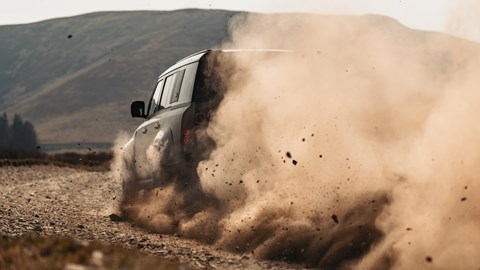
I imagine not many people will jump straight from a Nomad into an Octa, back to back, but that’s what I do now. My brain has to do a somersault. Suddenly, on this loose surface and with all those obstacles, the Defender feels huge and intimidating. Like the Nomad, it will catapult you over the gravel, all that power and four-wheel drive compensating for its beefy weight; but when you get to a corner it’s a different ball game. Without the unfiltered intimacy of the Nomad’s steering, it takes a while to build up in the Land Rover. Despite Octa Mode allowing up to 85 per cent of the torque to go to the rear axle, and despite the traction control being switched off, the Defender doesn’t slide like the Nomad. That seriousness – the fact that it can’t be provoked, even when you’re chucking over 600bhp at a gravel track – is disconcerting at first. But then you come to accept, this car wasn’t designed to drift, it’s designed to race in next year’s production category of the Dakar Rally. It’s designed to just monster loose surfaces. The pleasure, then, comes in its efficiency, not in any showboating. Drive hard and straight and fast, and the braking is incredible – more reassuring than the Nomad, even – the ride is serene, despite the rattling of the rocks under the floor. And of course there’s the way it jumps, confident and capable, landing with little more than a rubbery bob on its air springs. You end up flinging the Octa at corners, just like the Nomad, but apart from a little tuck and slide mid-corner, it just hammers out the other side, kicking up a towering dust plume the size of a cumulonimbus cloud.
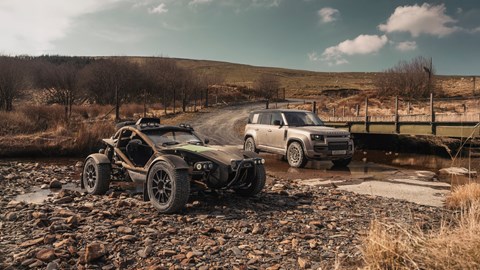
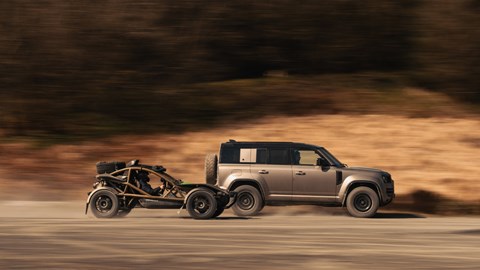
The Defender Octa is absolutely magnificent on and off road – as is the Nomad 2. What’s most surprising is how similar they are, in terms of outright pace. My brain tried to do loads of complex power-to-weight calculations, factoring in rear-wheel drive versus four-wheel drive, but then I decided that was much too complicated. Whatever the reasons, on tarmac and on gravel these two wildly different cars end up strangely neck and neck.
However, the way they do things is so different – on the road the Octa is unreal, scarcely believable, but on the gravel the Nomad rules; it’s so light and drifty and playful. Together, they exemplify why so many manufacturers have turned off the mainstream and gone down this performance side road. Leave those speed cameras and traffic jams behind you – these days, off-road is where the fun is at.
Land Rover Defender Octa
Price: £145.300 (£155,910 as tested)
Powertrain: 4395cc 32v twin-turbo V8, eight-speed automatic, all-wheel drive
Performance: 626bhp @ 5855rpm, 553lb ft @ 1800rpm, 3.8 sec 0-60mph, 155mph
Weight: 2510kg
Efficiency: 21.3mpg (official), 12.0mpg (tested), 300g/km CO2
Ariel Nomad 2
Price: £67,992 (£105,000 as tested)
Powertrain: 2276cc 16v turbocharged four-cylinder, six-speed manual, rear-wheel drive
Performance: 305bhp @ 5900rpm,382lb ft @ 2500rpm (with optional ECU re-map) 3.4sec 0-62mph, 134mph
Weight: 715kg
Efficiency: n/a mpg (claimed), n/a mpg (tested), n/a g/km CO2
Gravelling light
If you want to get off-road, these are the destinations to put in your nav.
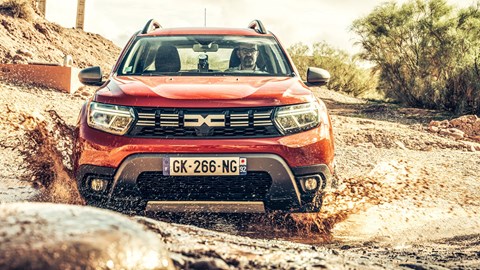
Pyrenees:
There are hundreds of miles of rocky trails that criss-cross the Pyrenees between France and Spain, and if you string them together you can do 750 miles off road from the Mediterranean to the Atlantic. Passing through pine forests and rocky passes, there are panoramic views at every turn – just make sure you keep an eye on the road, though, because you’ll be sharing the tracks with gangs of middle-aged (mostly) men riding BMW GS motorcycles.
Morocco:
Morocco may be developing fast and investing billions in its motorway infrastructure, but you’ll still find plenty of unpaved tracks in the south. Unlike the twists and turns of the Pyrenees, these gravel tracks along the north-west edge of the Sahara are often fast and empty – though you need to keep an eye out for goats. The routes are often completely unmarked, so take a GPS device… and pack plenty of water.
Albania:
One emerging destination worth considering is Albania. The Foreign Office urges visitors to exercise caution, but don’t be put off completely. Several companies are now offering guided 4×4 adventures on Albania’s empty trails, canyons and mountain passes.