► BYD’s new B-segment BEV
► Priced from £30,850; top trim is £34,950
► UK gets 50kWh battery and 200+ mile range
This is the Atto 2, BYD’s all-new B-segment electric SUV. It follows the much larger Sealion 7 and is pointed at one of the largest growing – and competitive – sectors in the electric car market. In the last three months alone, we’ve driven the Renault 4, Citroen e-C3 and Fiat Grande Panda to name a few…
So what does the Atto 2 have to offer? BYD calls itself a technology company first, with a mission to bring as much of it as possible to the customer – and for as little as possible. With that in mind, the Atto 2 promises to pack in all the ADAS and other creature comforts you could need.
UK pricing has just been revealed: the entry-level Boost trims starts at £30,850 and the larger-batteried Comfort kicks off at £34,950 on the road.
So have BYD’s 120,000 plus engineers done a decent job? We’ve driven the Atto 2 on UK back roads and motorways to find out.
Should I buy a BYD Atto 2? Maybe, if styling isn’t your thing. Generic looks combine with a strong tech offering and impressive performance – but BYD is no longer the Chinese bargain it used to be.
At a glance
Pros: lots of standard kit, innovative infotainment, enjoyable to drive on all roads
Cons: boring looks, not cheap, slow charging
What’s new?
Like the Seal and Sealion 7, the Atto 2 uses BYD’s e-Platform 3.0. That means it benefits from safer lithium-ion phosphate (LFP) Blade batteries, improved cell to skateboard integration and a heat pump. The latter can have a big impact in winter; BYD estimates the pump could bump your range 10-20% in colder months.
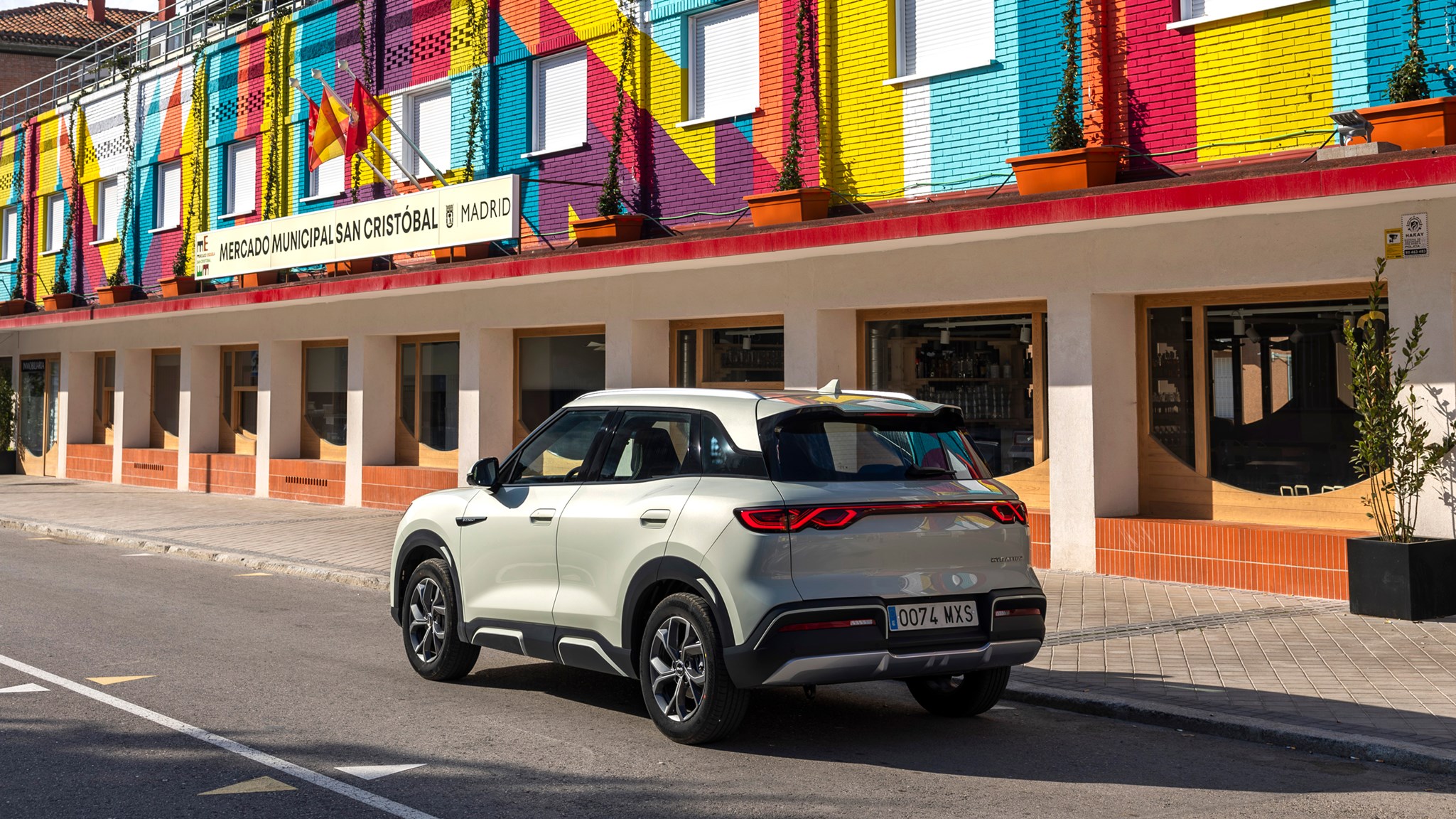
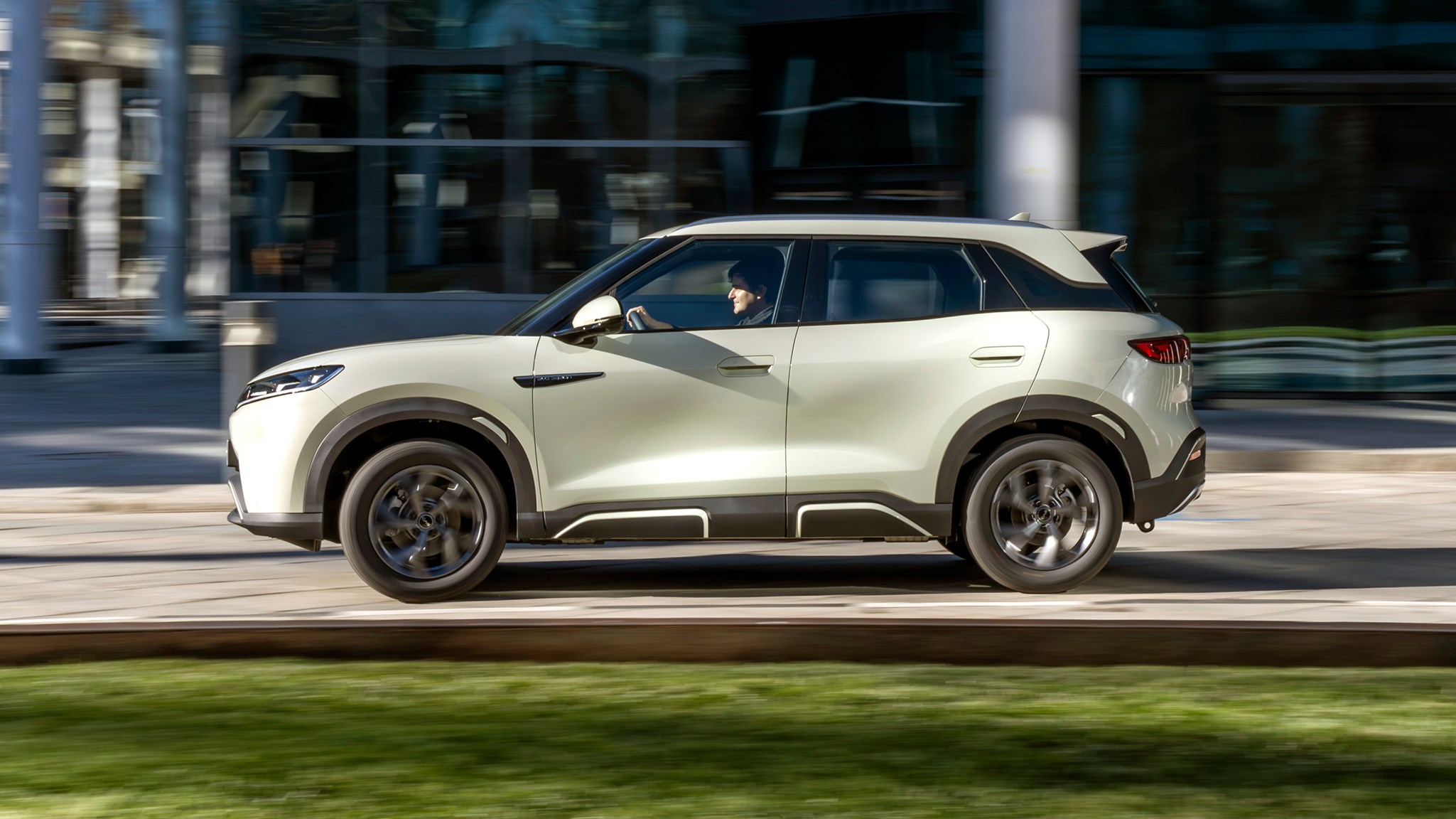
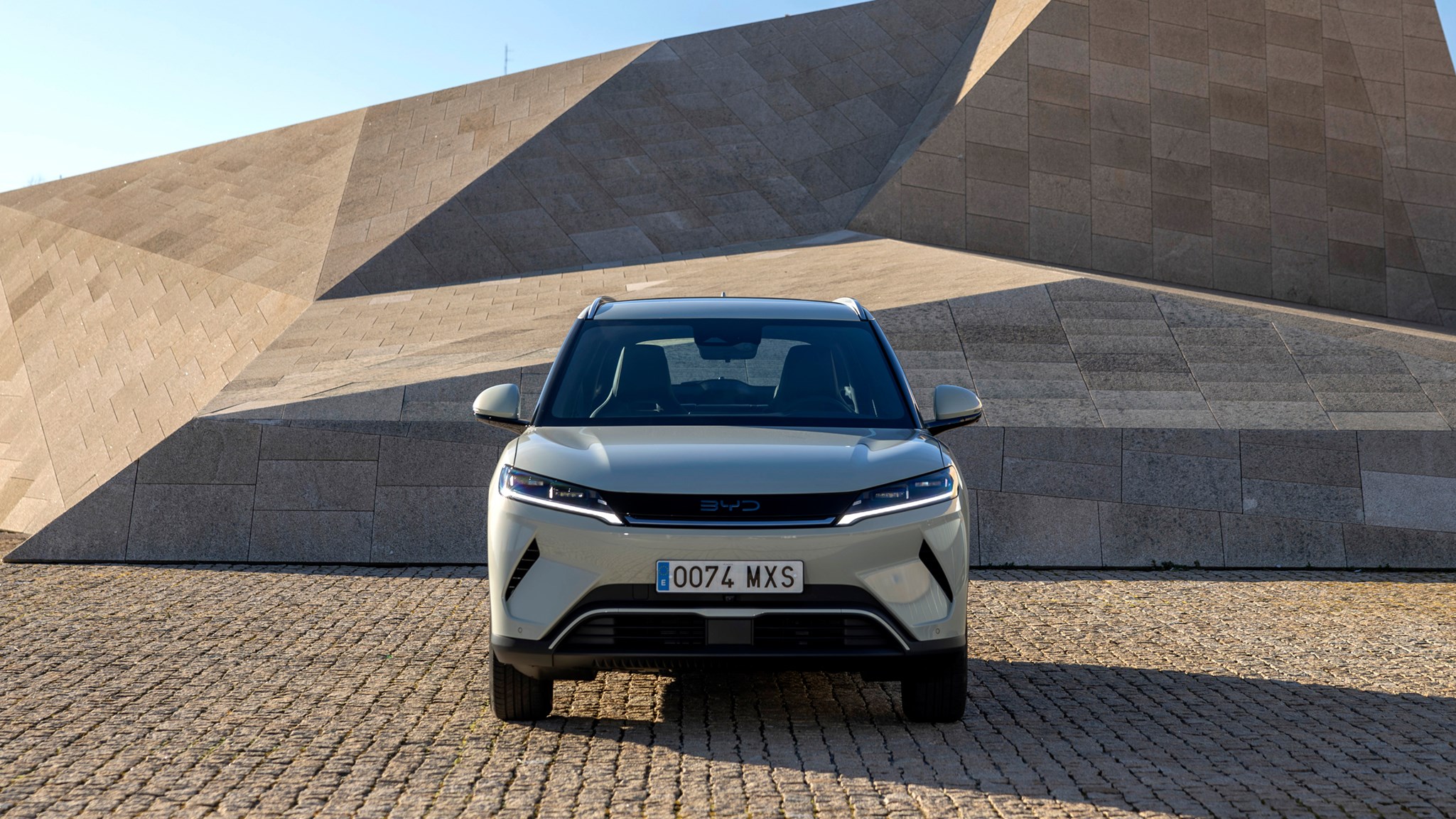
The Atto 2 measures 1675mm high, 4310mm long and 1830mm wide, and despite a few flourishes of detail such as the ‘knots’ in the rear lights, it’s very conservative looks-wise. BYD calls its Shenzhen design hub ‘the Black Crystal,’ but it’s not done much for the Atto 2.
In person it’s not got much road presence either – not uncommon in this class – and its 17-inch alloys and skinny tyres make it look rather top-heavy. Again, not a disaster for a B-segment SUV, but not great compared to rivals like the bold-looking Grande Panda for example.
What are the specs?
The car we drove, the lower Boost trim, used a 51.1kWh battery paired to a 130kW motor on the front axle. That makes for 174bhp, 214ft lbs of torque, a 0-62mph sprint of 7.9 seconds and top speed of 99mph.
There’s also a Comfort trim, due later in 2025. This has a larger battery (64.8kWh) and more power (150kW or 201bhp, and 229lb ft) so goes further (261 miles) but is no quicker in the headline sprint.
Things get a little less premium when you look at the charging time of the two models. The Atto 2 can only do 11kW AC and either 82kW or 155kW DC charging – both of the latter figures are adequate but not quite at the megawatt charging that BYD has pioneered on a concept car. That means getting from 10-80% battery capacity is either 25 or 38 minutes, depending on battery size.
Still, despite the slow charging speed the Atto 2 is happy to share; it has V2L technology so can put out 3.3kW of juice to small appliances and other tech.
How does it drive?
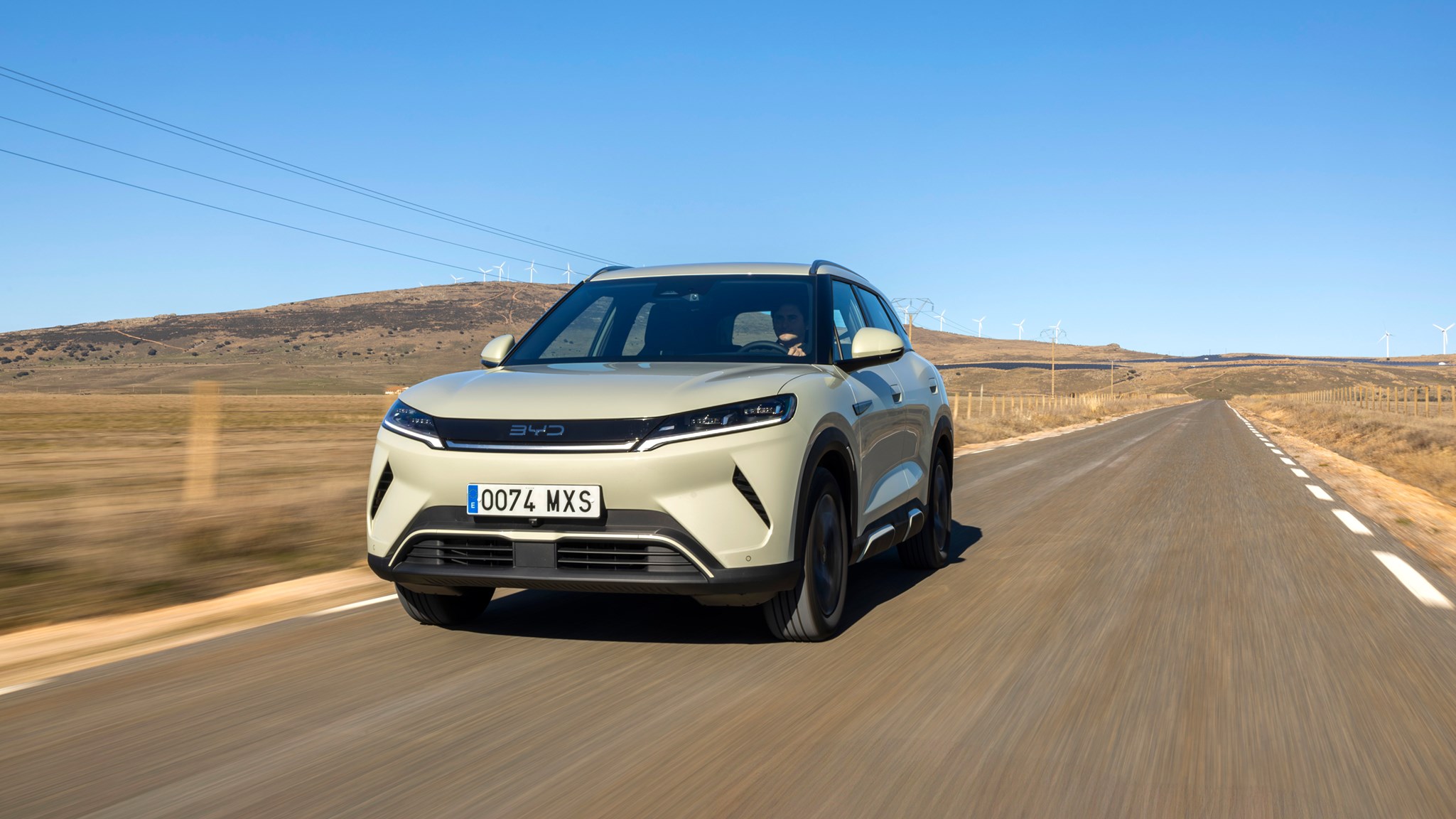
Is it harsh to describe it as ‘fine’? The anonymous looks are middling and so is the drive experience – the Atto 2 is not going to rewrite any of the rule books for this sector. On the plus side, it manages to feel taut without being stiff, feeling poised whilst soaking up much of the drains and cracks in the UK. Its 0-62mph sprint time of 7.9 seconds translates better than expected, with enough punch to make weaving through city traffic easy and out on the motorway, it was perfectly capable of keeping up with traffic. It didn’t feel out of its depth surrounded by much bigger and faster cars, and the Atto 2 never felt breathless on higher speed overtakes.
It’s here that we encounter most of the bongs, klaxons and alarms, which tell me to ‘keep my eyes on the road’ even when I’m messing with the infotainment. Other than that, there’s very little noise other than wind around the wing mirrors (not as silent as some EVs) and the occasional whine of EV motor. In fact, the only stressful things come from the car itself; we found the indicator sound annoying, but it’s possible to choose between a few different effects. Take note, Jeep Avenger.
BYD is heavily pitching the Atto 2 as an urban second car, and through a corner you can understand why. Body roll is pronounced and the steering, while precise, is entirely devoid of any feel and is more like twirling a piece of string. That said, the over-assistance works well in town.
The Atto 2 engineers have nailed the transition from motor regeneration to friction brakes, and the result is a left pedal that is both predictable, easy to modulate and therefore fun. The response is linear throughout and it benefits you in town, but also when driving on more exciting roads. It’s an important area so many EVs get wrong, but not so in the Atto 2.
What about the interior?
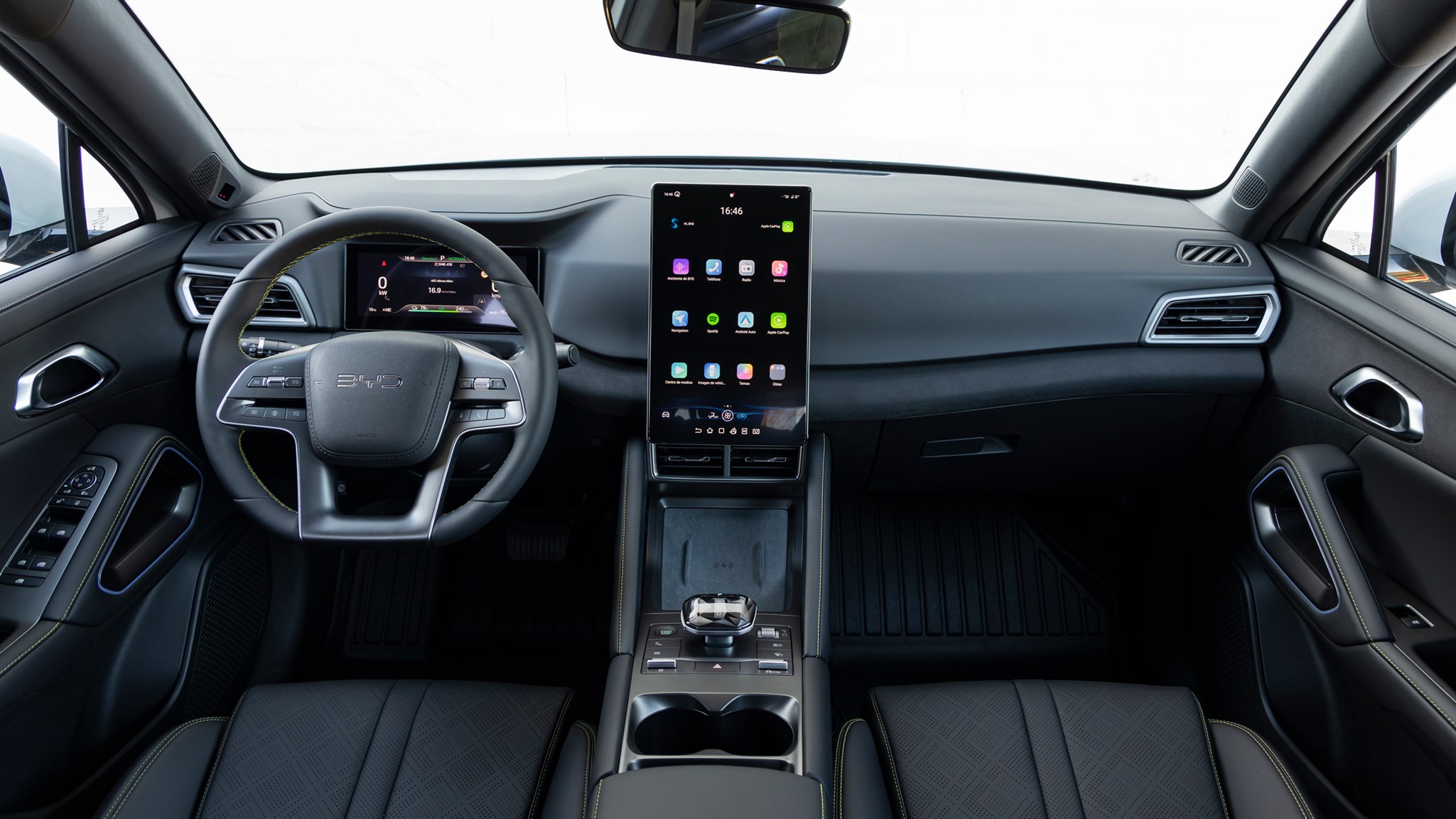
A spoiler: the BYD’s interior is a microcosm of the car itself, as it looks a bit boring but is impressive in places. There’s not much style to speak of, with black and silver textures working as a mundane backdrop to a pair of screens. Like many cheaper cars, everything at an arm’s length feels fine – but everything you have to stretch to feels less premium.
It doesn’t feel hugely spacious either; a ‘transmission tunnel’ makes the car seem more snug than you’d hope, and the dark interior of our test car didn’t help matters. Although the legroom in the back is impressive – a much more comfortable place than something like the Renault 5.
It’s on this dull backdrop that BYD deploys some neat tech. You’ll find a 12.8-inch touchscreen in the centre (with BYD’s usual rotating gimmick) but you can’t knock the quality of the panel. It’s quick too, with 8GB of ram and 8-cores ensuring we had no lag. The driver gets an additional 8.8-inch cockpit screen which is sharp, though could have an easier to read, higher-contrast UI – the power output figure and speedo are exactly the same size and font, making it confusing to read.
BYD’s infotainment UI is also geared towards customisation, so it’s easy to create a personalised dock of apps or a page of shortcuts. This was handy when it came to quietening many of the BYD’s bongs, beeps and warnings.
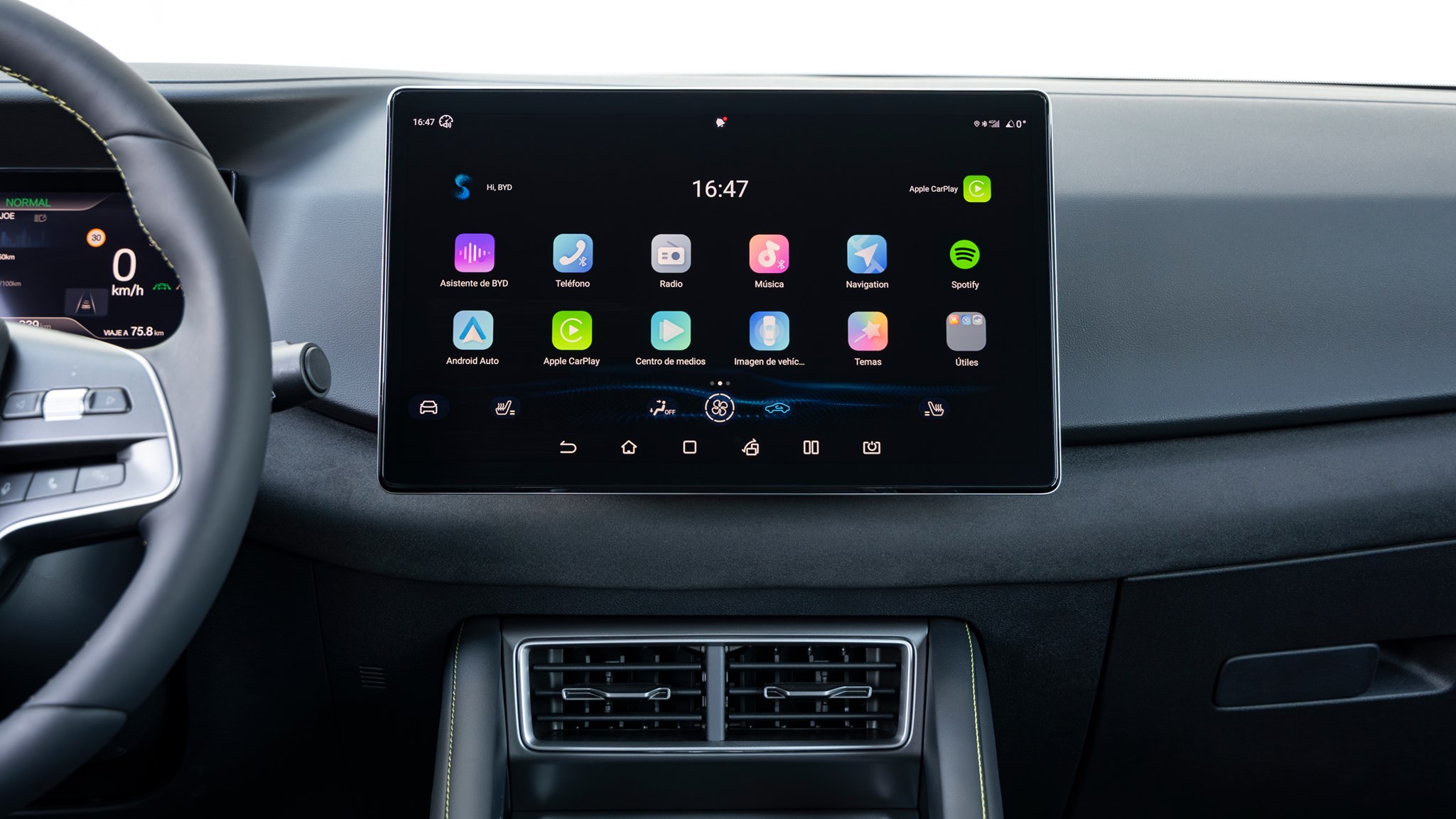
But the best feature? BYD engineers have included multi-touch technology so you can adjust the A/C by using three fingers – just like a MacBook. Swipe them up or down to control the temperature and left or right to control fan speed. Unlike hit-or-miss haptic buttons, this worked every time and feels like a genuine innovation.
The steering wheel makes do with physical buttons for adaptive cruise and the 360-degree camera, but that’s no bad thing, as they’re easy to use too. Look around and you’ll find a wireless charger for a smartphone, as well as lots of storage space, and a decent amount of room for rear passengers too.
Boot space is 400-litres, extending to 1340-litre with the seats down in the Boost trim. In Comfort, you get 450 and 1370 litres.
Before you buy
The Boost trim costs £30,850 and the range-topping Comfort weighs in at £34,950. That places the BYD much further up in the market than you’d expect: the Atto 2 sits somewhere between the Renault 4 (£25,495) and Skoda Elroq (£38,650). BYD will argue that the Atto 2 packs in more standard tech than the cars above but there’s no doubt that the pricing of the 4 has shaken the market up.
Boost gets electric and heated front seats, heated steering wheel, panoramic sunroof, a karaoke function (please god, no), vehicle-to-load, smartphone access instead of a key and wireless smartphone charging.
Verdict
The BYD Atto 2 is not big on character and, perhaps unsurprisingly, it follows that it’s only a middling performer. The spec list does most of the car’s talking, with a strong infotainment and ADAS offering putting it in the mix ahead of cheaper competitors but nothing with enough punch to put it towards the top of the class. BYD is pitching this as an urban-centric second car, but we’d still have liked to see faster charging at £30,850 for the Boost trim – which isn’t exactly cheap.
What’s odd about it is the engineering – BYD makes a big play of the fact it’s an engineering-led company (an entirely justifiable statement, given its track record) but with the Atto 2 the customer gets no sense of this. It’s an extremely capable car with no hidden depths, a car that will perform exactly as customers want but with zero character. The back story of BYD is full of over-achievement and intrigue but the Atto 2 doesn’t illustrate this. Pity.
Specs are for Boost model.