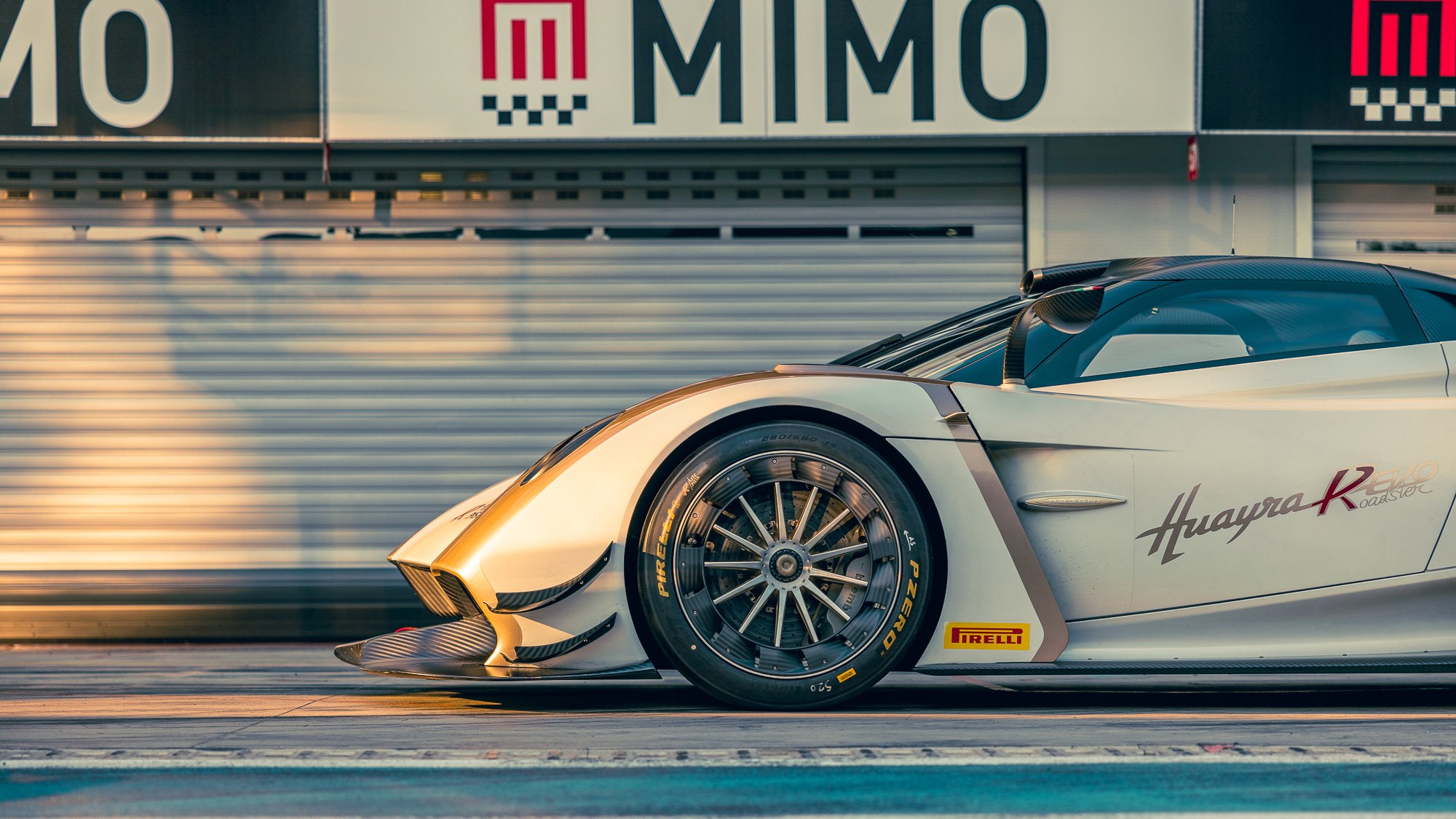
► Hardcore track-only Huayra
► Huge downforce and nearly 900bhp from N/A V12
► Priced at around £3.9m
You’d be forgiven for wondering why you’re only just reading about the Pagani Huayra R Evo Roadster – didn’t they start making that car in 2011? – but over in Modena things work a little differently. As while the Huayra model name was first introduced in 2011, Pagani has been beavering away on special editions of the car since 2017.
And this isn’t some cheap marketing strategy either. It’s not a new piece of trim here and a remap there. The Pagani Huayra R Evo Roadster shares zero bodyparts with the Huayra R which – in itself – is a very different car to the ‘bog-standard’ Huayra. Pagani knows its cars are special, so why not remake them every few years?
Arguably, the Huayra R Evo Roadster is the best incarnation yet. An extreme, track-only version of what was already an extreme, track-only version, it delivers huge aero (more than its own body weight at high speeds), jaw-dropping looks and an engine that spoils pretty much every other internal combustion unit on sale today. The price? £3.9m. But it’s worth every penny. Honest.
At a glance
Pros: The sound. The engine. The looks. The cabin. Did we mention the sound it makes?
Cons: You can’t drive it on-road.
What’s new?
As alluded to in the intro, the ‘Evo Roadster’ part of the name doesn’t quite do justice to the number of changes from the R. And, quite frankly, it may as well be a totally different vehicle to the base Huayra.
Although, interestingly, while it might not share any body parts with the Huayra R, it does share wing mirrors with the Huayra. Make sense of that… Especially when the Evo Roadster does it least use the same engine as the R.
A 6.0-litre naturally aspirated V12 built by HWA – the motorsport division of Mercedes-AMG no less) it’s essentially two straight-sixes joined together to deliver 888bhp and 568lb ft of torque. Thanks to a revised manifold with a new trumpet design and other changes such as tweaked camshaft profiles, it gets 50bhp more than the Huayra R.
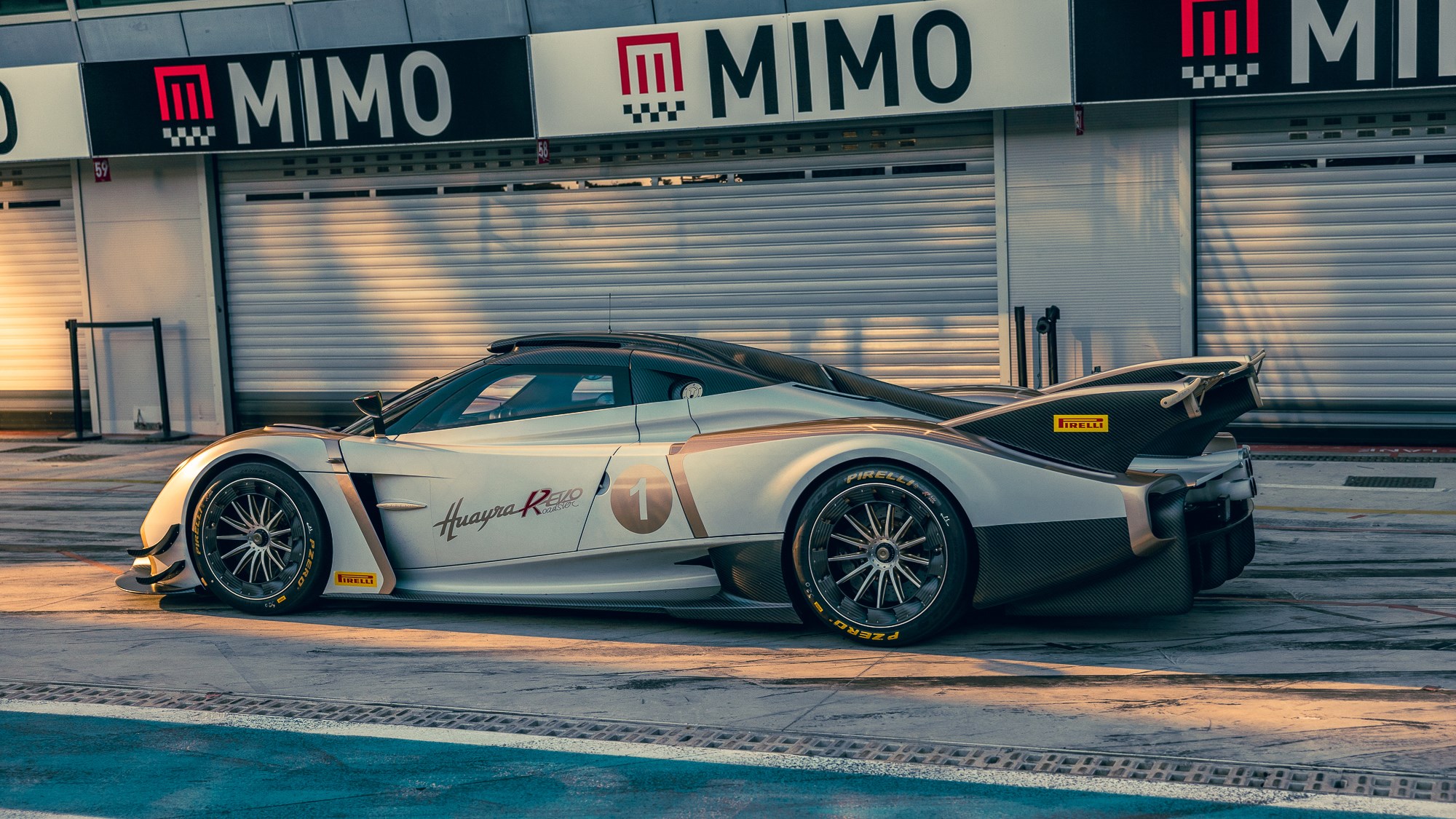
There’s plenty of visual differences, too. With a design conceived in parallel with the Utopia, the R Roadster is made from Class A carbon fibre which is nearly 40% stiffer than traditional materials. It’s also been extended by 101mm at the front and 190mm at the rear over the Huayra R, thus giving a more dramatic longtail ‘codalunga’ form and vastly increasing the aerodynamic underbody.
As a result, downforce is up by 45% (well over a tonne at high speeds) while aerodynamic efficiency is also up by 21%. Incredibly, removing the twin roof panels (the part that makes the car a Roadster) actually works to increase downforce by 5%, owing to the overall design of the aerodynamic surfaces.
Under the skin, a new heave damper on the suspension helps keep the ride height consistent – crucial when any sudden changes in downforce could cause a dramatic drop off in grip.
What are the specs?
We’ve spoken about the power, but perhaps the best bit is that in order to achieve it you need to rev the Evo Roadster all the way up to 8750rpm. If you wish, 9200rpm is achievable – assuming your eardrums can take it. Peak torque, meanwhile, arrives between 5800 and 8200rpm.
Pagani don’t declare a 0-62mph figure, but given the near 900bhp output and 1060kg dry weight, we’d estimate it at around 3.0 seconds. No doubt it would be quicker with all-wheel drive, but that’s somewhat missing the point, no? Top speed is 218mph.
In fact, the outputs and downforce are so impressive that Pagani reckon the Evo Roadster would set a lap time – on its Pirelli slicks – similar to that of a pole-sitting LMP2 car.
How does it drive?
We got behind the wheel of the Evo Roadster at Monza, the Temple of Speed. In July. Sufficed to say, it was extremely hot and the temperature inside the cabin was unspeakable – especially in black overalls. But were we complaining? Not one bit. The Evo Roadster is one of the greatest cars we’ve ever had the pleasure of setting foot in.
Despite appearances, Pagani has set the car up to be approachable for gentleman drivers. It won’t race and thus won’t be hammered around track for 24 hours straight by a team of fearless pros. As such, it’s been setup to encourage the driver with switchable ABS and traction control. Accelerating out of the pits for the first time reveals a raw but approachable set of low-speed manners.
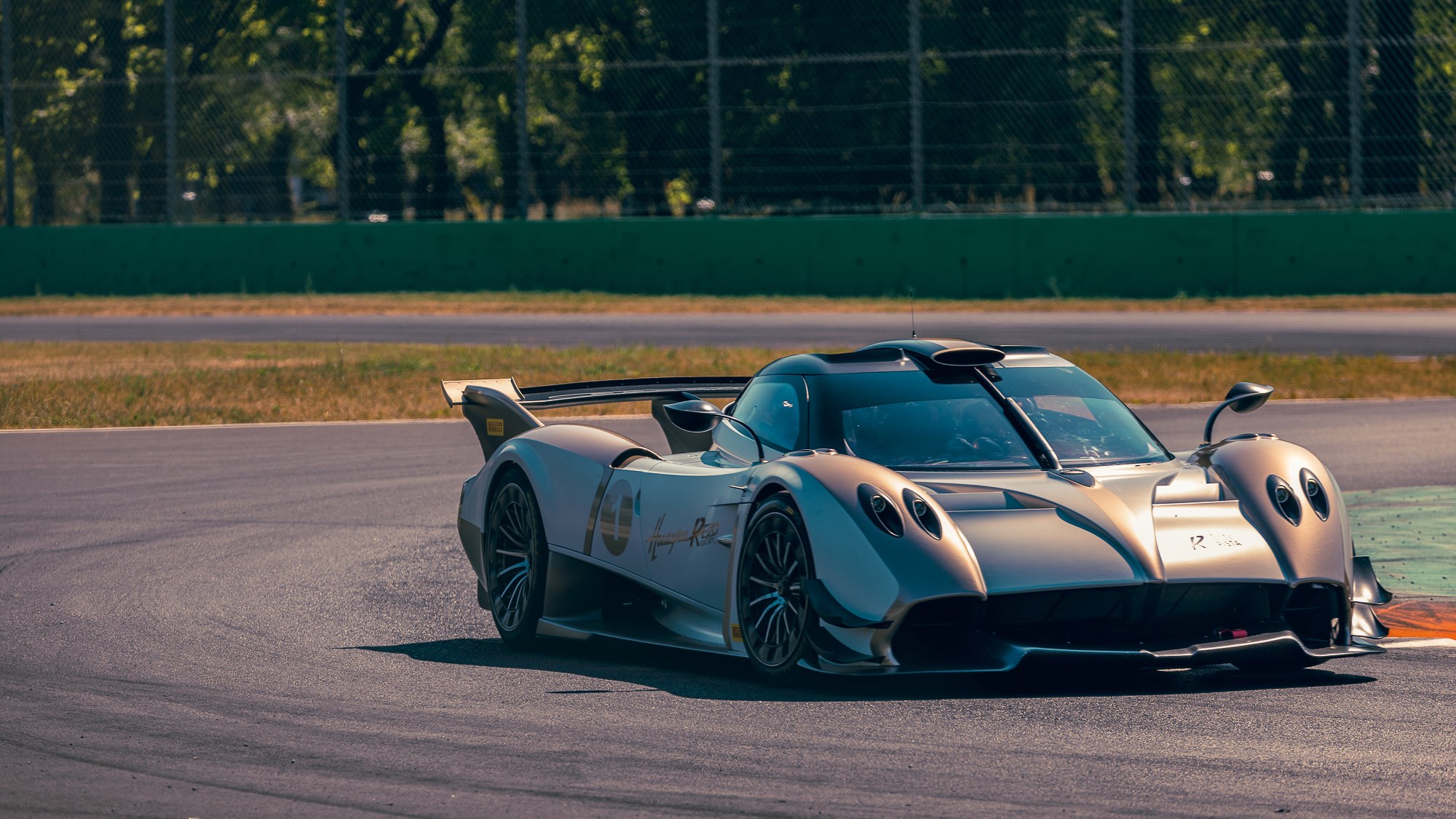
However it’s not until you reach the second chicane that the magic of the Evo Roadster really starts to show. A heavy braking zone down from the flat right-hander of Curva Grande, even with cold (ish) slicks the car is unbelievably planted. Speed is shed like nothing and the six-speed gearbox bangs down through the ratios with no detectable delay.
Turn in is pretty much perfect. It’s so far beyond even the most extreme road cars that it goes transcends mere cornering. This is a cheat code to the laws of physics. A flick of the wrist left, then right and we’re through the chicane. How exactly did that happen? There’s no aero at play at these speeds.
In truth, the slick tyres do a lot. But the Pagani’s crispness on the nose and ability to shrink around the driver’s seat is breathtaking. It’s not a small car (it’s well over five metres long), but it feels like you’re piloting something half the size given the immediacy of the responses. The sensation through your arms as the front end does exactly what you tell it to is deeply satisfying and suddenly every Lotus, Porsche or Ferrari road you’ve driven feels a little soft.
And now for the really good stuff. Accelerating up through the gears, the lightness of the car is obvious. In these wild days we live in, 888bhp isn’t totally outlandish. There’s road cars with circa 2000bhp. But in the Evo Roadster, those horsepowers must only haul around just over a tonne. As a result, it’s quick. And boy oh boy does it feel it.
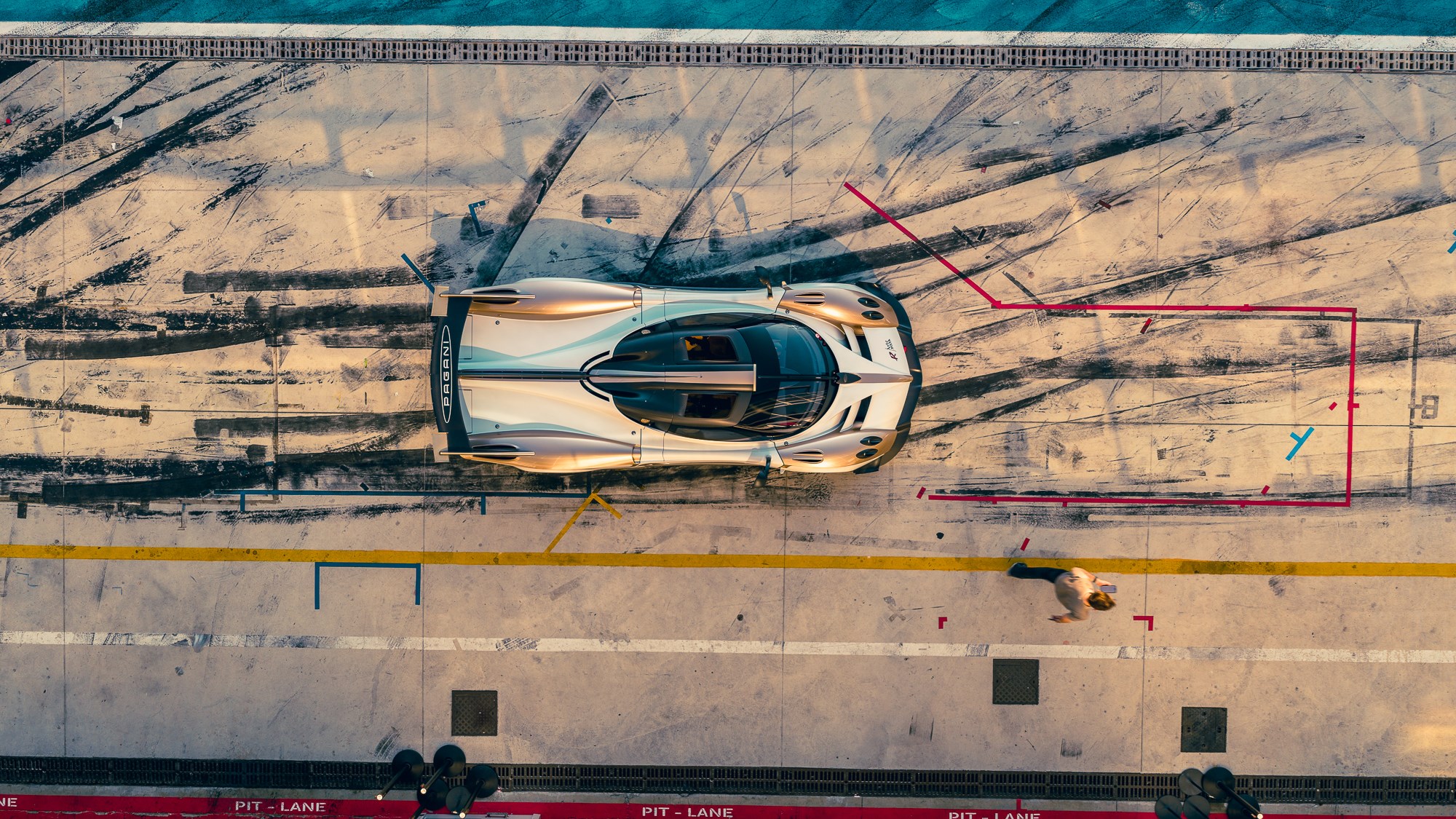
During each lap, we’re hitting at least 170mph (sometimes 180mph) on four occasions. With apex and exit speeds so high, the Evo Roadster has already done half the work as it hits the straight – split windscreen piercing a whole in the atmosphere and making the driver feel like they’re piloting the SR-71.
Mind you, even the Blackbird did not sound this good. From the inside (especially with the roof panels open), the sound is raw and deafening with a slightly less prominent undertone of V12 howl.
Step outside and listen to the car on drive by however and the chorus of 1990s Formula 1 is rich and unmistakeable. It’s exceptionally loud – so loud that the car would fail noise tests at most track days, hence why Pagani puts on its own – and brilliantly high-pitched. Be sure to watch our video review to hear it for yourself.
What’s it like inside?
The Evo Roadster isn’t a racing car yet anyone seeing it drive by would absolutely think otherwise. The speed, the sound, the looks. It’s all there. It’s only when you peak in the cabin that things are a bit different.
Most competition cars have a functional beauty to their interiors. Exposed wires and roll cage, data loggers and fire extinguishers all in open view. The Evo Roadster, meanwhile, is as finely upholstered as one of Pagani’s road cars. Which is really saying something.
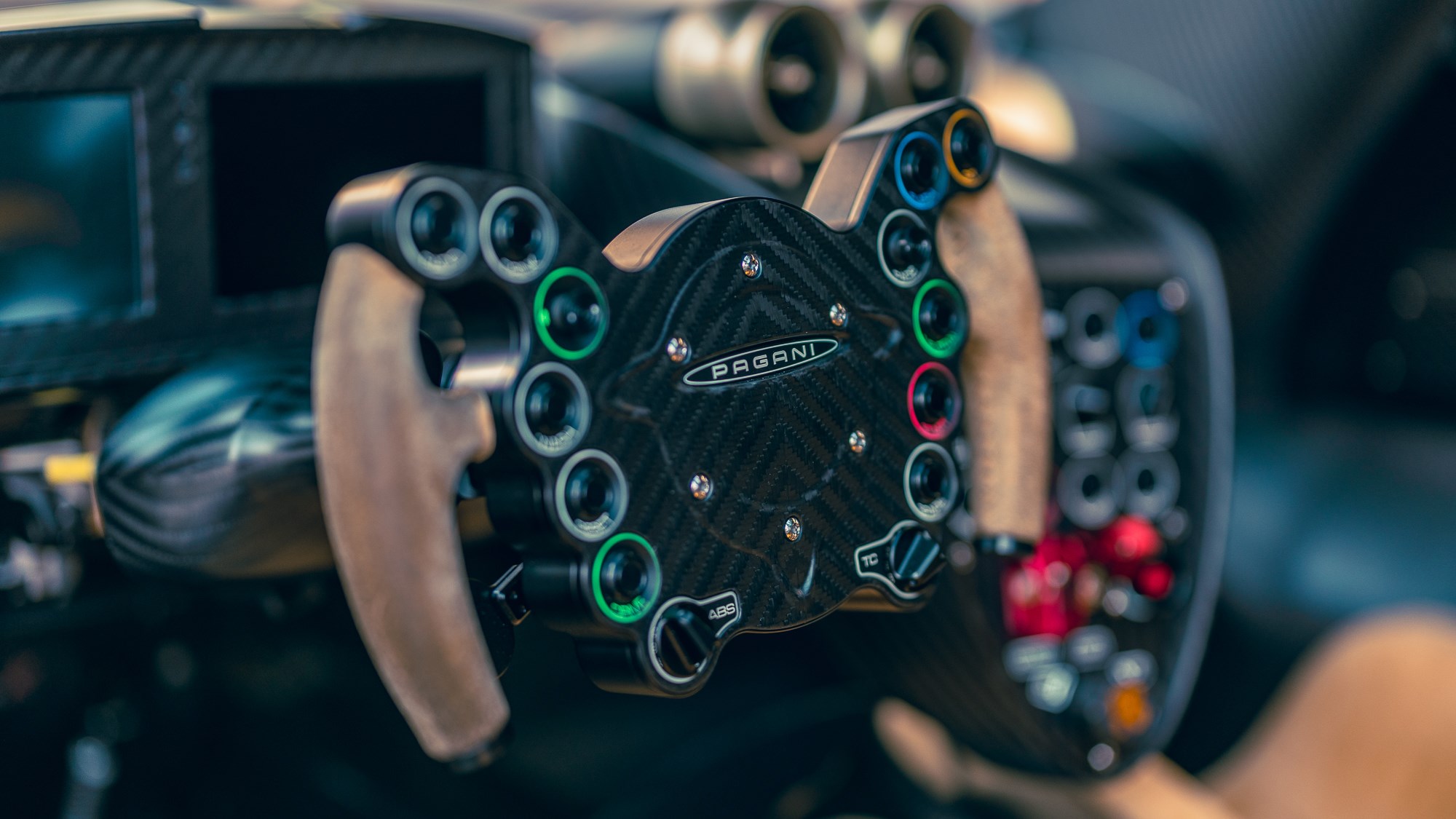
Every switch, every button, every hinge is beautifully crafted. The materials used sound almost alien – Carbo-Titanium HP62-G2 and Carbo-Triax HP62 – but it’s the way they’ve been carefully layered to form a cabin that’s almost as beautiful as the outside.
Nothing is shared with any other car on sale. Everything looks and feels unique. The light alcantara seats set against the dark carbon is spot on, while the steering wheel – functional and easy to use – has its own beauty. It’s not all analogue however, two screens directly in front of the driver work as the dash display and rear-view camera. Useful, when there’s no rear window.
Before you buy (trims and rivals)
Unless you fancy splashing out on a LMP2 car (that won’t even sound as good) rivals are thin on the ground. Meanwhile, customisation to the cosmetics is actively encouraged. You get the feeling Pagani would rather no two cars look the same.
Verdict
For a car you can’t drive on road, the Huayra R Evo Roadster is rather expensive. It’s also underpowered compared to a Ferrari F80 or McLaren W1 and, as mentioned, you can’t just take it – unmodified, at least – to your local circuit and expect to run it in an everyday track day.
It’s use case, then, is limited. But believe us when we say that whatever use you do get out of it will be as spectacular as it gets on four wheels. This is a car and an art form all at the same time. It’s dazzling beautiful and ferociously fast yet it doesn’t take your head off when you want to enjoy it. It’s the kind of car that only Pagani could make and – for sheer thrills and occasion – very little comes anywhere close.