► First test of Lamborghini’s new entry-level supercar
► V10 swapped for turbo-hybrid V8 and e-AWD
► 10,000rpm and 907bhp… but no V10 music
Much is riding on the new Lamborghini Temerario. Replacement for the Huracan – aka the best-selling Lamborghini supercar of all time – it also drops Sant’Agata’s legendary naturally aspirated V10 for a turbo-hybrid V8. It’s certainly an exciting prospect – not least the prospect of 907bhp and a staggering 10,000rpm, plus a triple e-motor hybrid set-up that’s basically copy-and-paste from the exceptional new Revuelto.
Effectively this is Ferrari SF90 technology in the Ferrari 296 GTB category. McLaren offers nothing comparable, though its much less powerful (!) 750S comes closest. And yet, at around £267,400 the Temerario isn’t a huge stretch from its rivals.
We’re testing it at Circuit Vallelunga on a 35deg C June day, the key options being Bridgestone Potenza Race tyres and the Alleggerita pack – which subtracts around 12kg and adds 67 per cent more downforce, not to mention around £50k to the sticker.
At a glance
Pros: Massive power matched to massive traction; fantastic brakes; neutral balance; roomier and better-equipped cabin
Cons: V8 lacks character; handling not as fluid as it could be; too much understeer
What’s new?
In over-simplified terms, the Temerario lands somewhere between a larger version of its predecessor and a downsized Revuelto. But its 4.0-litre V8 engine is truly unique – an all-new unit that has nothing in common with the same-size unit in the Urus SUV. (Lamborghini managed to keep the V12 for Revuelto, but the Temerario’s larger projected sales volumes mean it will make a bigger impact on fleet-average CO2 numbers – presumably spelling curtains for the V10).
Internally coded L411, the V8 features twin turbochargers mounted ‘hot’ in the vee, runs up to 2.5-bar boost, and alone makes 789bhp from 9000-9750rpm and 538lb ft between 4000-7000rpm.
Its aluminium block is hewn from motorsport-grade A357+Cu and is home to a flat-plane crank and titanium con-rods. The head uses an alloy that only two or three foundries worldwide produce – including the one that casts Ducati’s Moto GP cylinder heads – and features DLC-coated finger followers for the valvetrain.
As well as its transversely mounted dual-clutch gearbox, the Revuelto donates the 3.8kWh battery mounted in the ‘transmission’ tunnel and triple axial-flux e-motors – the front axle carries over, while the rear is now in ‘P1 position’, which means it’s connected directly to the engine crankshaft – the Revuelto’s can be decoupled, but only the Temerario’s front axle provides electric-only running. The electrified front axle, of course, means the Temerario is all-wheel drive.
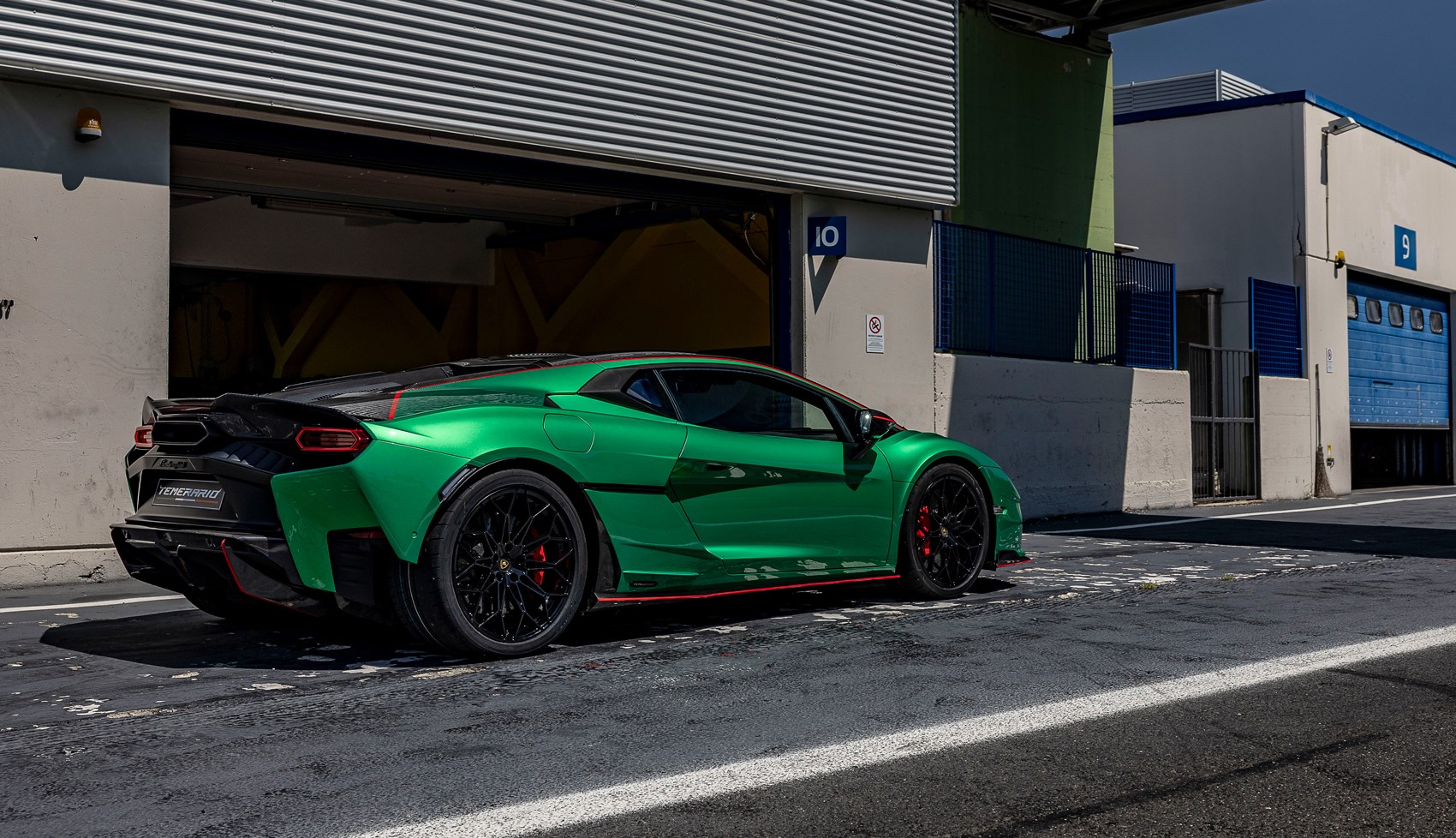
Like Huracan, aluminium spaceframe construction lays the foundations, but the Temerario’s is all-new and said to be over 20 per cent more torsionally rigid. There’s also double-wishbone suspension, 20-inch front and 21-inch rear wheels (wearing 255/30 and 325/30 tyres respectively), and Carbon Ceramic Brakes Plus with 10-piston front calipers and 4-piston rears (with 410mm and 390mm discs)
Measuring 4706mm long, 1996mm wide without mirrors and 1201mm tall, the Temerario’s dimensions increase by 139mm, 63mm and 36mm over the Huracan respectively. A wheelbase of 2658mm is 38mm longer.
Together with the chunky hybrid bits, the larger dimensions help add an extra 300-plus kilos, for a claimed 1690kg dry all in.
What are the specs?
Lamborghini says all figures are best-in-class. With petrol and electric combined, the Temerario produces 907bhp, accelerates form 0-62mph in 2.7 seconds and gets from 0-124mph in just 7.1 seconds. Top speed is quoted at 214mph.
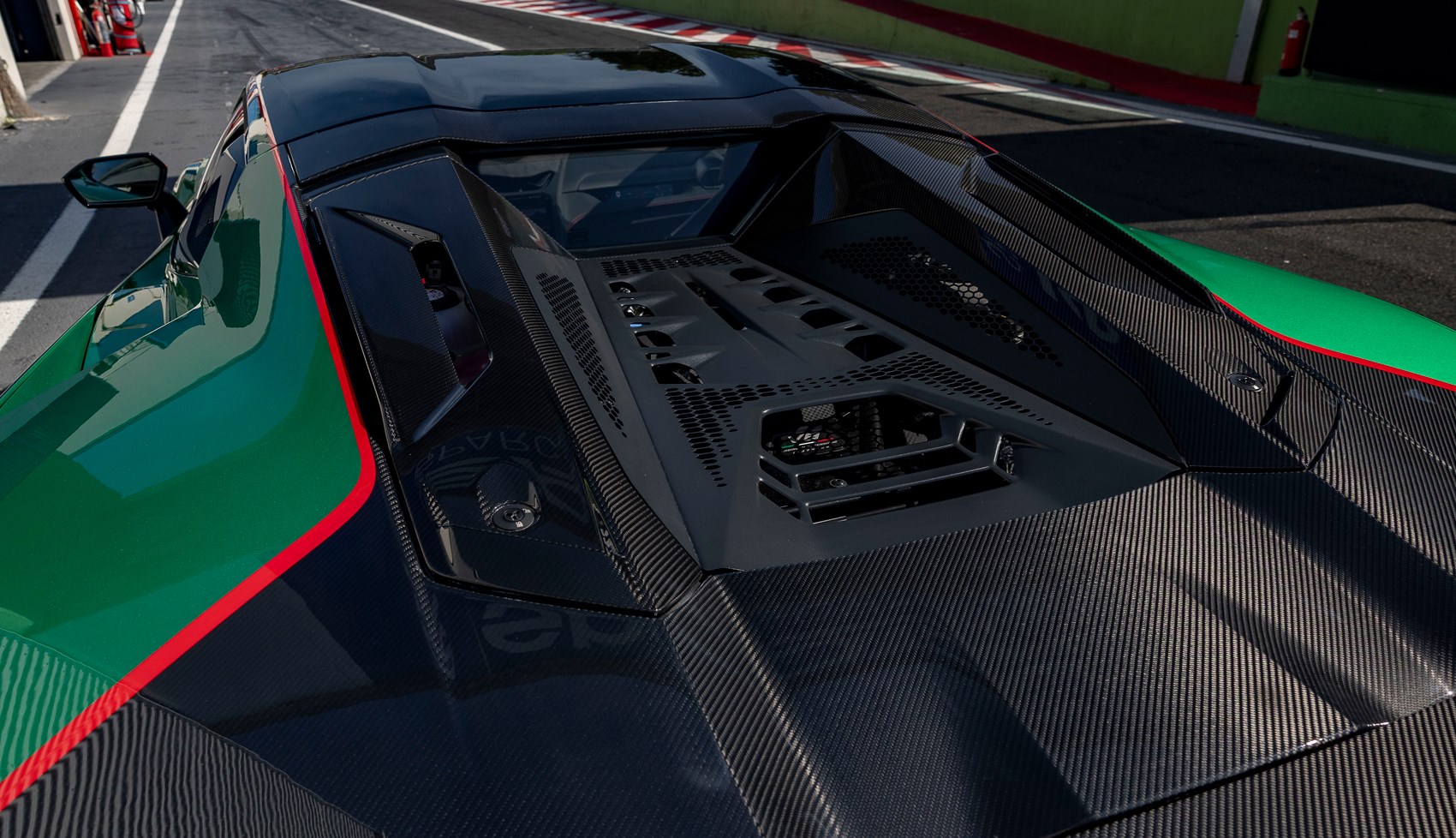
The Temerario can also manage a – definitely not best-in-class – five-mile or so max on electric alone. The 3.8kWh lithium-ion battery can be charged at up to 7kW, or – much more likely – topped up using the V8 as a generator.
How does it drive?
The new V8 twin-turbo is clearly the big deal here, and it couldn’t be more different to the V10 – quieter, gruffer, less tuneful, and closer to a McLaren V8 in terms of mechanical grit and overall character than anything previously born from Sant’Agata.
Throttle response is sharp and there’s zero turbo lag, plus a suitably muscular mid-range (if not quite as strong we expected). But at typical speeds it lacks sense of occasion – though our early test car was missing the final crackles and so on that will soundtrack a throttle-lift.
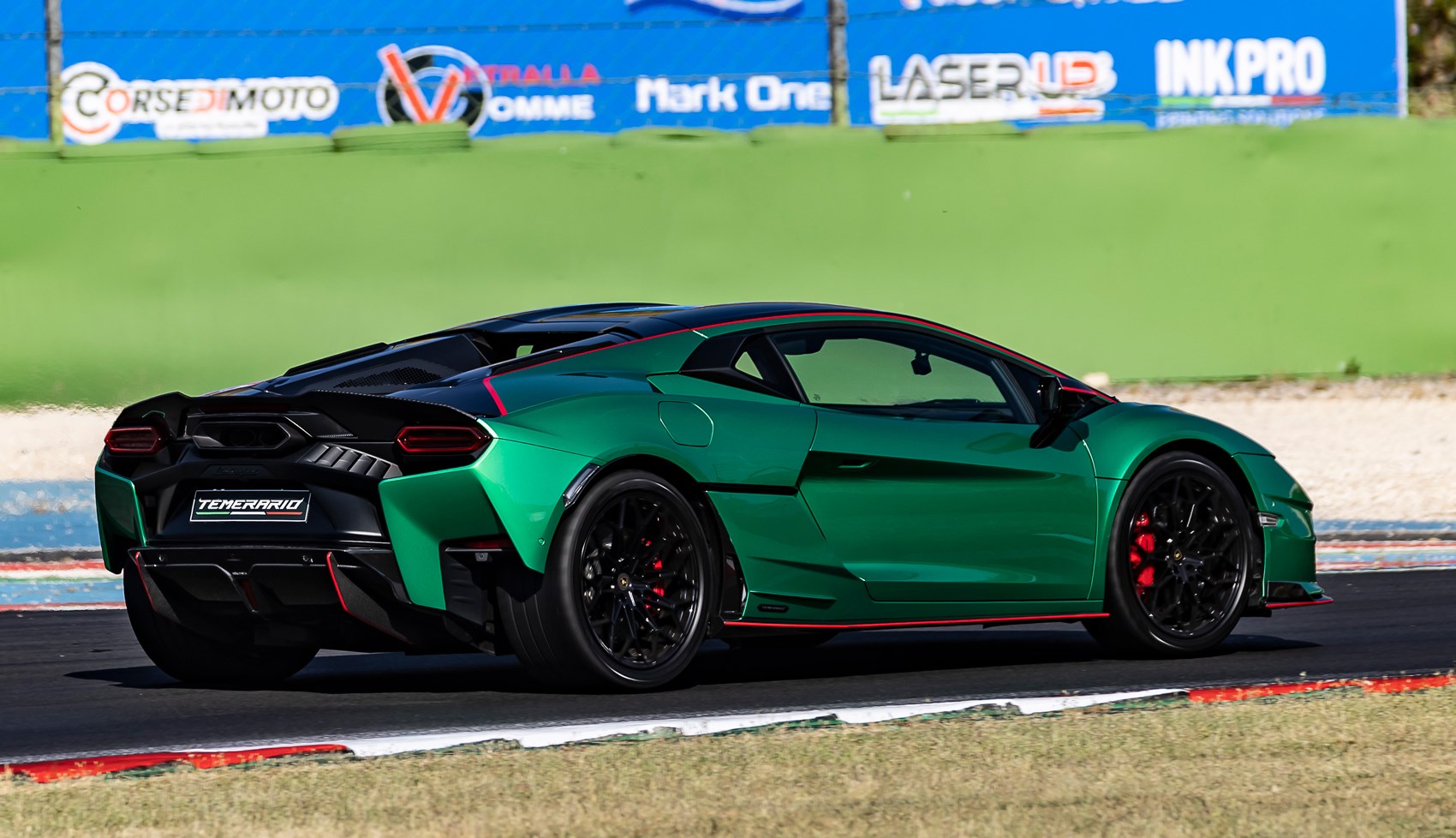
At first, shifting at 7000 or 8000rpm feels natural, at which point the Temerario takes on a more compelling urgency, but following Lamborghini test driver Marco Passerini made it clear just how much performance you’re missing if you do – he dropped me each time I did.
Use all those revs and there’s a manic blare, extremely rapid progress and a pleasing urgency to the exhaust note. And yet the process of actually getting to 10,000rpm is less thrilling than winding the old V10 out to 8500rpm – it feels like less of a crescendo, presumably because peak power extends from 9000 to 9750rpm.
The Temerario feels more neutrally balanced and heavier than the Huracan – if not the full 300kg extra. Weight distribution of 44/56 front-to-rear shifts the balance palpably closer to the front than the 40/60 rear-wheel drive Huracan Evo, and apparently its centre of gravity is lower too.
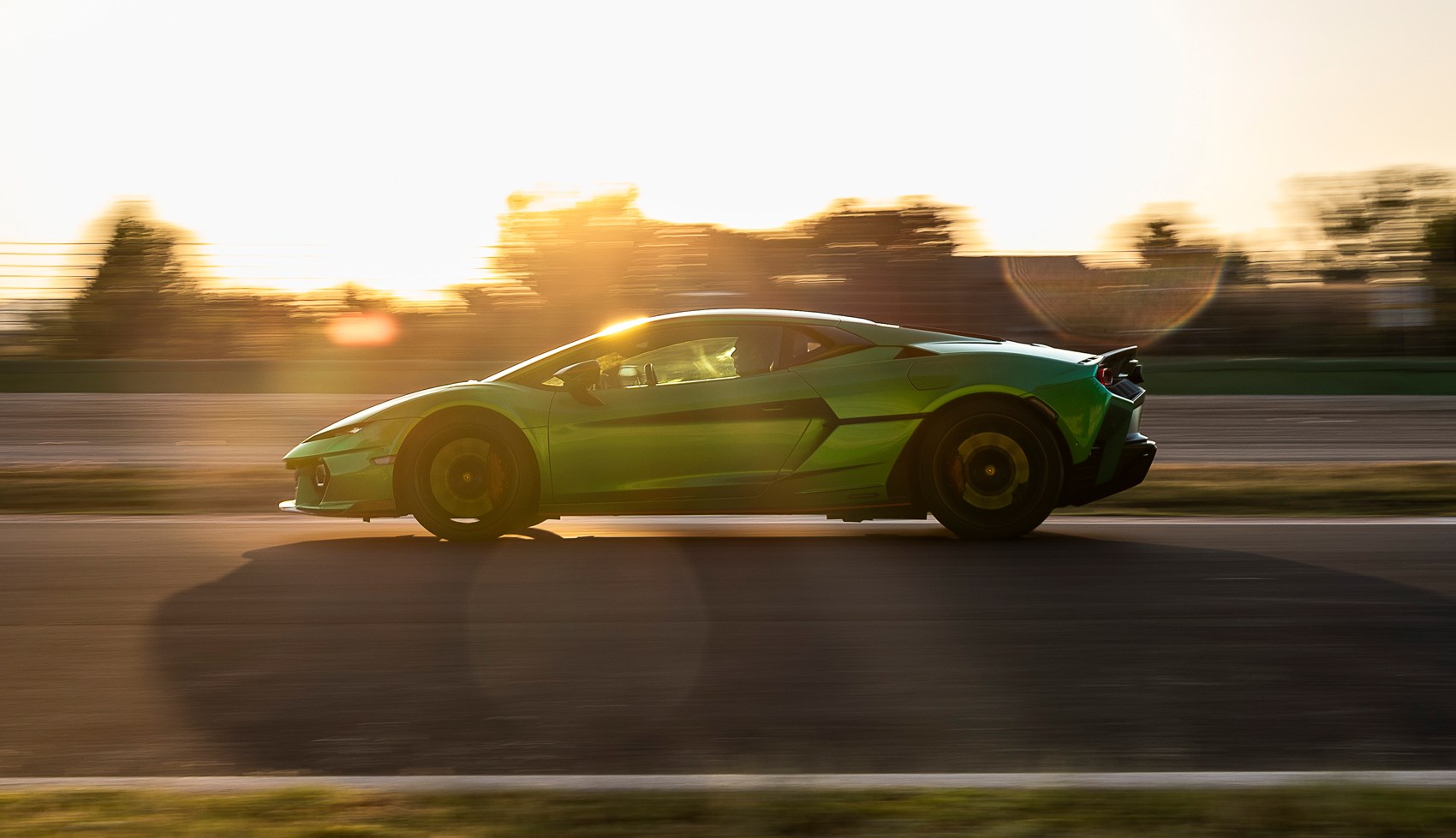
This is exactly how the Temerario drives – it is more tolerant of big steering inputs, and more stable generally, particularly when you stand hard on the excellent carbon-ceramic brakes and a surprisingly small amount of weight moves forward (though clearly suspension stiffness feeds in here too). The downside is it feels less biddable than a Huracan, though it still adjusts its line if you lift the throttle mid-bend.
More of an issue during our drive was high-speed understeer, and some pretty dogged understeer in mid-speed corners. The Temerario was also keen to straighten itself when we did get it rotated, where really I wanted to drive it out of the corners balanced on just a fraction of corrective lock. This was in the more neutral (and intended to be faster) Corsa mode. Pitting to drop our front tyre pressures during our 35-degree C test session helped, and we found Sport mode more fluid and natural – though stability control intervention was intrusive (as ever with Lambo, you can’t mix and match modes quite as freely as we’d like, and this car’s three-stage drift mode was disabled – perhaps it’s more conservative setting would have worked best for fast laps).
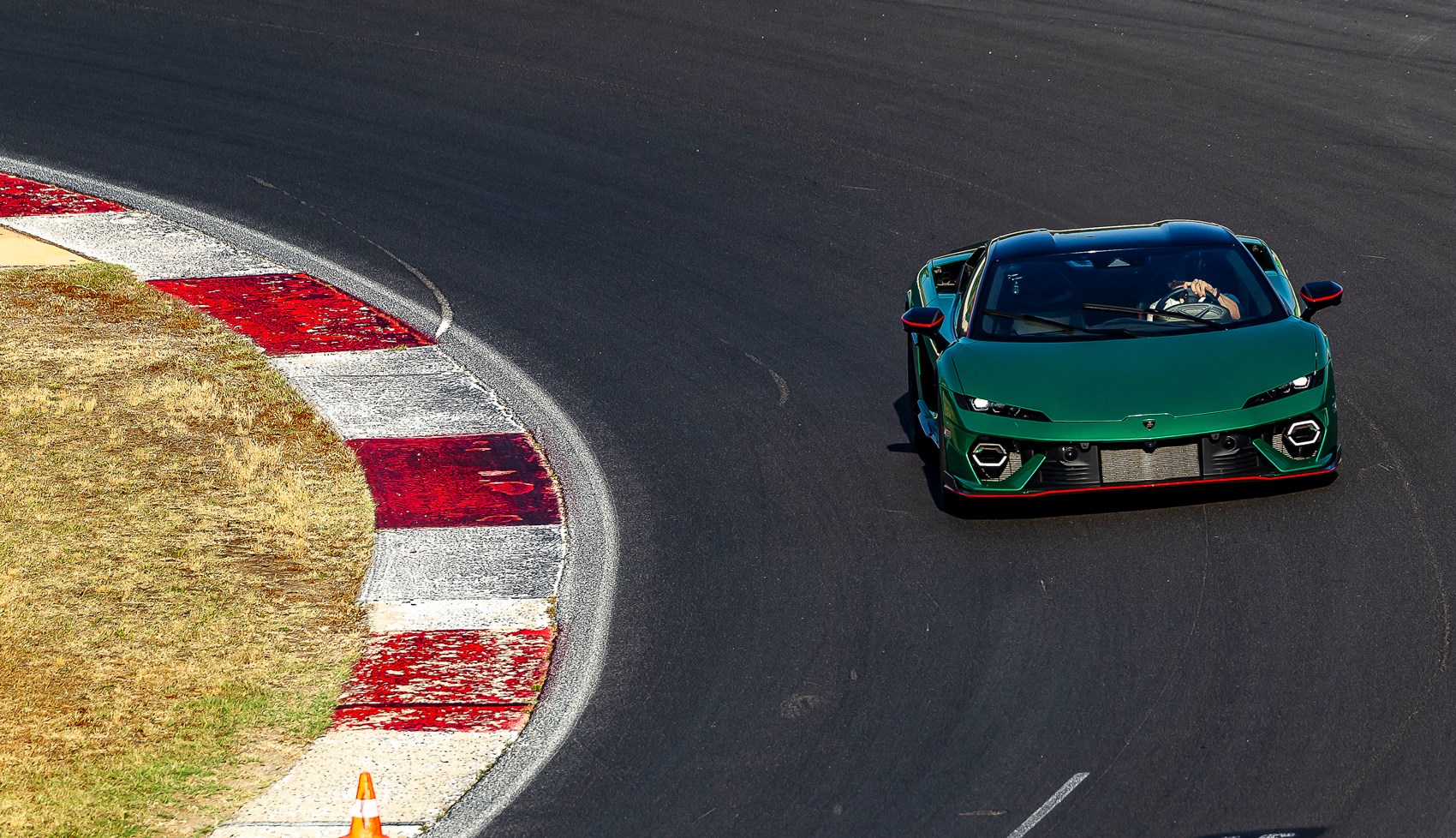
It is not a perfect comparison, but my lap times were comparable to the much less powerful and much lighter Huracan STO I drove round Vallelunga, also on Potenza Race tyres. (Caveats: the STO was the most hardcore Huracan, where the Temerario is the entry-level model, I got more seat-time in the STO and was focused on the lap, where I was also attempting to present a video in the Temerario – which you should please watch).
What about the interior?
It’s a big step forward, with much more interior space. The windscreen appears to be less aggressively raked (though it’s still pretty wedgy) and rear visibility through a vertical pane of glass is vastly improved. So too the infotainment, which essentially lifts from Revuelto with its triple screens – a 12.3-inch digital instrument cluster, another 8.4-inch screen in the centre console and a 9.1-inch display for the passenger to see how fast they’re going.
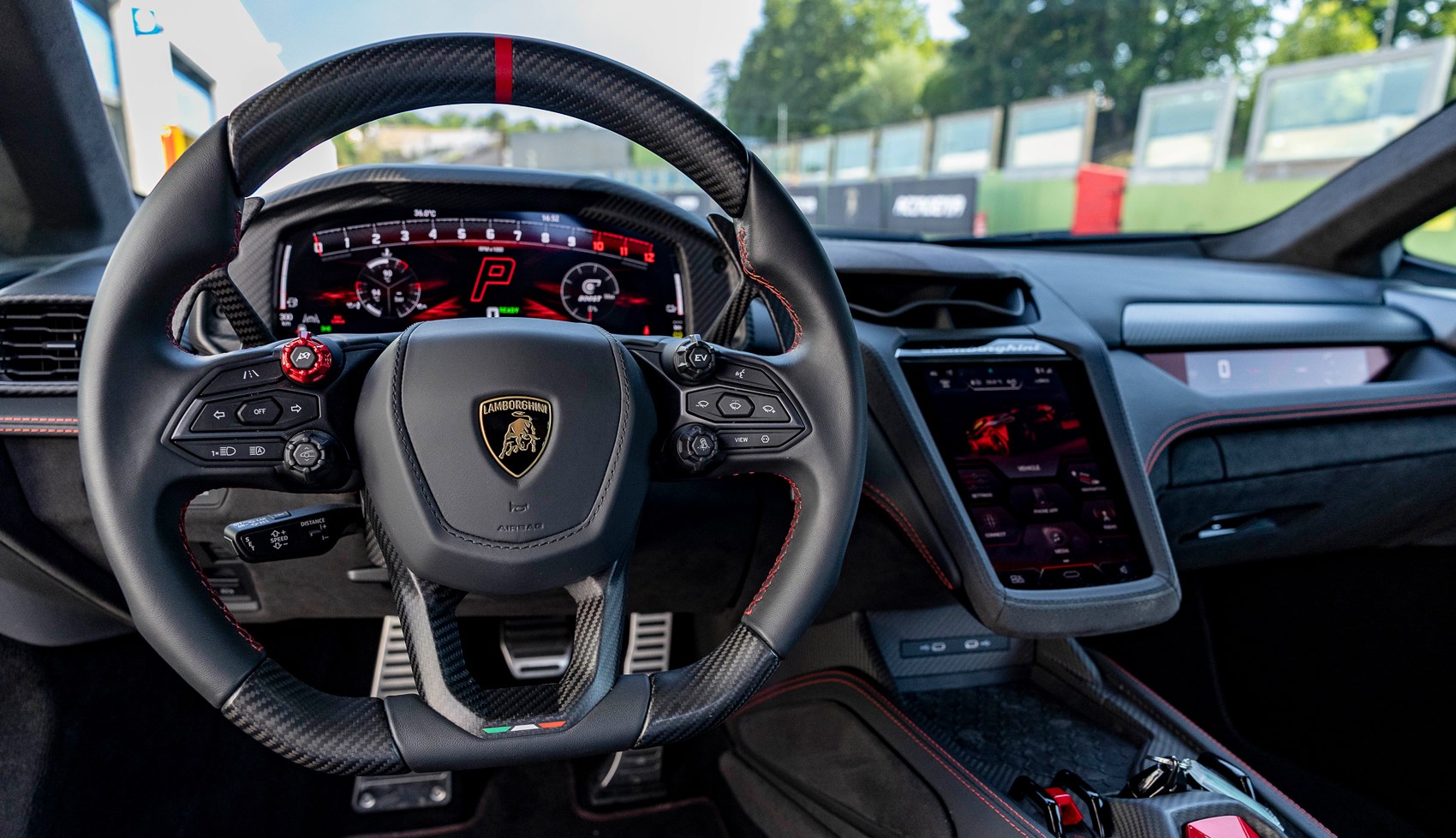
The Temerario also debuts the Lamborghini Vision Unit – LAVU for short – system, which uses three cameras to provide a second-gen telemetry system (the Huracan STO had something similar), ‘Memories Recorder’ and Dashcam, all of which can be replayed through the infotainment system and Unica app. Tight timeframes meant we didn’t get to try any of this stuff on the press launch.
Before you buy
The Temerario stacks up very convincingly against rivals – its £267,400 asking price isn’t vastly more expensive than the Ferrari 296 GTB and McLaren 750S, but the Lamborghini offers significantly more performance.
It’s also worth noting that its big-brother Revuelto costs almost £200k more and produces just 94bhp extra (while also weighing 82kg more).
Verdict: Lamborghini Temerario
Twelve laps is little time to understand such a complex supercar, and our test crucially included no road driving, so we do not yet have the full picture. As it is, first impressions suggest the Temerario is a highly impressive car, but that its handling isn’t as intuitive as it could be and that the V8 can’t compare with the old V10 in the emotional stakes. We’ll update you when we get a more comprehensive stint behind the wheel.