► Kia PV5 is the brand’s first electric van
► Pricing will turn heads and attract buyers
► A few quirks prevent perfection
Usually when you see a new name entering the electric van market it’s an unknown one with no brand awareness or reputation in this country. Not so with the all-new Kia PV5.
It still feels like an unexpected step, as Kia hasn’t even flirted with the idea of commercial vehicles in this country of late – not even through a car-derived van, which takes much less commitment and development. There’s definitely been plenty of development that has gone into the PV5, and not it alone – there are more models in the planning, including a PV7, PV9 and possibly a PV3, too.
Kia isn’t doing things by halves for the PV5 either, as it’s planning to offer three panel vans with a choice of two lengths and two heights as well as a variety of different models including a refrigerated version, box van and even a light camper. There will be passenger versions too, with a five-seater set to be followed by ones with room for more.
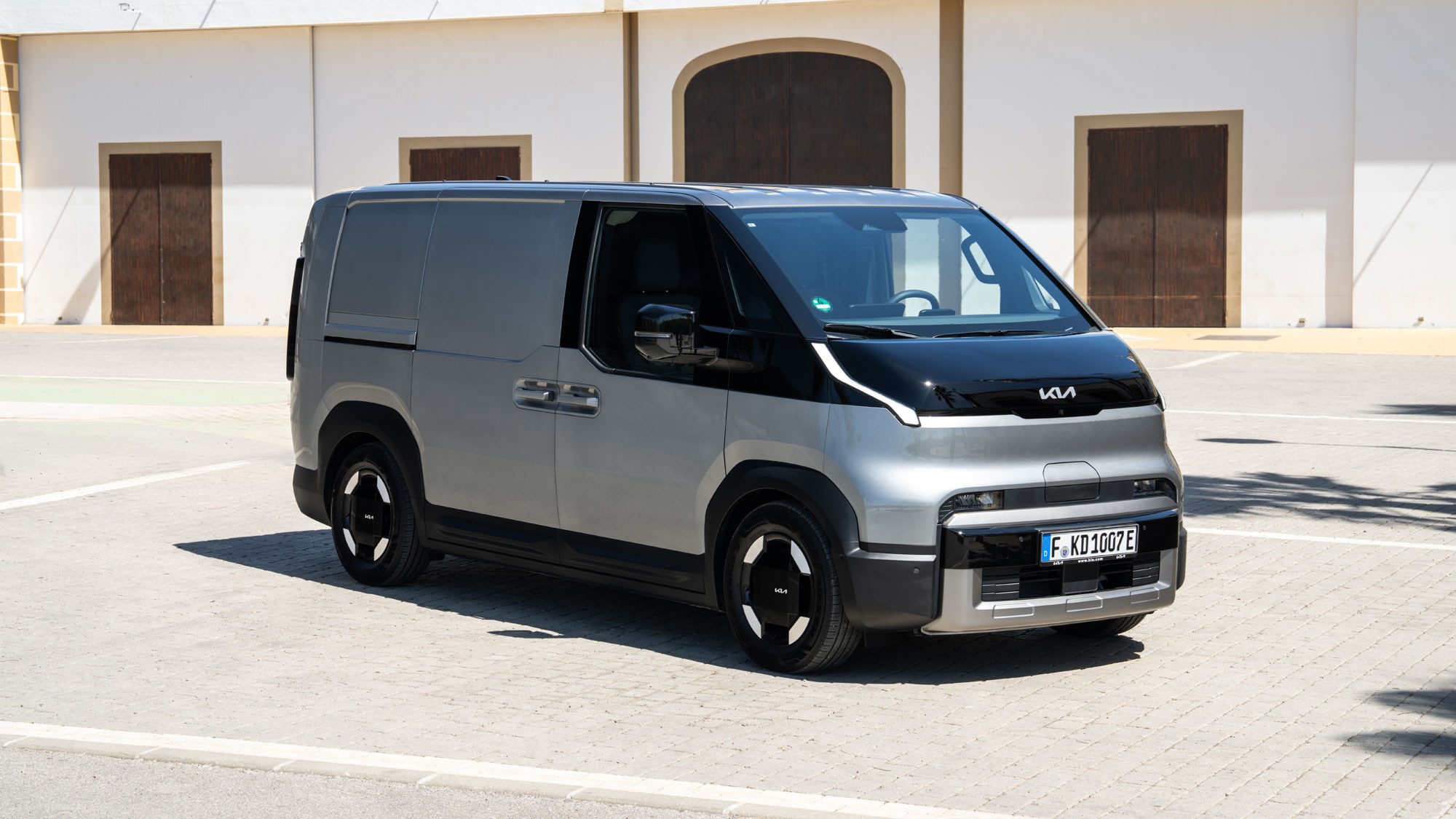
Does this make it more or less crucial that the PV5 is a success? It certainly suggests that Kia is committed come what may, and that you’ll get much more support than if it was dipping a toe in the market. It certainly comes with a few quirks – some of which only a new entrant to the market could offer. Not least of those is the fact that it doesn’t slot neatly into the conventional size categories. Instead it sits sort of between the small (Citroen Berlingo) and medium (Ford Transit Custom) classes, dovetailing a bit with both. For many buyers this won’t be a problem but it could provide the odd challenge to some, not least if you want to transfer existing racking systems or the like.
Should you buy a Kia PV5? For van buyers, vast amounts of what we say here plays second fiddle to one crucial element – the price. Value sits above all for many, as it’s a business purchase rather than a treat to oneself. This is not the case with the Kia, as it offers spectacular value. When you factor in the government’s Plug-In Van Grant it starts at just over £22,500 (not including VAT). This is less than the older, entry-level, smaller, diesel Citroen Berlingo. That’s an absolute bargain.
At a glance
Pros: Staggeringly good value, High quality interior, Drives well, Great choice of versions
Cons: Quirky rear opening, Doesn’t get top safety score, Too much controlled through the touchscreen
What’s new
Everything is new on the PV5 – Kia hasn’t just taken a car platform and shoved a boxy back onto it, this is a bespoke, deliberately engineered and catchily named Electric-Global Modular Platform for Service (E-GMP.S) platform. It has been created as a result of the so-called PBV strategy. PBV currently stands for Platform Beyond Vehicle, but originally it was Purpose Built Vehicle. It’s just vans though.
The PV5 Cargo is set to come in a short, low-roof L1H1, a longer low-roof L2H1 and a longer high-roof L2H2. The smallest overlaps with the largest small vans, while the biggest is potentially an alternative to the smaller medium vans. This is less of a radical concept than it might seem, as it’s the same general niche into which the Volkswagen ID.Buzz Cargo slots.
Kia has embraced the VW as its natural rival, speaking of it as a comparison. However, it hasn’t taken a similar approach to pricing, with value right at the top of Kia’s list of priorities. As well as an enticingly low cash price, it also comes with a choice of two well-equipped trim levels. There is also the choice of two batteries, meaning you can keep costs down or opt for an electric range that is as good as pretty much anything in the class.
There are some oddities. Kia has said it wanted to offer the lowest possible loading height, getting the rear entry point down to 419mm. This comes with a compromise though, as this takes you below the top point of the suspension assemblies, meaning there is a second incursion into the loading bay and the rear aperture, alongside the usual one created by the wheel arches.
You can get a false floor to go over it, but it looks a little strange and like it has been engineered after the fact. That quest for value has also resulted in a slightly lower safety score, with Kia anticipating four stars rather than five.
What are the specs?
There is only the one motor offered in the PV5, but there are two power outputs. The smaller battery gets 120bhp, while the larger gets 160bhp. Both get the same 184lb ft of torque. Outright performance is rarely a priority for a commercial vehicle, to the extent that many manufacturers don’t quote it. Perhaps because Kia’s new to all this, it has chosen to tell us however.
The smaller battery is capable of getting from 0-62mph in 16.2 seconds while the larger equivalent manages it in 12.4 seconds. However, it stresses that this is fully laden in both cases, so it might well feel faster on the way back from a delivery than on the way out. It certainly offers some of that mid-range instant response that is often lacking from an electric van, which makes it handy for an overtake.
There are two batteries to choose from in the UK – a 51.5kWh and a 71.2kWh version. These provide an electric range of 184 and 258 miles respectively, which is good rather than excellent for the class, being just below the latest maximum offered by the ID.Buzz Cargo, but above plenty of those in the medium sector.
It has the ability to connect to a 150kW DC charging point, where it can top up from 10-80% in 30 minutes. The 51.5kWh battery version will take 4h 45mins to get from 10-100% on an 11kW AC charger, while the 71.2kW version will do the same in 6h 30min.
How does it drive?
How the Kia PV5 drives is one of the less remarkable things about it in many ways – it performs how you would hope and expect an electric vehicle would from a manufacturer that has turned out some excellent models on the passenger car side of things in recent times.
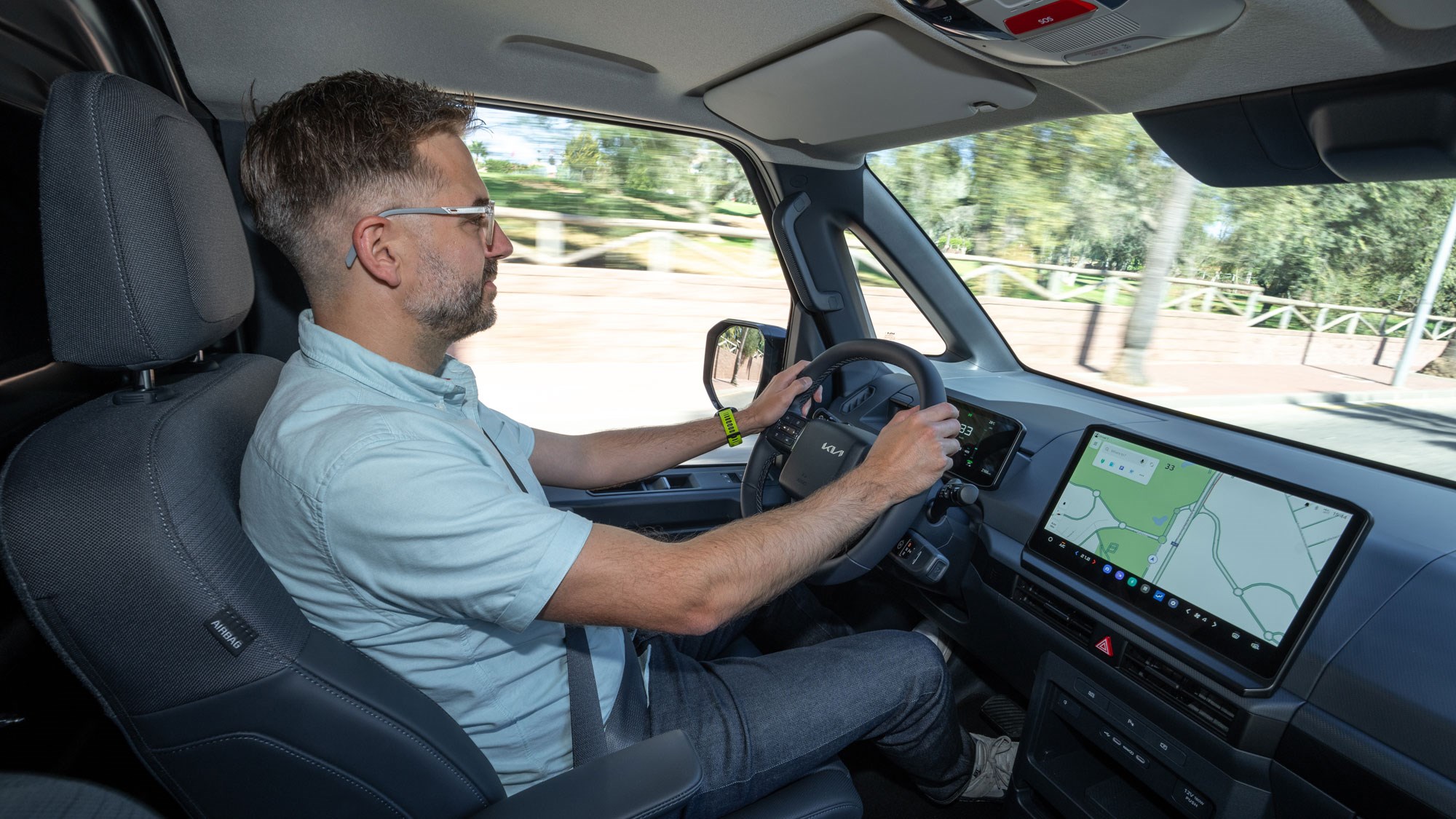
That said, it isn’t just business as usual for the van sector is concerned. There are several elements that make it stand out, not least the bit I alluded to earlier – it has the ability to offer a little burst of acceleration that is characteristic of an electric vehicle, but is often dialled back a bit in a commercial vehicle. It’s not so aggressive that it will throw the unsecured contents of your loading back careering into the rear doors, but it does provide a little feeling of zippiness that provides a bit more confidence come overtaking time.
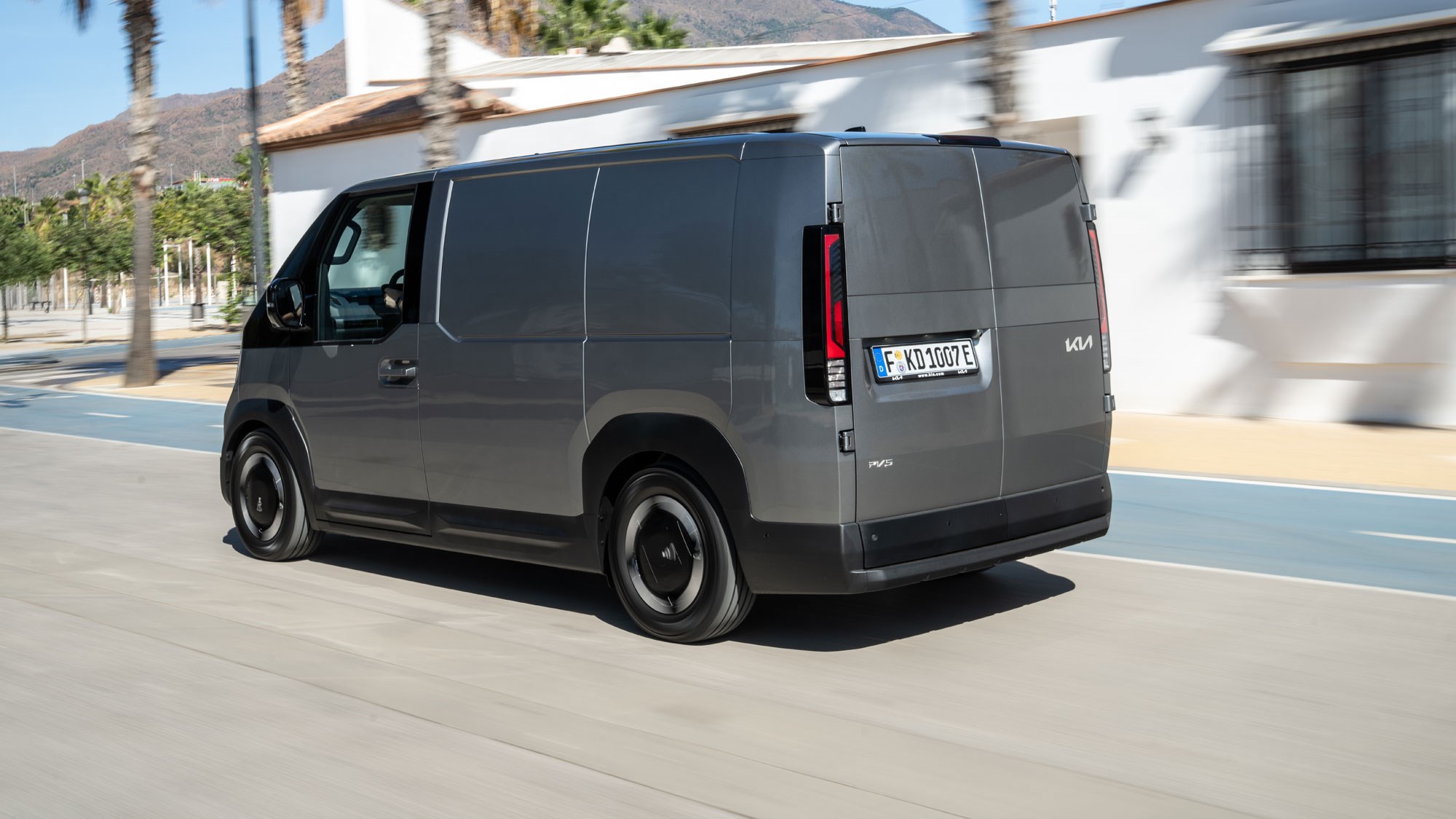
The suspension is the same physical setup as the one in the passenger carrying PV5 but has been tuned for the van, so it is a little firmer and more adept at dealing with 800kg of load over the rear wheels. It’s stable and rides nicely, while the steering is smooth and responsive – perfect for those tight urban manoeuvres. It’s quiet, too – the noisiest element on our test drive was the fastenings holding down the 400kg load in the back, which were squeaking away relentlessly.
What about the interior?
The cabin is smart and minimalist in some senses, with most controls through the touchscreen rather than via buttons. This is an irritation in most vehicles, but more so in vans where you are more likely to be leaping in and out with gloves on, or with filthy hands that you don’t necessarily want to be smearing all over a screen. Still, said system is fairly easy to use at least.
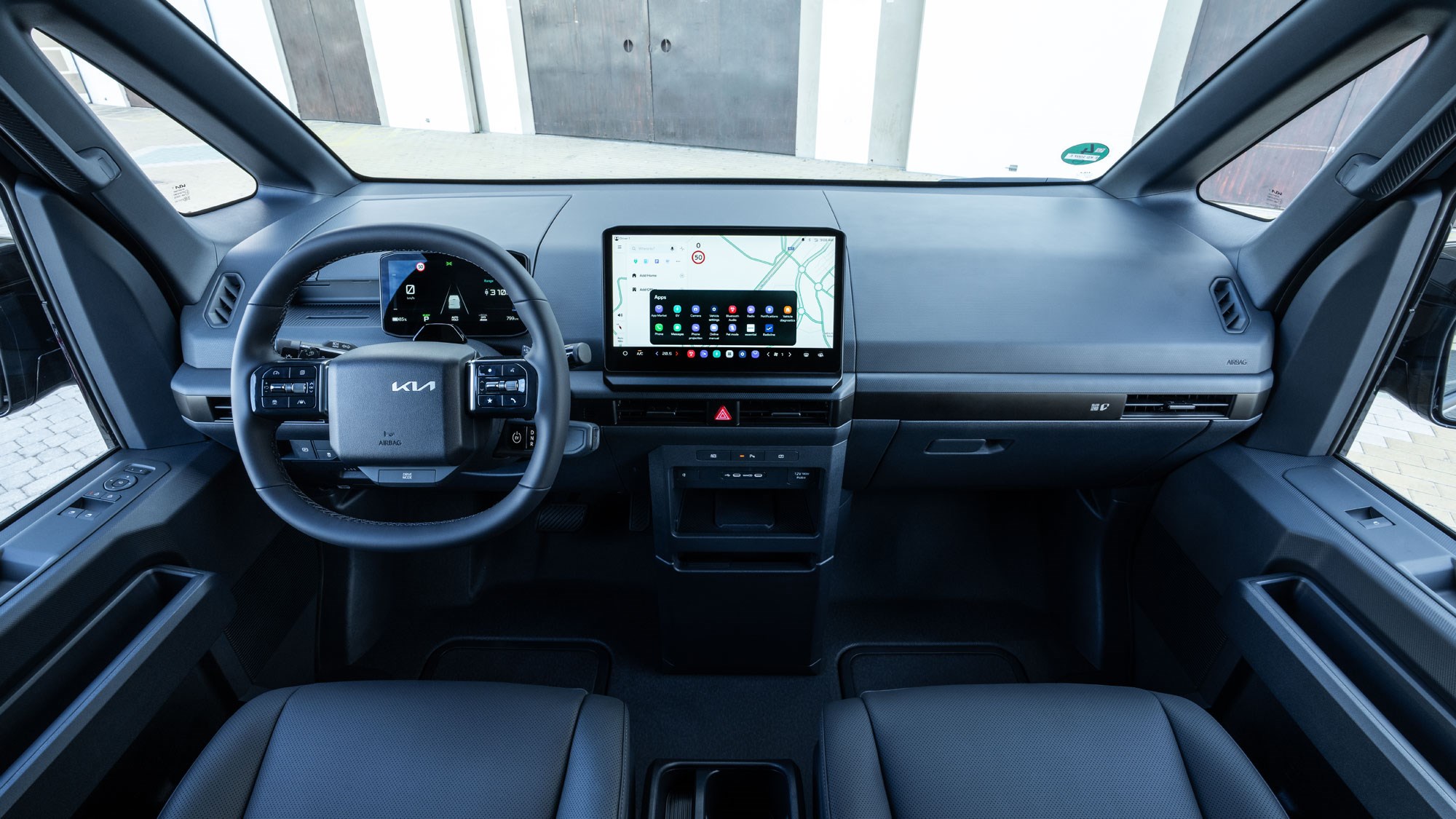
The initial PV5s are all two seaters, but there will be a three-seat option as time goes by. The two-seater has plenty of room for two, and there are elements that suggest a third adult will be happy enough in the front too. Not least the flat cabin floor, which allows a little more space for feet in the middle. It also allows there to be a large drawer at the middle of the central console, which offers handy out-of-sight storage.
The other storage options in the cabin are a bit mixed. There is another excellent under-floor area in the passenger footwell, although this could well be hidden under a carpet, too, making it harder to access. There’s also a lidded box on top of the dash in front of the driver. There’s nothing on the top of the rest of the dash, though, and the glovebox isn’t huge. There are a couple of different spaces in the doors, but most of those are fairly visible.
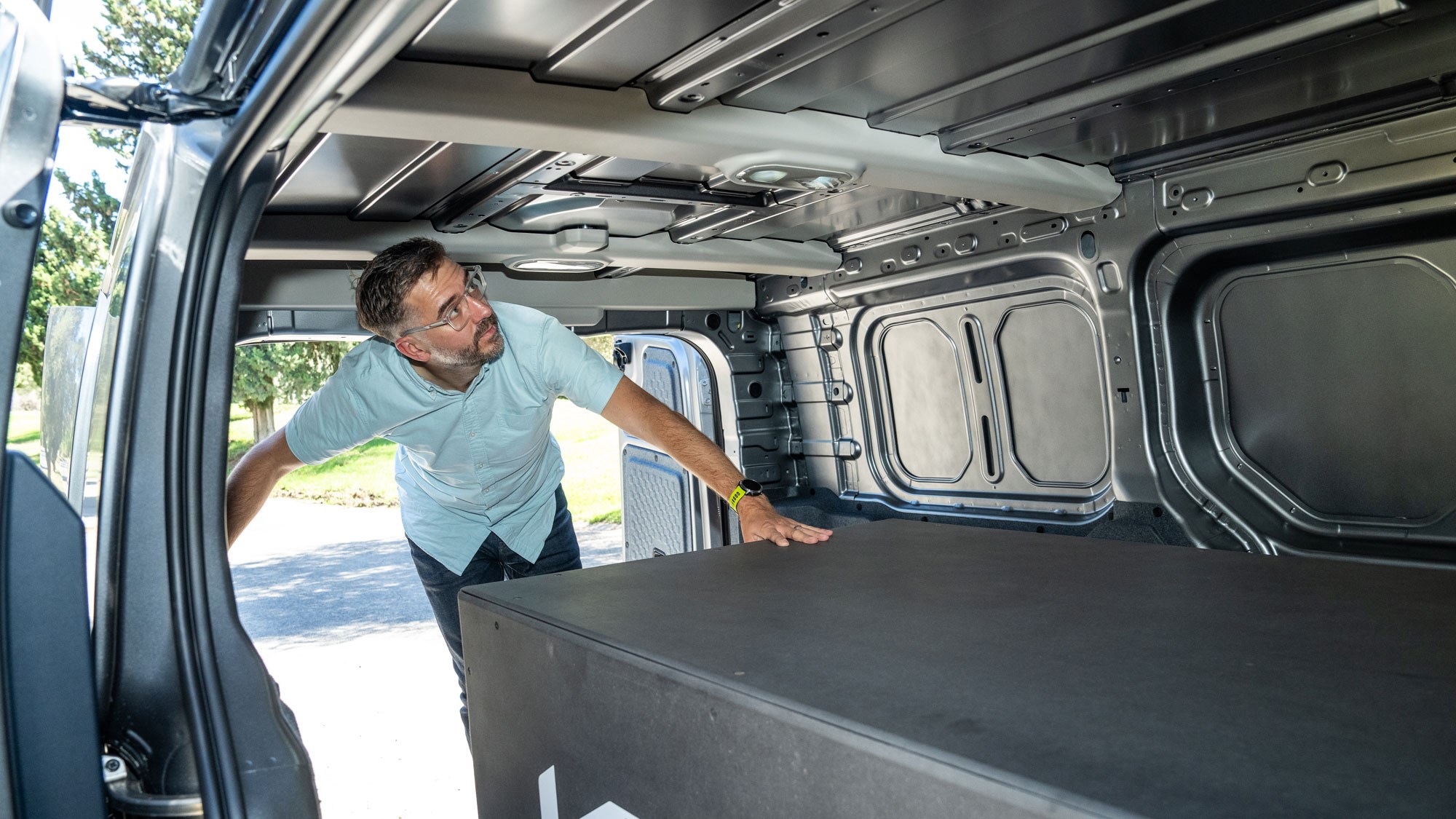
The loading bay is the other area that is a little quirky. Kia has openly said that it targeted having the lowest possible entry point at the side and rear doors, which is fantastic and helps with getting in and out of the back for all those deliveries. However, the rear loading point, at just 419mm high (the side one is even lower at 399mm) is below the top of the suspension assembly, meaning that there is a little incursion into the side of the cargo area. This extends to the back of the van, meaning there are two small encroachments into the doorway at the bottom corners.
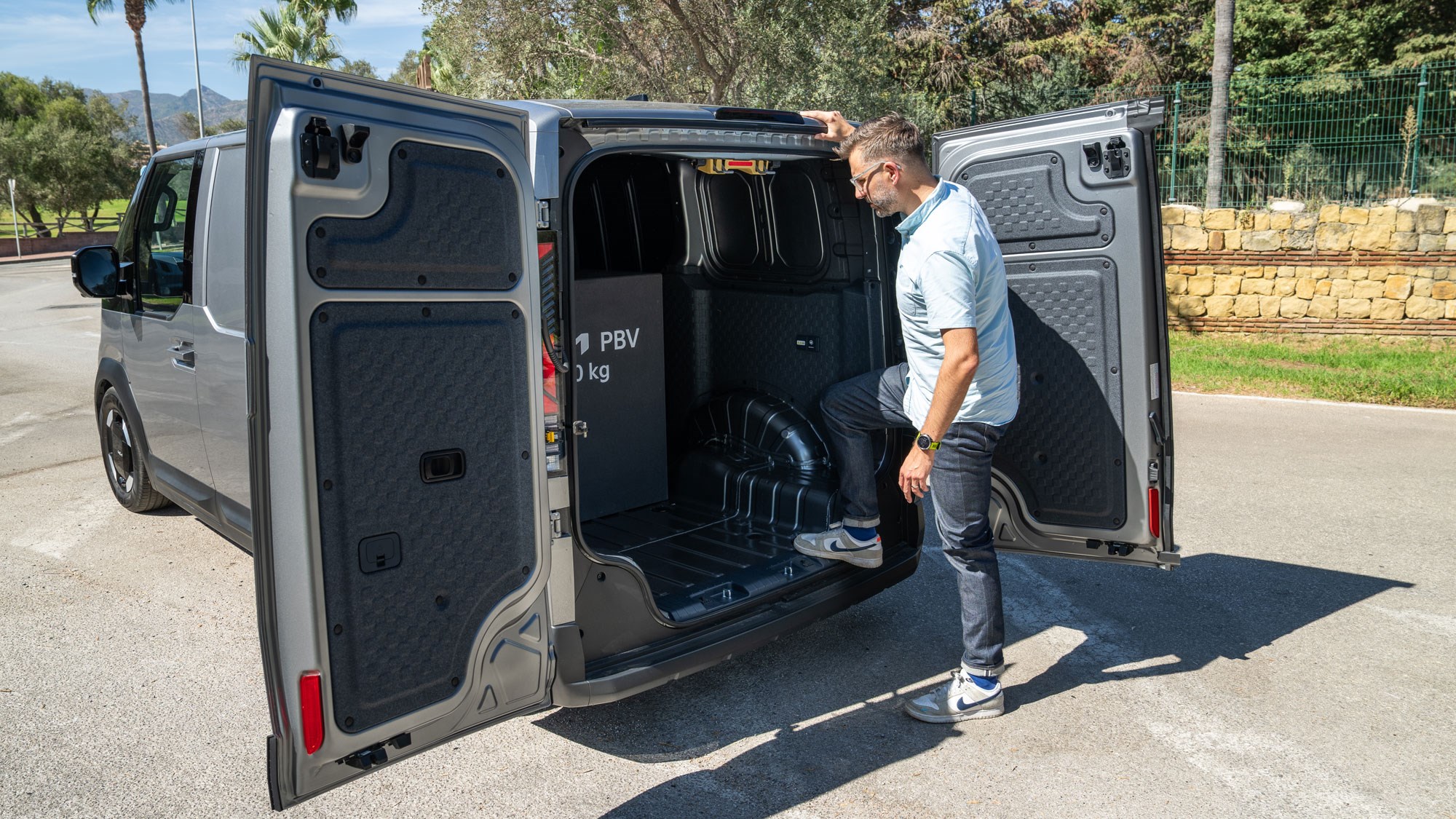
You can still load a Euro pallet in through the back doors, but only sideways in between the wheel arches, whereas a second can go closer to the front of the van. Only if you load it from the back, though – the side door isn’t wide enough to get it in and out.
The floor issue can be got around by adding a raised flat base, but this obviously has an impact on the loading bay height. If you don’t carry large and square shaped loads, then this is unlikely to be a problem, and many will fit some form of racking anyway, rendering all this irrelevant.
Payload is ok, and pretty much par for the class, ranging as it does from 665kg for the long-range version with the extra side loading door up to 790kg for the standard range three door.
There is a good level of technological and safety kit on the PV5, with a 12.9-inch infotainment screen that has an Android Auto-based operating system with its own navigation. There is also the ability to keep tabs on your van, including its location, battery status, energy usage and driver behaviour – handy if you are investing in a small fleet of PV5s. There’s also the usual Apple Carplay and Android Auto phone mirroring.
Elsewhere you can get vehicle-to-load tech on the higher Plus trim, which allows you to plug in tools while out and about. Handy if you are planning on converting it to a coffee van or similar too.
The safety tech is something that vans have been forced to up their game on in recent years, thanks to stricter legislation, but there are still choices to be made. Kia has opted to not pack the PV5 with kit, which means it is likely to get a four-star Euro NCAP rating rather than the maximum five. Still, it comes with a range of the usual systems, although you have to upgrade to the higher trim to get rear cross traffic avoidance, blind spot collision avoidance and safe exit warning.
The warning sounds are not too intrusive, but Kia has included the feature that allows you to turn off the speed limit warning bongs by holding down the volume button for several seconds should you so wish.
Before you buy
I alluded to this earlier, but the Kia PV5 is stonkingly good value. It benefits from that slightly heavier build, as weighing more than 2500kg means it qualifies for the full £5000 government plug-in grant, which is set to remain in place until the end of the 2026/27 tax year at least.
This means that its already punchy starting prices can be brought down even further. Its starting price of £27,645 (not including VAT) is pretty low anyway, but that makes it even more attractive. We’d go for the long-range model, which adds £2500 to the pre-grant price, but there is enough kit on the Essential model to not worry about the higher Plus trim too much, although it only adds £910 to the price.
The Essential comes with kit including heated and powered door mirrors, automatic wipers, driver’s armrest, keyless entry and start, under-seat trays, 12.9-inch colour touchscreen, wireless Apple Carplay and Android Auto and two USB-C ports. Plus then adds electrically folding door mirrors, heated and cooled seats, vehicle-to-load power and wireless phone charging. There are few options of note, other than a heat pump which can only be added to the Plus trim.
That pricing is what really makes the Kia PV5 stand out in its class – the Volkswagen ID.Buzz Cargo starts at just over £35,000 (again before VAT and the grant) so is notably more expensive. It’s also cheaper than electric rivals from the likes of Renault and Citroen etc, despite being larger and newer. It’s a fantastic way to make a huge splash in a class that really does put value above many other attributes.
Verdict
It’s incredibly hard not to recommend the Kia PV5 on its price alone, but thankfully the rest of it backs up its eye-catching numbers. It’s great to drive, has a brilliant cabin and it is smooth and comfortable but all of that is trumped by the fact that you can buy one for less than a smaller, older, diesel rival like the Citroen Berlingo. And you get a longer and more comprehensive warranty. Price parity for EVs is one thing, but to actively undercut the competition with a package like the PV5 goes far beyond that and should be great reassurance to a sector of the industry that is doing its utmost to play catch up as far as sales are concerned. The other electric van makers should be getting their calculators out.