► Ford’s mega Mustang driven in California
► 5.2-litre supercharged V8 with 815bhp
► Is it a true rival for the 911 GT3 RS?
The Ford Mustang GTD is not your usual Ford Mustang. It might wear the famous badge, but it’s built 200+ miles away from Flat Rock in Canada. And while the tried-and-tested front-engine V8, rear-wheel drive format remains, the GTD promises to be far more than a muscle car.
For example, what muscle car can lap the Nördschleife in just 6 minutes and 52 seconds – a mere three seconds off the latest Porsche 911 GT3 RS? This one can and it’s evidence that, despite recent evidence to the contrary, Ford’s performance car days aren’t over just yet.
The Mustang GTD is the fastest, most outrageous, most expensive Mustang ever produced by the Blue Oval and it represents a genuine effort by the North American giant to take on the likes of Porsche and Aston Martin at building a track-focused super sports car.
Have Ford succeeded? We travelled to Palm Springs, California for a road and track drive in the GTD to find out.
At a glance
Pros: Brilliant V8 engine, super-clever suspension, looks the part
Cons: Cabin is underwhelming, nearly two tonnes, LHD only
What’s new?
The Mustang GTD starts its life on the same production line as other Mustangs in Flat Rock, Michigan. However, come the body-in-white stage, it’s hooked aside and sent to Multimatic’s facility in Markham, Ontario.
A controversial move – building a Mustang in Canada – but Multimatic have pedigree. They made the last Ford GT for one, so they were the obvious choice when it came to the manufacturing of the GTD.
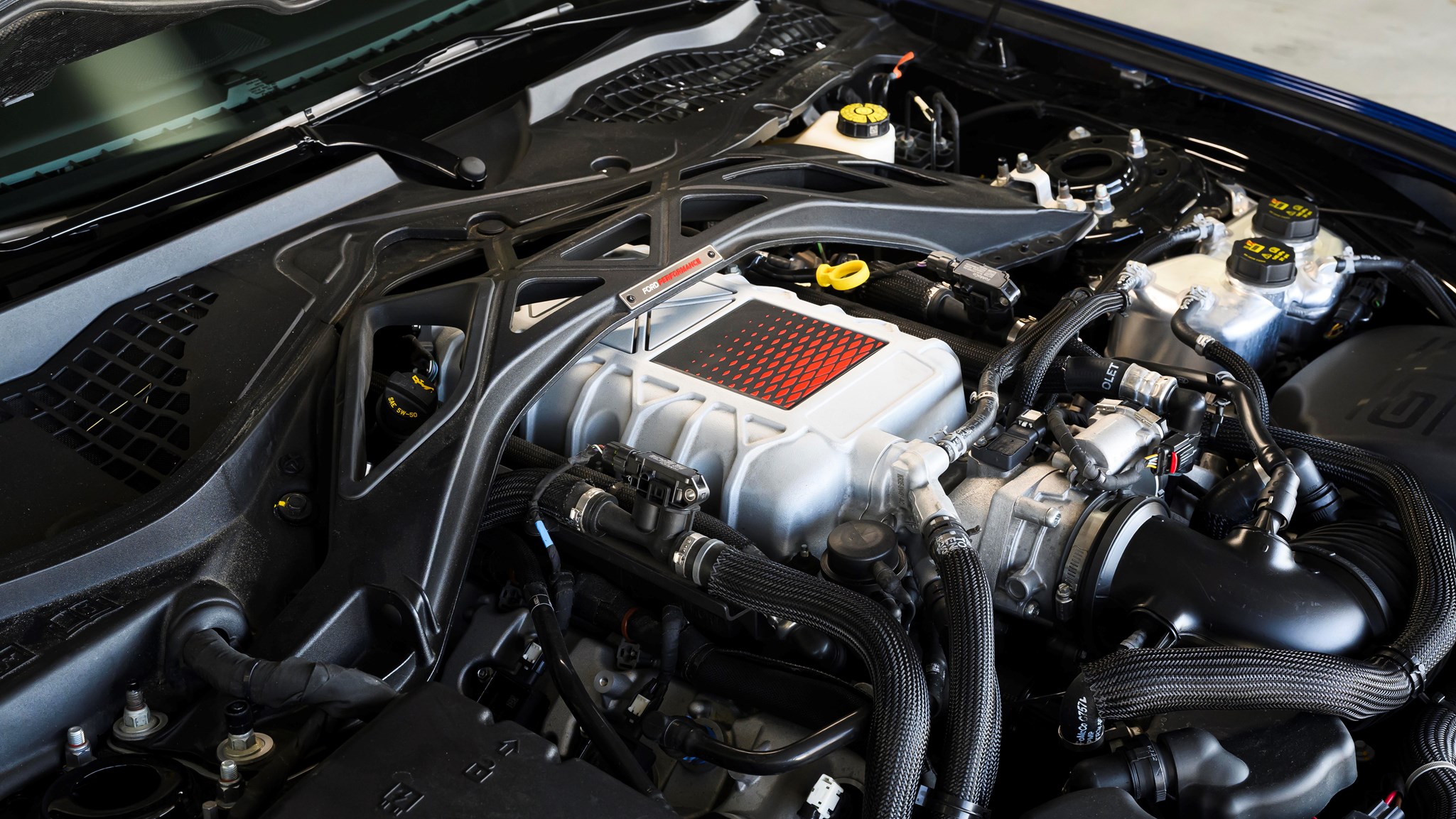
The ingredients, too, are mouth-watering. The 5.2-litre supercharged engine comes from the Shelby GT500 but gets a bigger airbox, tweaked forced induction and a dry sump.
There’s also a brand-new eight-speed dual-clutch gearbox from Tremec attached to the rear of the engine in a transaxle configuration. It contributes to a perfect 50:50 weight distribution and promises far crisper gearchanges than any Mustang auto ‘box before it.
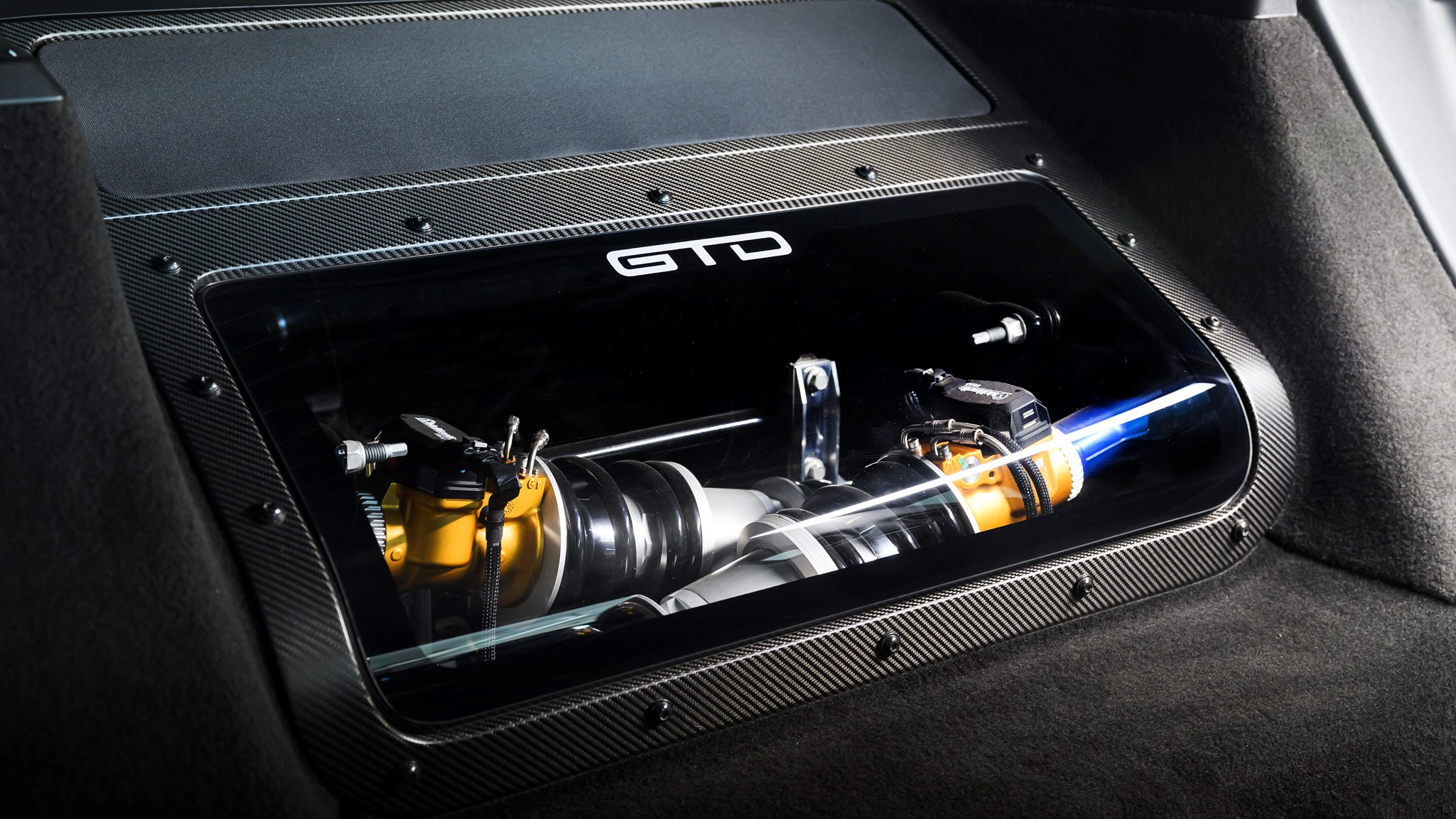
It’s not the only thing that’s new at the rear end. Inboard Multimatic adaptive spool valve shock absorbers sit inboard within a new rear subframe and deliver semi-active suspension tech that allows two crucial tricks.
First, hydraulic compression can double the spring rate on the second spring (each damper has two) to tighten body control, while a ride height drop of 40mm at the front and 30mm at the rear can also be employed for track use. Given the harsh penalties for minor ride height infringements in most types of motorsport, you can appreciate how much of a difference a significant drop should make to how the car drives.
An electronic LSD helps meter out the power (it’s rear-wheel drive only, no fancy all-wheel drive systems here), as does standard-fit Michelin Pilot Sport Cup 2 R tyres. They’re the only ones available with the GTD and when you see the size of the front rubber – 325/30/R20 – it’s not hard to understand why.
Built specifically for the GTD, Michelin reckons the tyres are the largest it’s ever fitted to the front of a sports car. When Ford approached the French company, the conversation wasn’t the usual ‘this is what we need, please make it’, it was ‘this is what we want to create, how big does the tyre need to be?’.
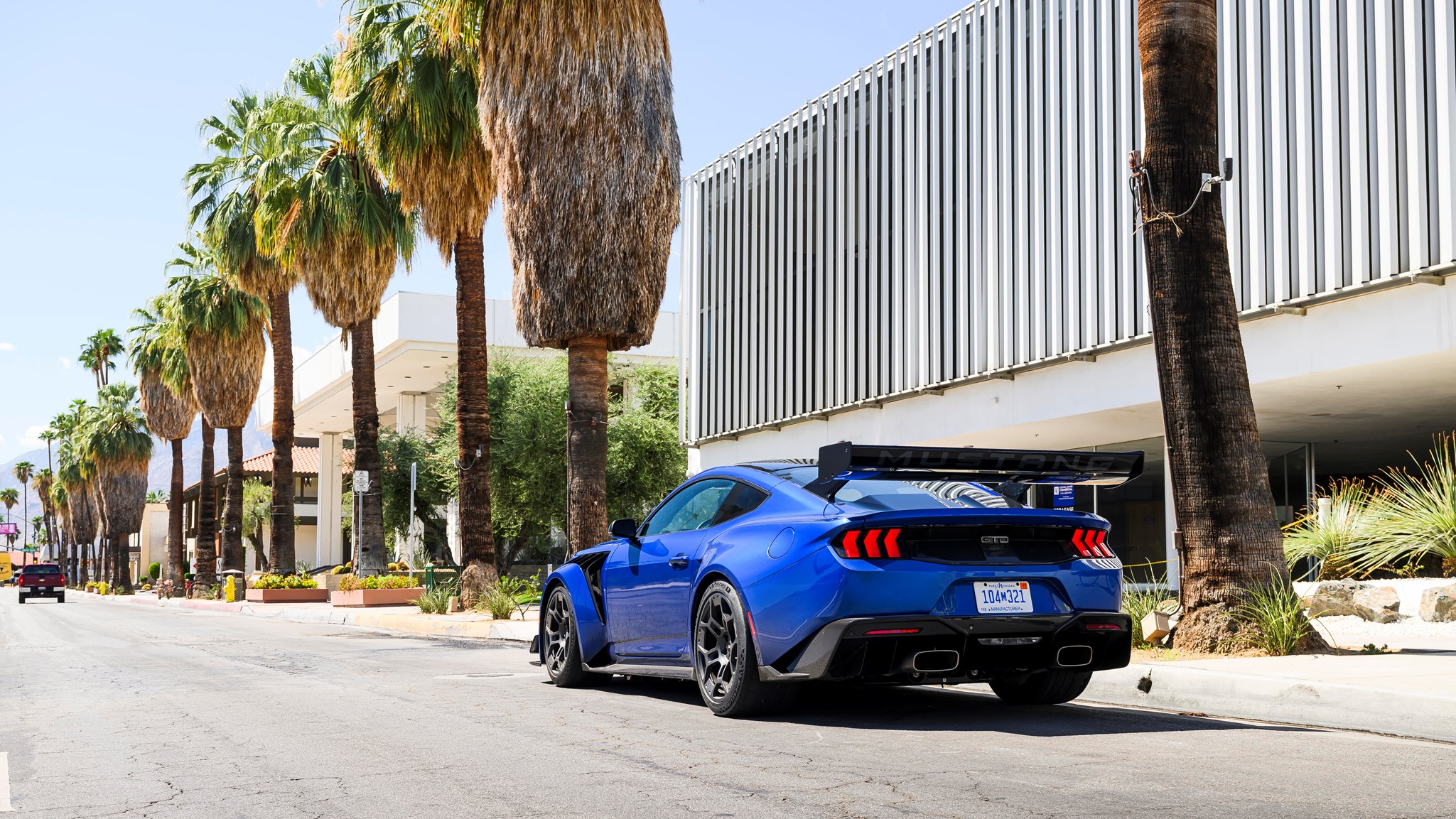
This enormous rubber width means the whole car is a whopping 164mm wider than a regular Mustang, with flared arches and giant louvres and cut-outs showing the GTD’s intent. Active aero – from the huge rear spoiler and two hidden underbody flaps at the front – is another surprise in the armoury with the GTD able to deliver 885kg of downforce at 180mph. For context, a 911 GT3 RS makes 860kg at 177mph…
What are the specs?
The downforce figure above is impressive, but it’s only the start of it. The 5.0-litre V8 engine makes 815bhp at 7400rpm and 664lb ft of torque from 4800rpm. Ford refuses to quote a 0-62mph time but estimates suggest 3.5 seconds. Top speed is claimed to be 202mph.
If you’re wondering why Ford are staying tight-lipped on the acceleration times, it’s likely because there’s two key aspects of the car that mean 0-62mph sprints might be a little slower than comparatively powerful rivals. There’s the obvious RWD element (putting down 800+bhp through two wheels is rarely easy), but also the weight.
Ford quotes the GTD at 1,989kg. That’s getting on for half-a-tonne more than the 911 GT3 RS. Yes, it’s got a lot more power but because of that hefty kerb weight the power-to-weight advantage is narrowed to under 60bhp.
Oh, and it’s not cheap, either. If you were thinking that the blue-collar, muscle-car roots of the Mustang would mean Mustang pricing then you’d be wrong. Given all the tech and development that’s gone into the car, the GTD is expected to be priced from £315k when it comes to the UK in 2026.
How does it drive?
We drove an American spec GTD in the USA, so the engine (and the sound it makes) may come across a little different in Europe. But believe me, the noise from the V8 – even on start-up and at low speed – is spectacular.
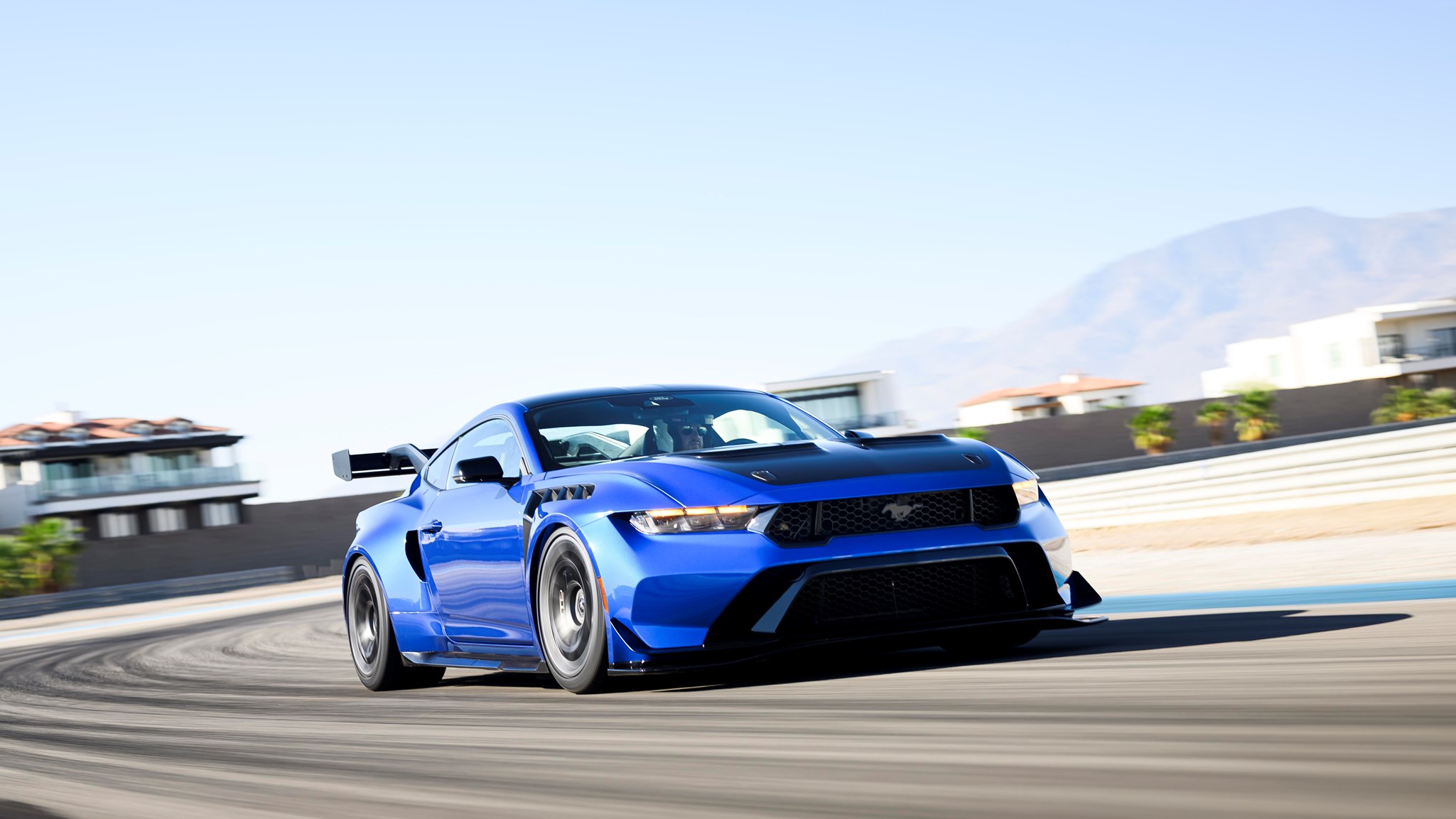
It’s so brilliantly different to the high-pitched screams of European rivals yet it’s easily one of the best-sounding cars on sale today. Deep, rich and filled with aggression, the noise is one of the first things that strikes you when driving the GTD.
The next thing you’ll likely notice is how easy and civilised this track-focused thoroughbred is when you’re driving at normal speeds. There’s several drive modes but Normal, Sport and Track are the ones you should care most about. Normal (with the suspension dialled back to its softest setting and gearbox in full slush mode) is surprisingly relaxing.
In this respect, the GTD remains a proper Mustang. The ride and refinement is such that you could, quite easily, cover big miles just cruising in a straight line enjoying the burble of the V8. Potential owners won’t care about the fuel economy, but sufficed to say it drinks like you’d imagine with 10mpg about as much as I saw.
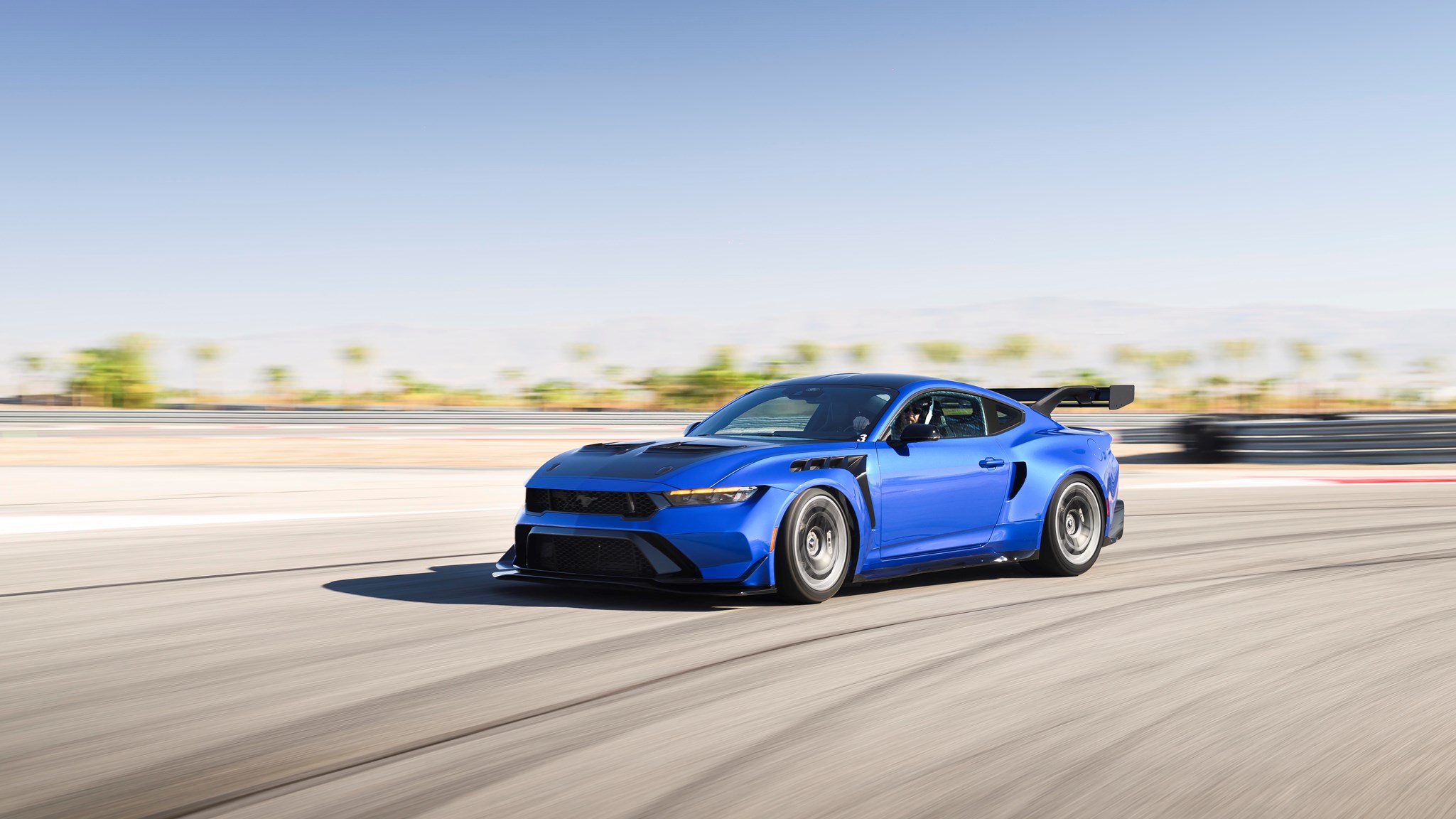
A lot of our road driving in the GTD took place in the rain and it did highlight a flaw in its usability. Whereas the 911 GT3 RS is available with tyres that are capable in both dry and wet conditions, the Cup 2 Rs on the GTD naturally struggle when the heavens open. That said, it’s far more approachable than any 800bhp+ rear-wheel drive car has any right to be.
On track (and in dry weather) we were limited in how much we could explore the GTD’s potential. For unforeseen reasons beyond our control, we were unable to try the GTD in Track mode which, given the ride-height drop and spring rate changes, would likely have made a significant difference.
However, we were able to glean impressions about the general balance and engine – both of which were exceptional. There’s no shortage of reasons as to why manufacturers are moving towards hybrid or turbos (or both) for high-performance cars, but the GTD’s 5.2-litre supercharged V8 shows what they’re missing.
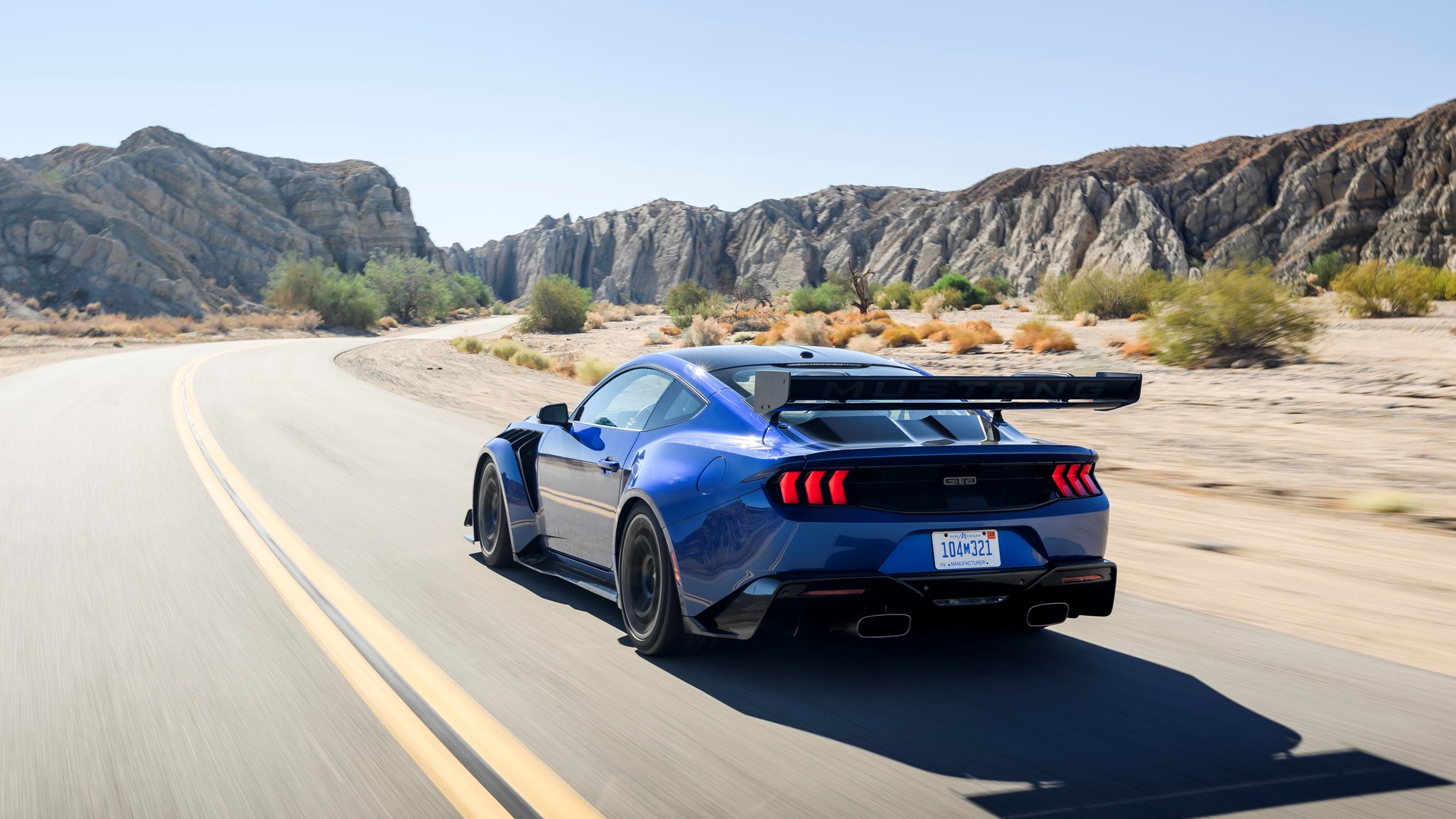
It feels naturally aspirated in both its linearity and response, but there’s an added element that’s boosting the power throughout most of the rev range. The speed is bombastic, but it’s the useability and raw sound of the powertrain that stands out. Praise also needs to be heaped on the Tremec gearbox. Changes are slick and timely with the accompanying rev match deeply satisfying. It is perhaps not quite as gunshot fast as the best PDK, but the shortfall – if any – is tiny.
Coming into medium speed corners, shifting down to third before entry, the GTD broad front tyres dig in quickly but – at least in Sport mode – there’s a slight pause before everything is set and ready for the exit. Clearly, part of this is down to the drive mode, but ultimately the near two-tonne kerb weight is – while well controlled – still likely to make itself known under provocation.
Braking power is impressive and pedal feel is decent, but the meaty steering – while in-line with the character of the car – is ultimately lacking the last level of detail that is so valuable on track. That doesn’t harm the levels of general approachability, however, with the GTD feeling like the sort of well-balanced track car that rarely highlights any sloppy inputs in a way that the sharper, leaner 911 GT3 RS would.
What’s it like inside?
The differences from a regular Mustang aren’t as great as you might expect given the £315k price tag. Revised trim, extra buttons on the flat-bottom wheel and titanium gearshift paddles made from old F-22 fighter jets are the headlines, but broadly speaking it does have the honed, specialised feel you might be hoping for. Granted, it’s a blue-collar Mustang – not a Ferrari – but the price tag leads you to expect more.
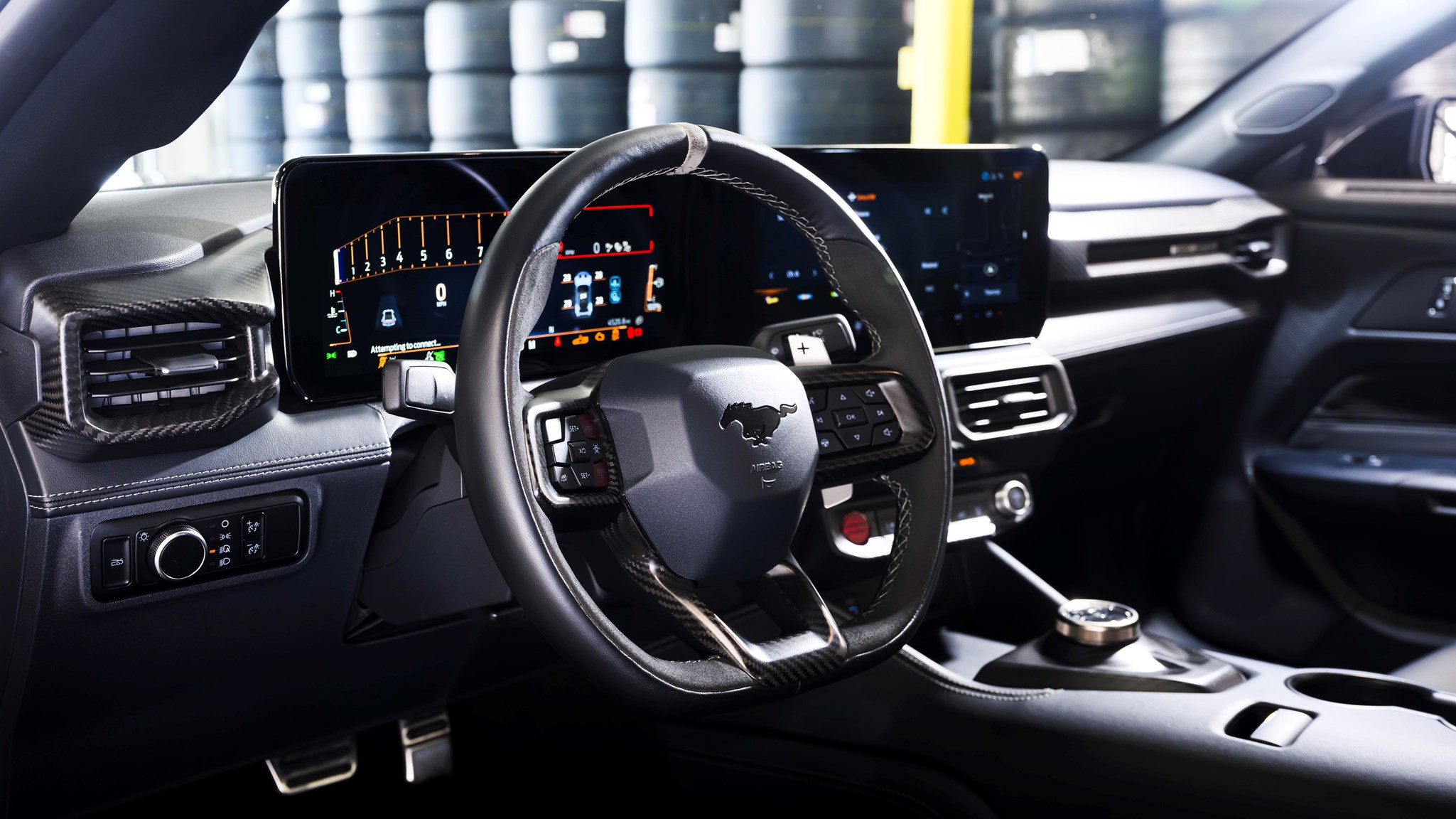
The rear seats are noticeable by their absence (the GTD is a strict two-seater), while the front seats are made by Recaro. Again, fairly wide and not heavily bolstered, they’re far removed from the carbon bucket items you might expect but it’s hard to deny that they’re comfortable and easy to get in and out of for everyday use.
Before you buy
The only thing that’s really worth considering before buying a Mustang GTD is whether or not to go for the optional Performance Pack. The answer should, naturally, be a strong ‘yes’ as it includes the aforementioned active aero tech, front dive planes + larger splitter, as well as 20-inch Magnesium wheels.
Verdict: Ford Mustang GTD
Our time with the Mustang GTD was ultimately compromised by the weather and other factors beyond our control. Not being able to utilise Track mode, especially, was a shame and meant we were unable to experience the settings that ultimately delivered that hugely impressive Nürburgring lap time.
The GTD is, however, far from one-dimensional in its abilities. The track focus is clear (not least from the choice of tyre), but the comfortable Recaro seats and exemplary everyday driving manners mean that what’s underneath the broad, active aero-clad bodyshell is still, at heart, a Mustang. And it’s all the better for it.
On our California test route it was hugely enjoyable, bristling with character yet still easy to drive. Whereas cruising in a straight line or rounding corners at 70% speed in a 911 GT3 RS feels like a waste of potential, the GTD takes it in its stride. And yet it requires a mere prod of a button to properly awaken the astonishing engine and tap into what it is a friendly, enjoyable yet hugely capable chassis.
We’ll have to wait for another opportunity to truly discover what it can do on track, but everything we’ve seen thus far points to exceptional ultimate ability, but perhaps not the raw tactility or feel of the Porsche that Ford itself references the GTD against. That they’ve been able to get within shooting distance first time out is a huge achievement in itself and indeed some may prefer the GTD’s character spread of abilities. It’s not perfect, but it absolutely is everything you could possibly want from the ultimate Mustang.