► Another great EV from Hyundai
► Spacious and mostly luxurious
► Starting from £64,995
Remember the Hyundai X300? Of course you don’t. Introduced in 2000, it was a big, soft, V6-powered ‘luxury’ car from a brand selling cut-price alternatives to mainstream motors, and it tanked.
Wind forward 25 years and the luxury-packed Hyundai Ioniq 9 is no longer a flagship of folly. This five-metre long three-row SUV comes from a brand now known for bold design and some of the best EV tech on the market. Where most brands have fumbled electrification, Hyundai’s electric cars are better than its combustion ones.
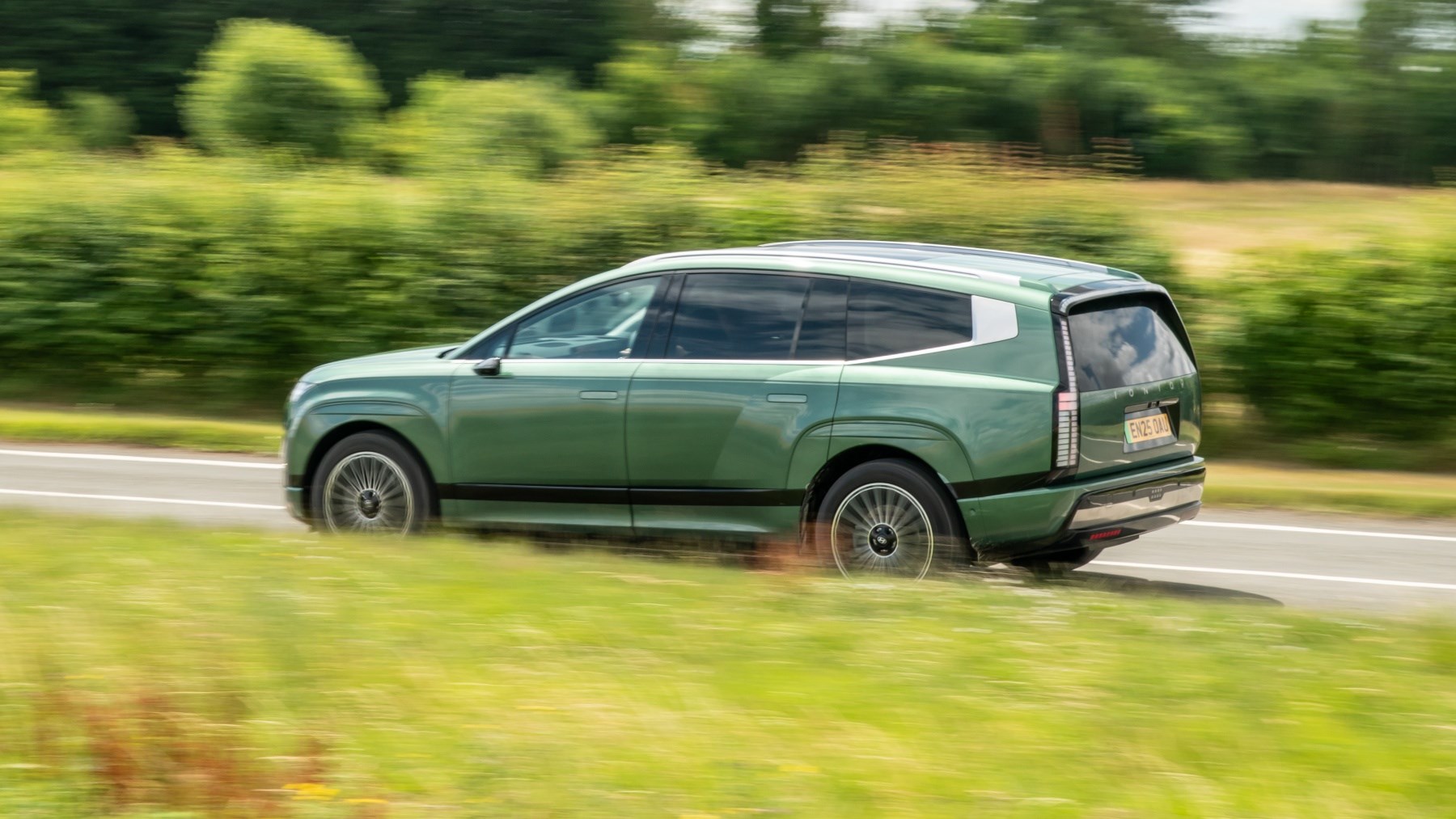
We already know the Ioniq 9 is good from a drive in Korea, but now we’ve experienced it in the UK. If you’re considering a Volvo EX90, Kia EV9 or VW ID.Buzz LWB, you might want to read this review first. If you want to know more about how we test, we’ve put together an explainer page.
At a glance
Pros: Cool, calm and comfortable; distinctive; hugely flexible interior, good range
Cons: Infotainment screen is busy; lots of lean in the bends
What’s new?
This is Hyundai’s latest Ioniq-branded car, with its number dictating that it’ll likely be the biggest one it makes. The original vision spawned from the Seven Concept – an early nod to this being called the Ioniq 7, before Hyundai’s team decided to nudge the number up to give the model range some space to breathe and allow for a wider range of future models.
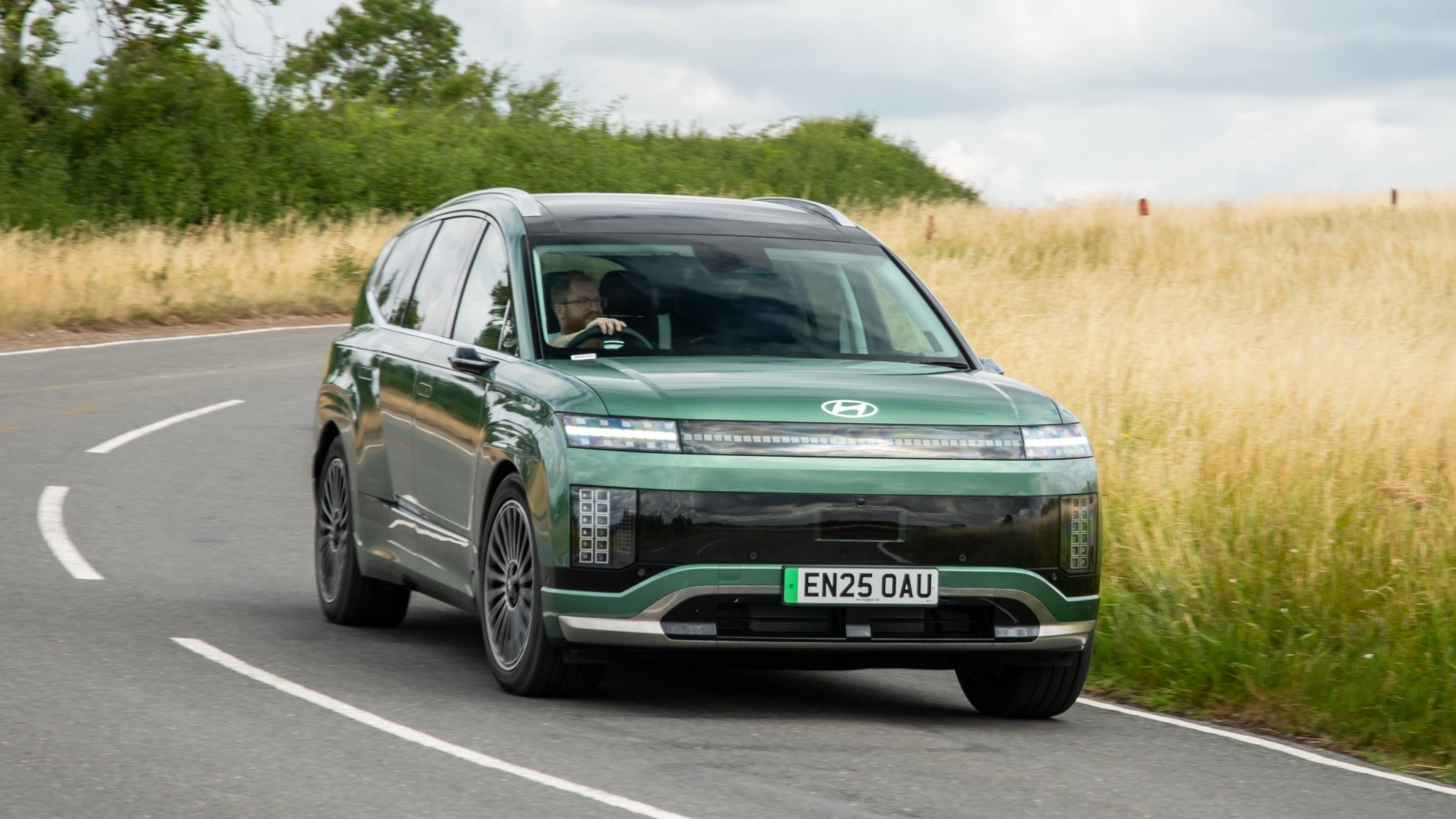
It still looks familiarly like an Ioniq car, mainly thanks to details like the ‘parametric pixel’ lighting designs front and rear. At the nose, the DRLs have a properly Space Invader-spec retro vibe and, when the rear brake lights are applied, there’s a neat single band of red light that wraps around the whole of the tailgate. It’s a look that may need a little time to absorb and feels colour dependent, but it looks distinctive and different in a sea of blob-ish cars of a similar size.
What are the specs?
The Ioniq 9 measures in at 5060mm in length, 1980mm in width and 1970mm tall. That makes it even longer than Kia’s EV9 – the Hyundai’s direct sibling – and the Volvo EX90. It’s all about the space inside, though, with Hyundai also says it has the longest wheelbase of any production car the brand has ever built, at 3170mm.
Hyundai has confirmed three specifications for the Ioniq 9, which have quite self-explanatory names. Every version features a huge 110.3kWh battery pack and, due to Hyundai’s E-GMP platform underneath, allows for up to 350kW of DC charging.
Long Range RWD
Power output: Single e-motor, 215bhp, 258lb ft
0-62mph: 9.4sec
Top speed: 124mph
WLTP combined range: 385 miles
Long Range AWD
Power output: Two e-motors, 309bhp, 446lb ft
0-62mph: 6.7sec
Top speed: 124mph
WLTP combined range: 376 miles
Performance AWD
Power output: Two e-motors, 429bhp, 516lb ft
0-62mph: 5.2sec
Top speed: 124mph
WLTP combined range: 372 miles
For now, these are the only variants confirmed, and we’ve only driven the flagship AWD Performance. Will there be a full-fat Ioniq 9 N? Simon Loasby, senior vice president and head of Hyundai design, says maybe; ‘we feel our brand can stretch that far,’ he tells me, ‘and I think the progression for N will be to tap into more sophistication with the performance, and here we have a car that is super sophisticated.’
The spec walk-up much is like the smaller Santa Fe – another Hyundai SUV we’re a big fan of. That means trims start at Premium rising to Ultimate and flagship Calligraphy – with increasingly sophisticated equipment on board. That said, we could see an Ioniq 9 N Line model, matching the Ioniq 5 and recently-revealed new Ioniq 6 N Line versions.
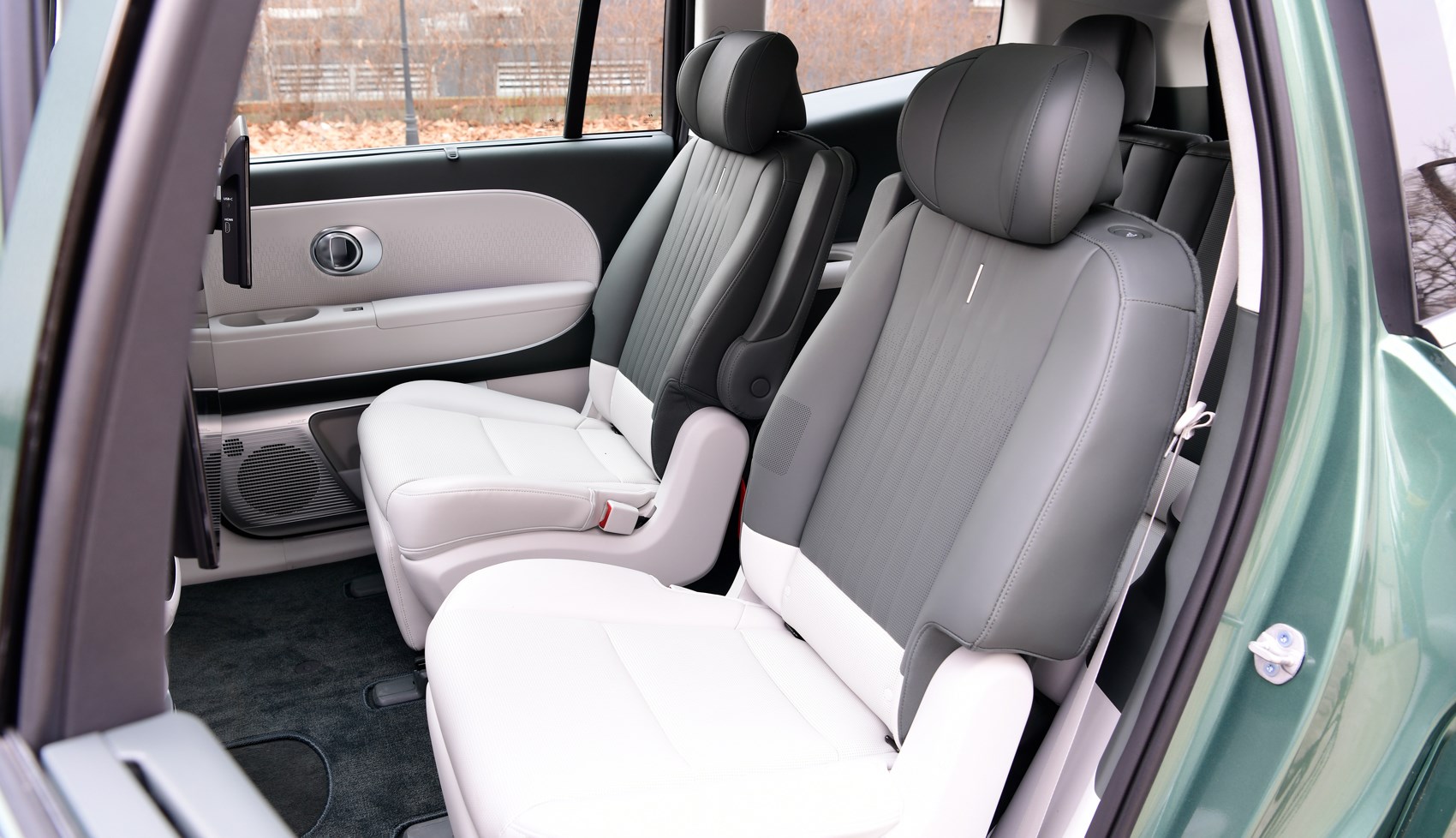
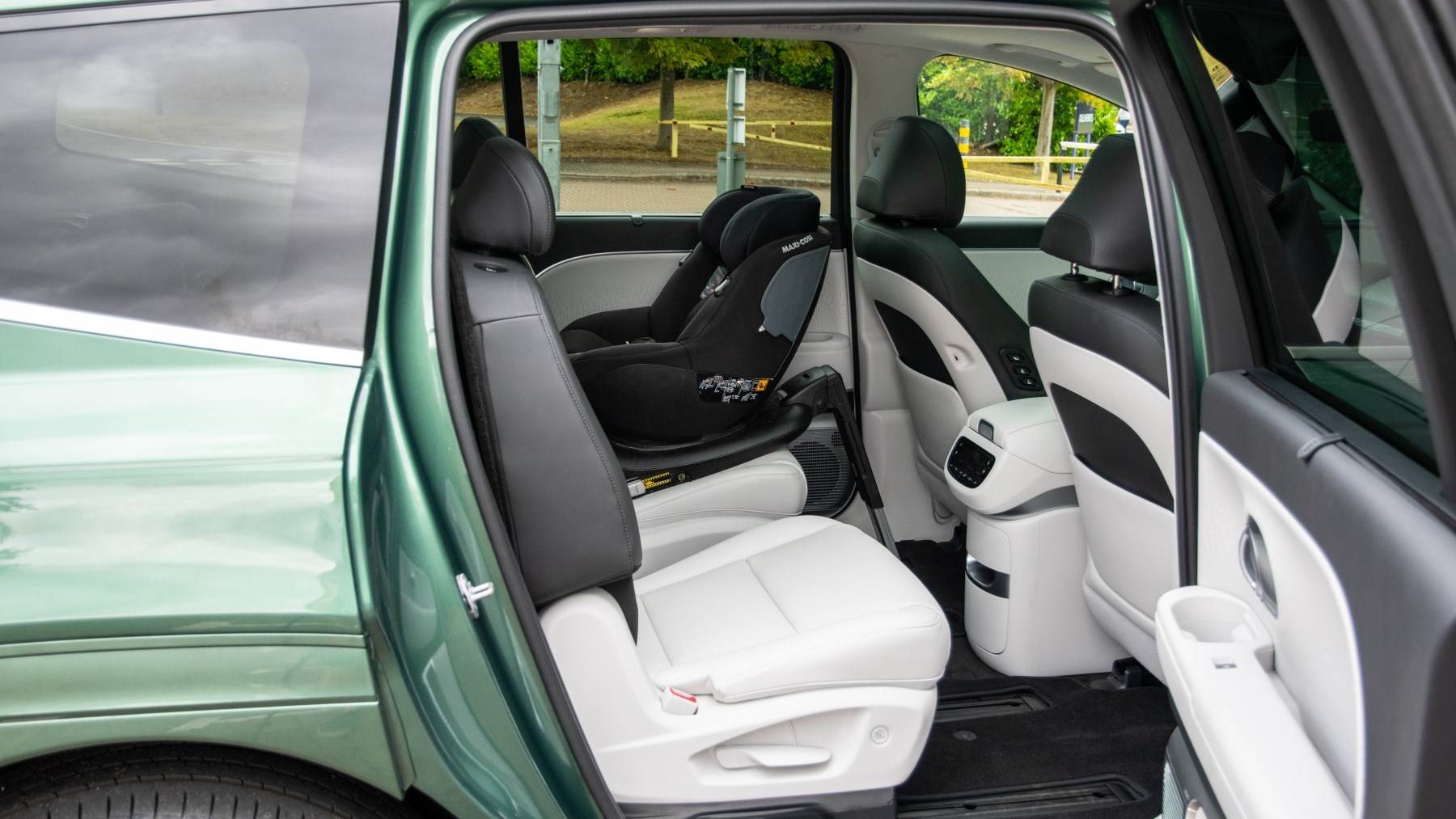
Besides that, you’ll be able to choose from a standard seven-seat SUV version and a six-seat model that chucks out the second row bench seat for two captain’s chairs.
What’s it like to drive?
Naturally, this isn’t a rorty i30 N from Hyundai; the Ioniq 9 is built to be a big, comfy cruiser – a squishy armchair with wheels that you can sink into and relax.
Overall, the ride quality is impressively well balanced. There’s a waft and plumpness to it that’s certainly reminiscent of a previous-gen Range Rover despite the 9 having regular coil springs and fixed dampers instead of air and adaptive.
However, it also struggles with sharp road imperfections like the old Rangey. Driving over a deep rut or manhole cover? Yes, the car will jolt despite the 21-inch wheels getting huge sidewalls, but at cruising speed on the motorway or on slower roads with dimpled imperfections, the Ioniq 9 manages to smooth over many of those without much interruption.
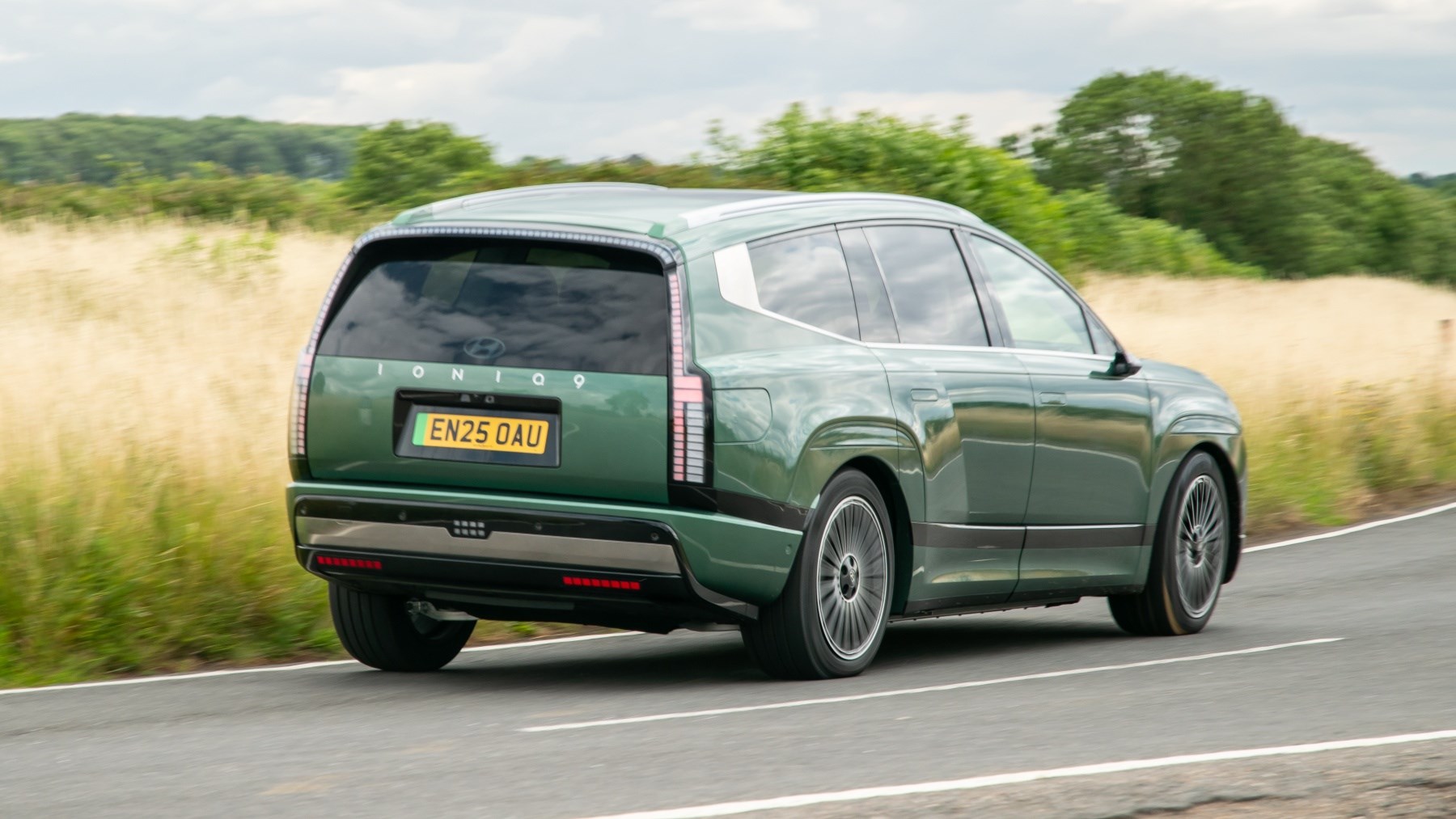
We wouldn’t mind if the 9 had a smidge less body roll but, again, this is a big car with a lot of weight to manage and no clever suspension to prop it up. By comparison, a Kia EV9 (particularly in GT Line spec) feels crashy and jittery more of the time when you’re behind the wheel, where the 9 would only feel moderately fidgety. A BMW X7 or Mercedes GLS would be comfier still, though.
Get past the body lean and you’ll find the 9 has plenty of grip and a safe, secure handling balance. ESC off is not an option here. Performance models get the same amount of power on both the front and rear axles, with lesser Long Range AWD receiving a less powerful front motor. In theory, the rear bias could make for more entertaining handling, although the stability control will stop any shenanigans.
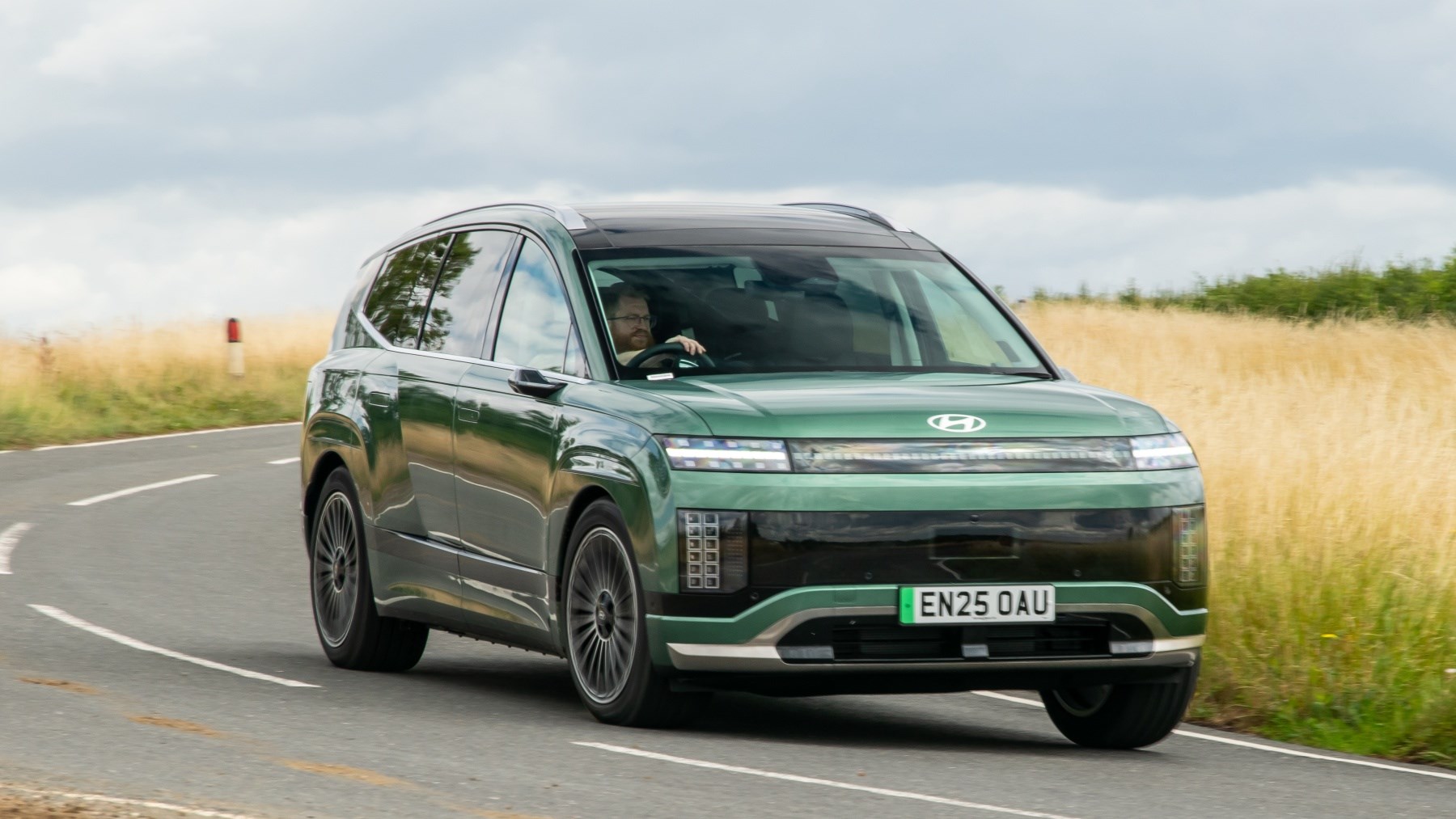
It certainly feels like some improvements have been made over the prototype we drove in the California desert in late 2024. There, we grumbled that the steering had a bit of a dead-spot at the centre but here, in this production model, it appears to have been tightened up. It’s not twitchy or over-alert, but there feels like more clarity in your inputs than there was before.
And, of course, the amount of power from this top-spec AWD Performance model is plentiful. There is a bit too much of a delay between the accelerator pedal hitting the mat and full power being released in Normal drive mode, and there’s still a little one in Sport mode that frustrates. That’s about our only complaint, with smooth, linear and forceful acceleration after that. Frankly, this model is a little much, to the point we’d suggest just sticking with the Long Range AWD model instead – it’s still got plenty of power, but can achieve an even better range and we’d argue wouldn’t overwhelm the physical brakes so much in extreme circumstances.
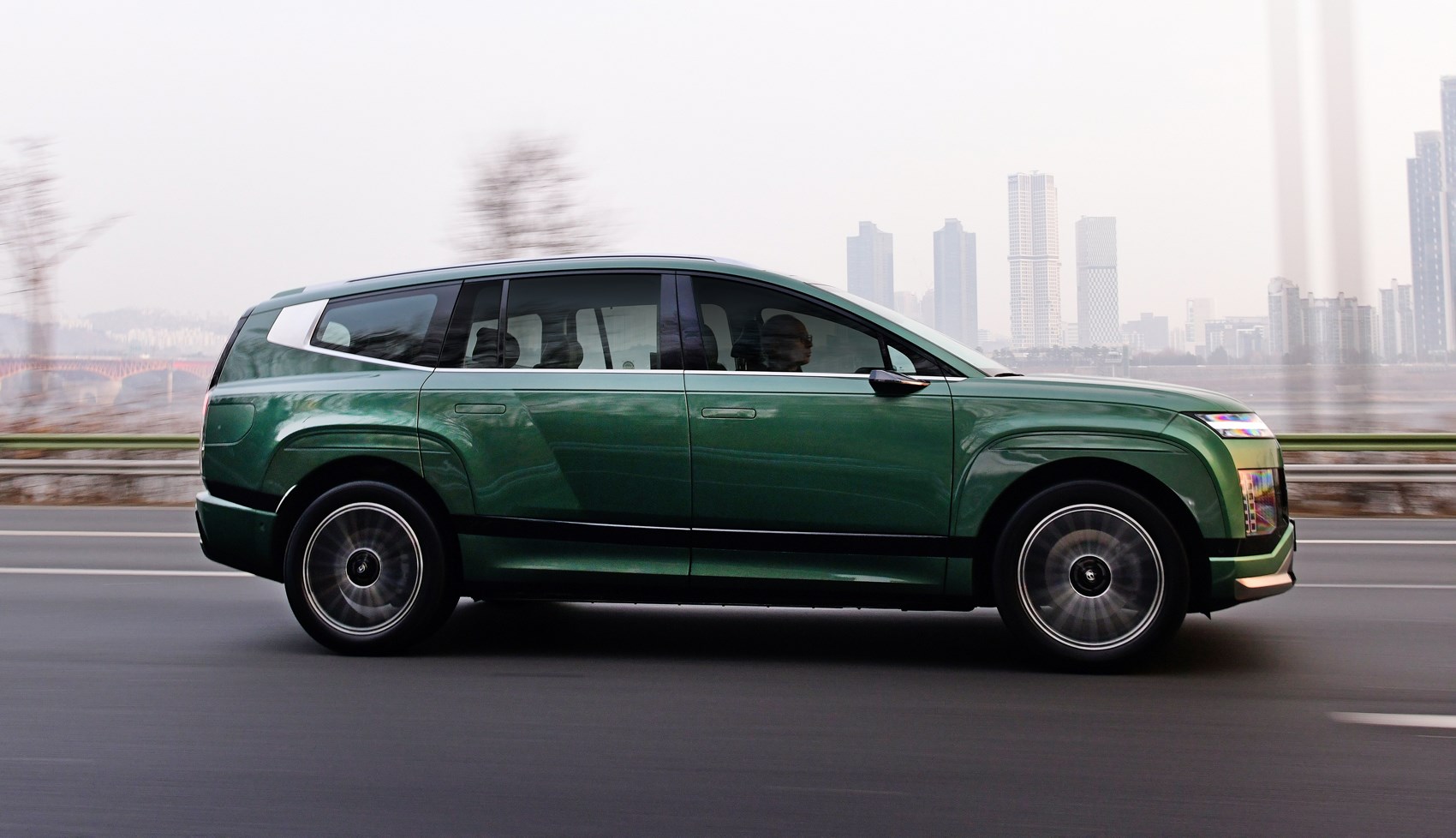
At speed, rolling refinement is impressive, with only roughly surfaced roads drumming up particularly notable tyre roar. Wind roar on our camera mirror equipped test car was low for a chunky SUV and the motors were subdued. You can happily hold a conversation at high speed without having to raise your voice.
It’s not a car that’s going to be a thrill ride, but it’s not designed to be one either. If anything, the Ioniq 9 will lower your heart rate – not raise it.
What’s the interior like?
Quite possibly the Ioniq 9’s party piece, given the immense flexibility built in. Plenty of thought has been put into the interior, with a great mix of physical switchgear and digital tech.
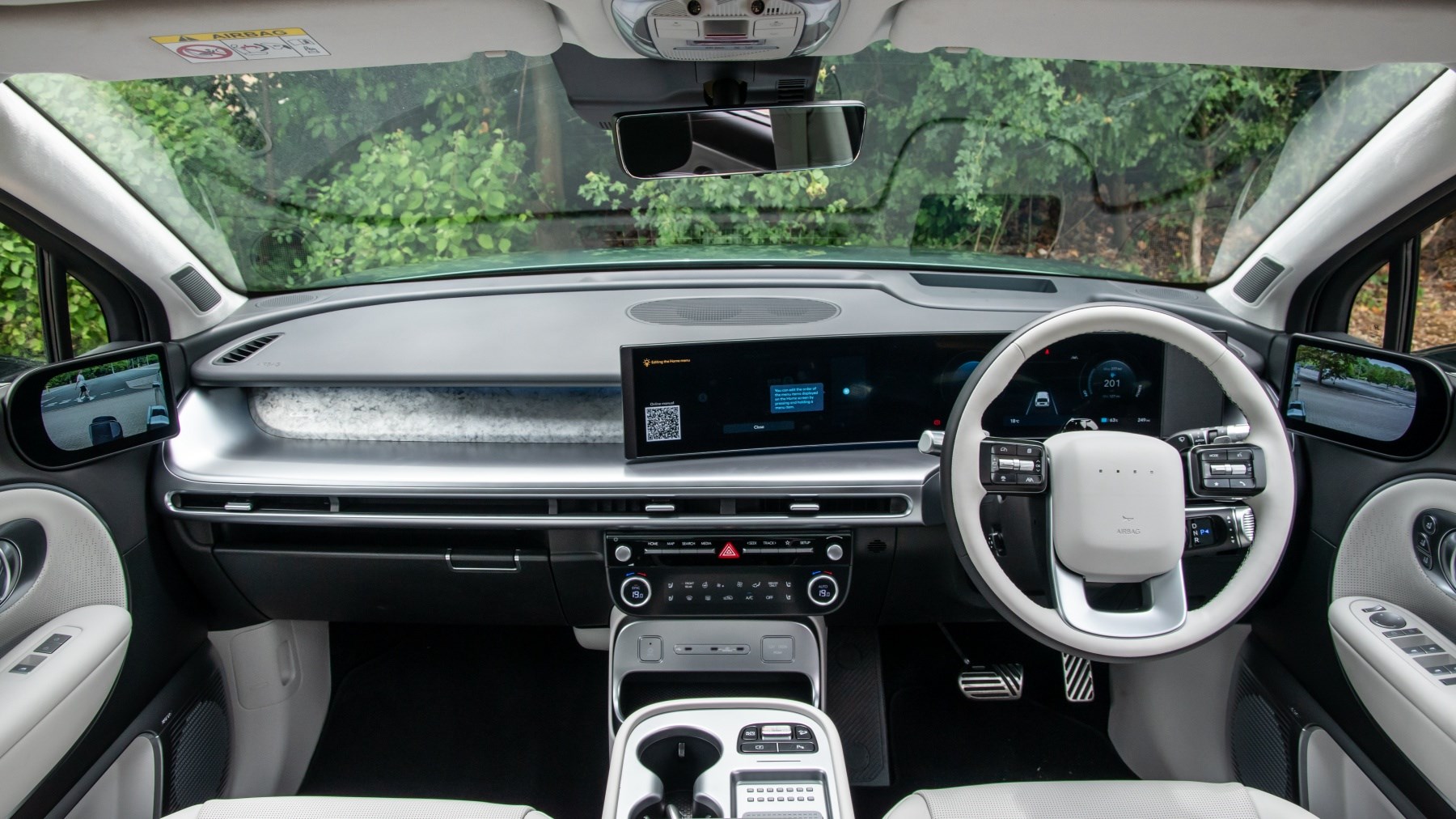
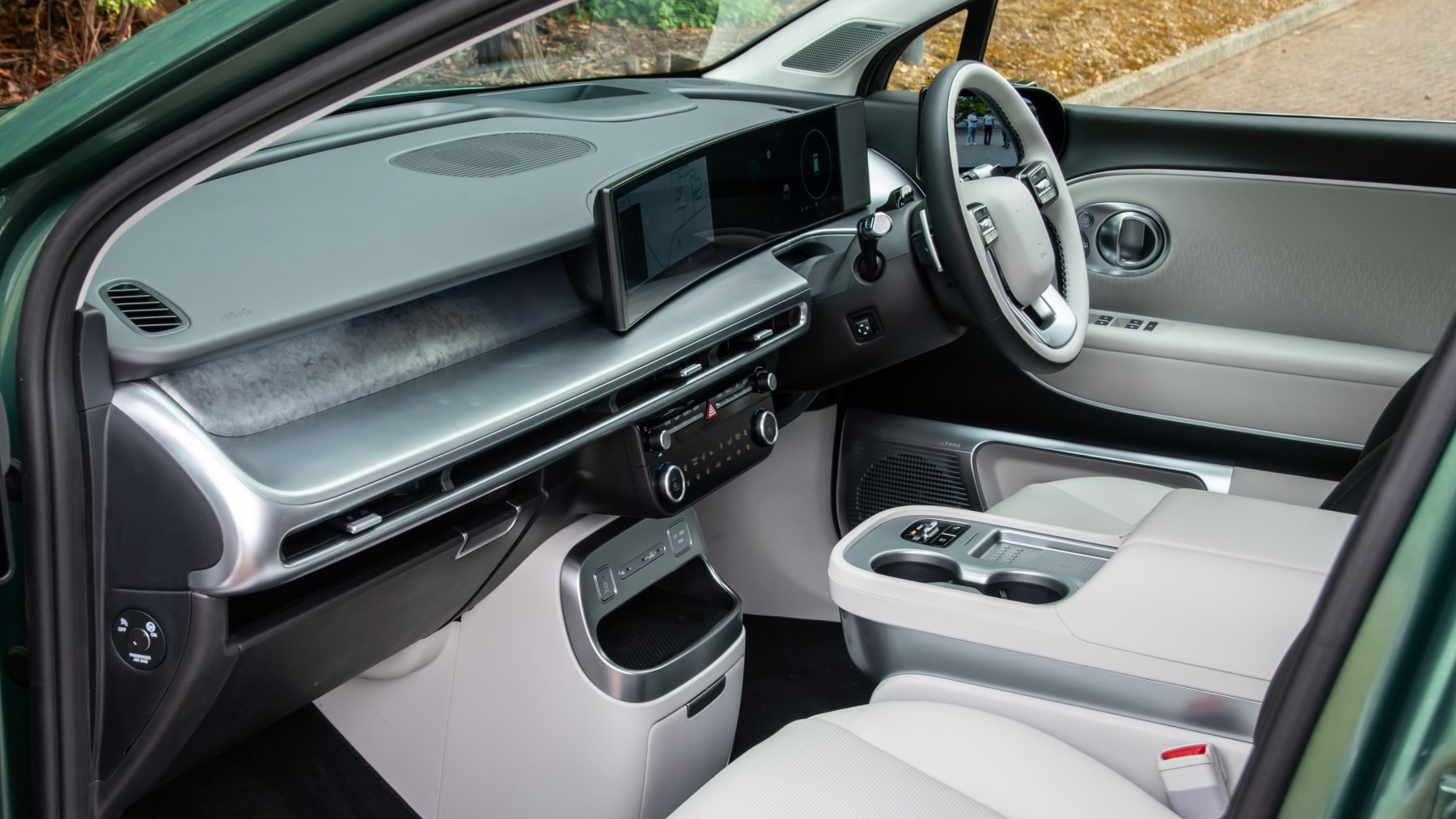
The dashboard itself has a single, wide and curved panel mounted on it that includes both the drivers’ instruments and central infotainment display. Welcome menu buttons and climate dials rest below for you to help navigate the displays, but the system is quite menu-heavy and not the easiest to navigate.
Most of the cabin trim feels solid and soft touch, with only those silvery bits on the dashboard feeling a bit tinny. The biggest disappointment is the choice of interior door handle. Silver painted plastic just doesn’t feel as good as metal. Below the climate controls you have storage areas and, in Calligraphy trim, you even get a UV light storage area that’s supposedly meant to decontaminate your phone. Vehicle-to-load will also be available, allowing you to power pretty much anything with a three-pin plug.
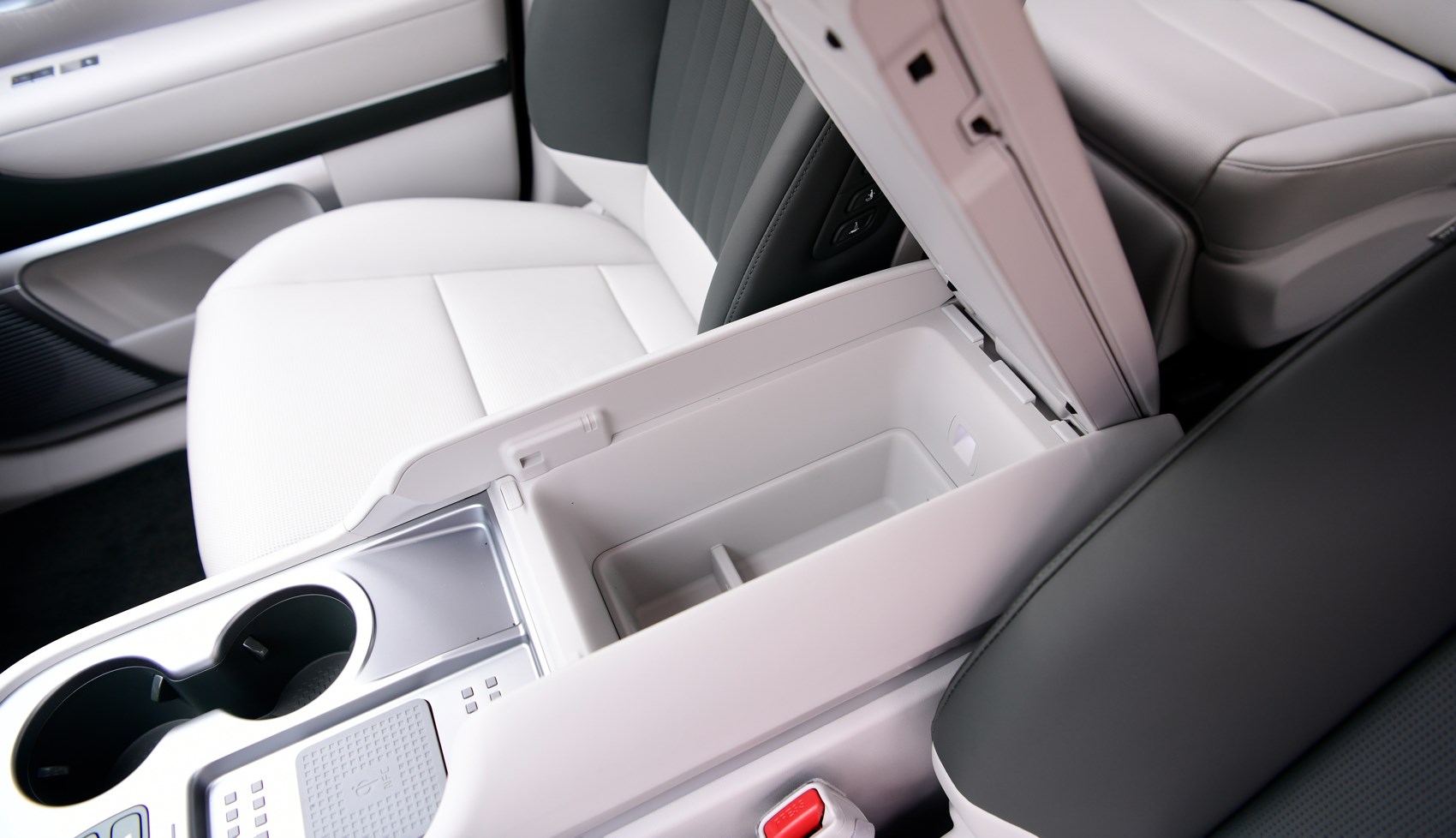
Splitting up the front seats is the new ‘Universal Island’ storage area. As well as some controls for driver aids and modes, this is where you’ll find cupholders, phone storage, drawers both at either end, and a vast central storage area accessible by those in the front or rear. It also slides fore and aft in top six-seat Calligraphy trim, providing you with the ability to make it more accessible for those in the second row.
The driving position is very adjustable and, despite it being a big car, you get a good sense of where you’re placing it on the road. We’re still not sure about the (thankfully optional) camera mirrors, though; granted, these are some of the smoothest we’ve used, but the aerodynamic benefits are arguably negligible and they’ll be a huge cost to replace if they’re damaged.
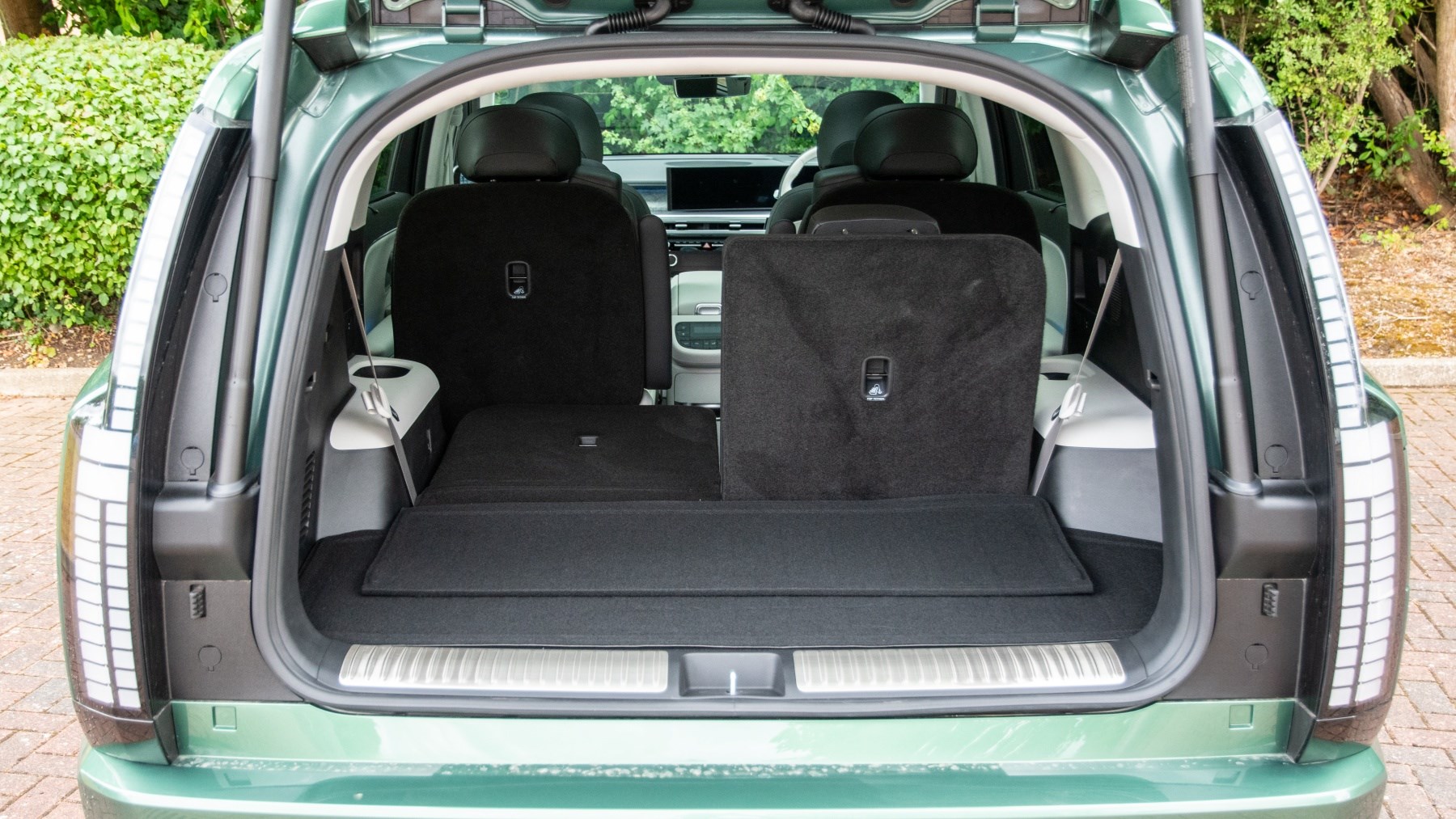
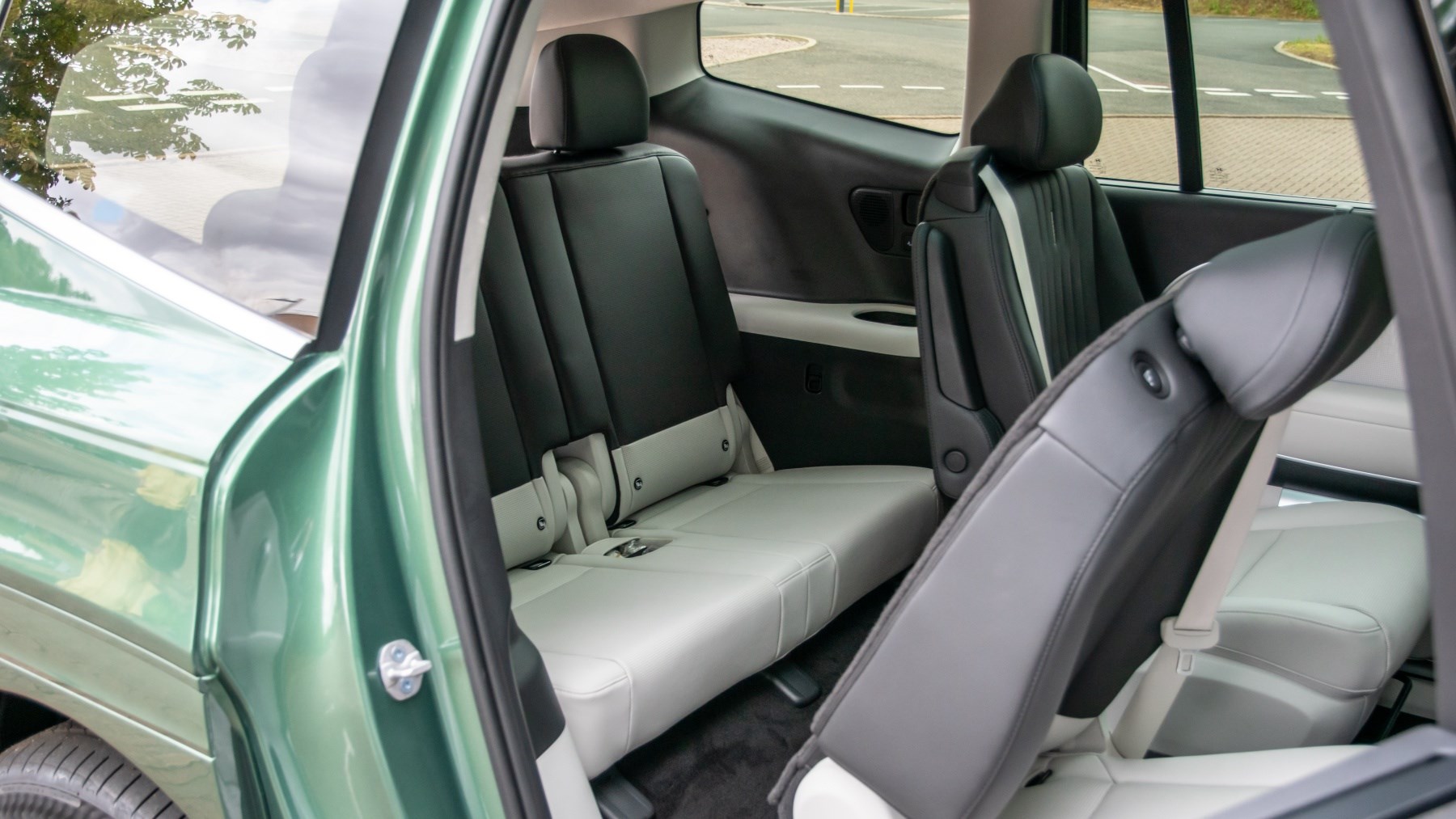
And the space! So much of it, no matter where you sit. I’ve been in business class flights with less room if you choose the six-seat option, with a huge amount of flexibility in the reclining seat functions. Even in the third row, there’s enough room for adults to handle moderate-length journeys, and everyone inside gets at least one cupholder and a charging port available to them. As you’d imagine, boot space is plentiful at 620 litres with all seats up. With all of them down, the 9 can act like a small van
Before you buy
The list price structure is similar to the Kia EV9 – its closest rival and Hyundai Motor Group sibling – so starting around £65k, and topping out below £80k. Compared to the Kia, the Ioniq 9 is still physically a large car but manages to hide its size much better; driving the EV9 by comparison feels like you’ve attached a steering wheel and pedals to a village hall. The Ioniq also rides better than its Kia sibling in its top spec.
Entry-level Premium trim comes stacked with kit including 19-inch wheels, a power tailgate, heated steering wheel, heated and cooled front seats, heated rear seats, three-zone climate, auto lights and wipers, and the big screens up front. It only comes with the single motor, though.
If you want a bit more pep without a big range drop off, Ultimate is worth a look. It’s nearly £10k more than Premium, but you do get a lot more power and all-wheel drive from twin motors. Additional equipment includes 20-inch wheels, a panoramic roof, full leather seats, ventilated second row seats, a Bose stereo and active noise cancellation.
Top Calligraphy trim is available with seven seats and the basic all-wheel drive motor combo, or as a six-seater with the Performance upgrade. Extra kit includes 21-inch wheels, Nappa leather seats and the UVC tray.
Even in its flashiest spec, the Ioniq 9 costs less than a basic Volvo EX90 – another electric seven-seat family SUV that’s brimming with plushness and kit. But I’d argue that the Ioniq 9 is almost as well built inside, even more practical and almost certainly more user-friendly than the Scandi.
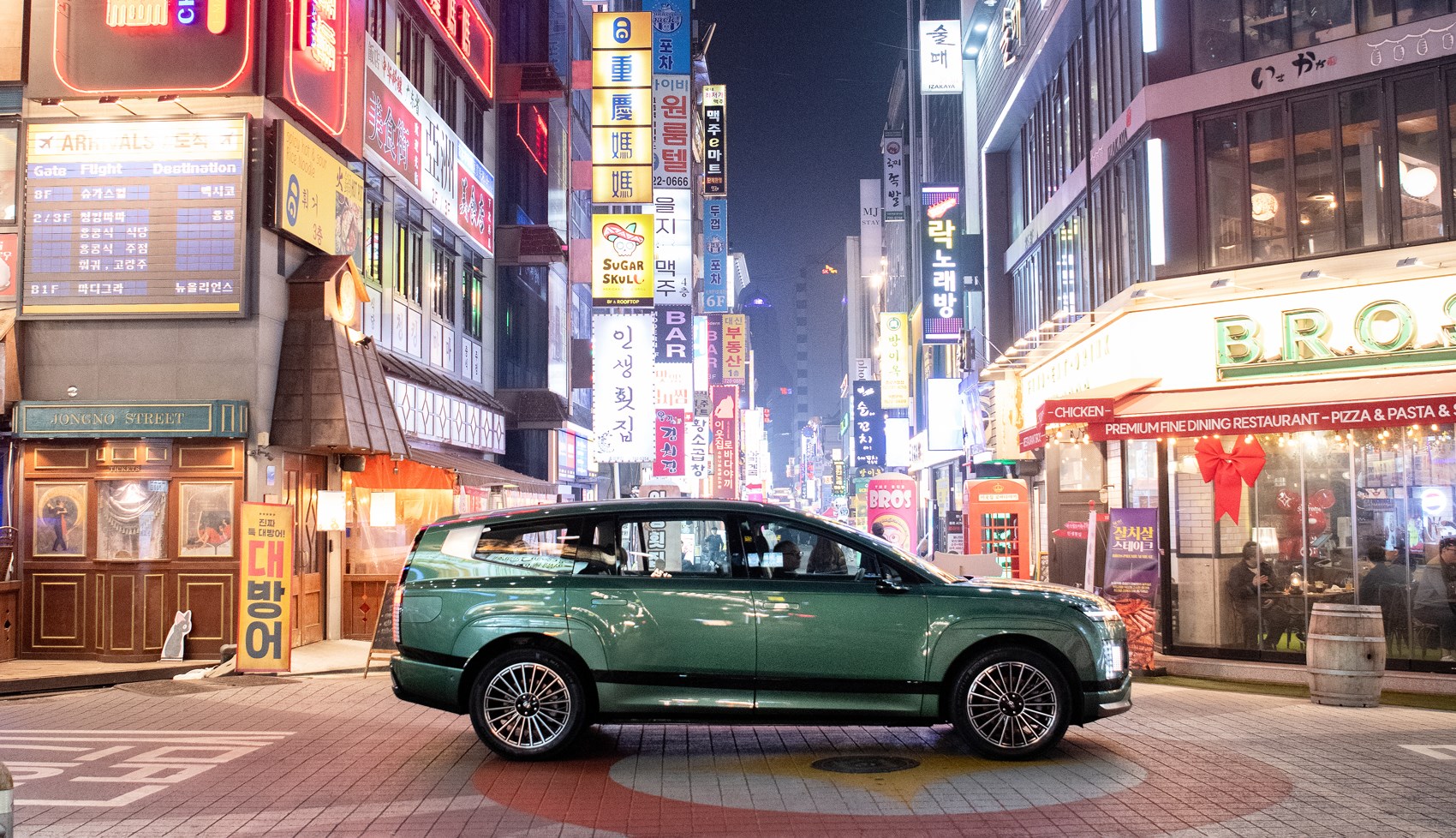
We wouldn’t be surprised, too, if those who currently own Range Rovers or a Range Rover Sport were looking at this and the EV9. Given how long JLR has delayed an EV version of its flagship, this Ioniq 9 will more than do the job an e-Rangie can do – and likely for half the price. Reading this and thinking the same? Overcome your badge snobbery and give it a look.
Verdict: Hyundai Ioniq 9
Will we look back on the Ioniq 9 with more fondness than the unlovely X300? Absolutely. But, in all seriousness, the Ioniq 9 will be deeply attractive to those looking for a grand, gracious and hugely flexible family SUV.
Aside from a couple of small grumbles – namely the roly poly handling and a menu-heavy infotainment system – the Ioniq 9 is refined and smooth to drive, calming to be in and will tackle family life better than most other cars ever could. And when all of this can be done for less than an EX90, or the upcoming electric Range Rover, the Ioniq 9 feels like great value.
Specs are for Ioniq 9 Performance AWD