► The best dashcams tested
► A range of budgets considered
► 4K, dual, mini, and mirror dashcam recommendations
Dashcams serve a necessary purpose for many motorists out on the public roads. If you’ve been on the end of an insurance claim, especially without a witness, then you’ll know how useful a dashcam could be in arguing your case. It could also be vital in discouraging thieves from stealing from your car – or the car itself.
Having a reliable dashcam is important, because the day might come when you’ll need clear footage, and a faulty or poor unit won’t be of much use. A study conducted by Nextbase determined that up to 11% of drivers drive while being distracted, that’s why 70% of UK drivers support dashcam usage. A dashcam can provide an additional set of eyes on the road – think of it as your own secret service operative keeping an eye on things.
The best dashcams 2025 at a glance:
• The best dashcam: Miofive S1 Ultra – buy from Amazon
• Editor’s pick: 70mai 4K Omni – buy from Amazon
• The best resolution dashcam: Viofo A329 – buy from Amazon
Not only can dashcams be useful during an insurance claim, in some cases they can even lower your premium. The quality unit that’s been hardwired into your car can alert you and discourage criminals and ensure car and its contents are safe.
There are a number of different types of dashcams available: from quality units with 4K resolution, or budget options. If you’re wanting extra coverage then we’d recommend a dual dashcam, or even a mirror dashcam to double up as an interior mirror. Ultimately, there are hundreds of options to choose from, and our experts have been testing them to give you the best chance of bagging the best this industry has to offer.
How we tested
All of the dashcams were tested over the course of a couple of weeks. This allowed us to assess the video quality, and a range of features, in a variety of situations. There was an importance on testing products in low-light and varied weather conditions. Each dashcam was also taken onto the motorway to see how they would cope when the speed increased.
All cameras were fitted using the supplied instructions, and then used as intended. This included downloading and linking to the app (if available) and using any ADAS or speed camera warning systems. After a couple of weeks the memory card was removed from the dashcam and inserted in a PC to review footage quality.
The best dashcams 2025
Miofive S1 Ultra
The best dashcam
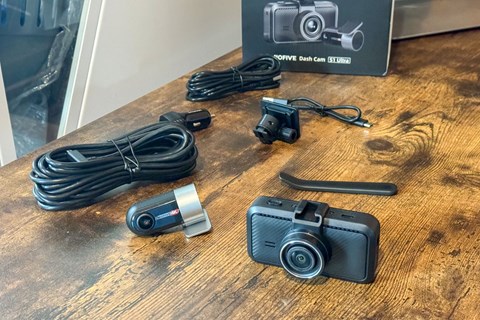
Pros: Dual 4K resolution, good low-light video, great value for money
Cons: Flimsy mounting arm, frequent voice alerts
The Miofive S1 Ultra is an affordable dual dashcam that offers 4K footage out of the front and rear. It comes with a three-inch screen which is genuinely useful for viewing footage and changing settings. The 4K footage is great, even in low light, and storage isn’t much of an issue either because the S1 Ultra comes with a 64GB memory card.
The front camera can shoot in 30fps with a 140-degree viewing angle. In comparison, the rear camera makes do with 25fps and 112-degrees. That sounds pretty convenient to me, as most rear dashcams only offer 1080p or 2K resolution.
Installing the Miofive is as easy as installing any other dashcam, but I didn’t like how it hangs off the mount. Worry not, as the camera can be mounted behind the rear-view mirror if you want it to be concealed for distraction-free driving.
The app isn’t the most intuitive, and doesn’t have as many functions as some others, but it has all the useful features that you would expect. Voice alerts can be activated or turned off depending on your preference.
Overall, the dual 4K footage is useful for getting clear video when you need it, so if you’re looking for a great value dashcam with competitive specs then the Miofive S1 Ultra is ideal. It’s so good it picked up the Best In-Car Technology award at our sister site Parkers’ 2026 Awards.
Click below for great deals
70mai 4K Omni
Editor’s Pick
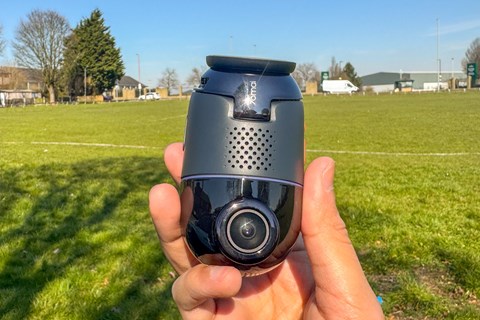
Pros: Impressive build quality, good footage, easy to use
Cons: Others offer better value for money, rotating function isn’t massively useful
The 4K Omni is a rotating dashcam from 70mai. It comes with a front 4k camera and rear 1080p camera. When combined you can expect 30fps, or 60fps when using only the front camera.
I was quite intrigued when testing the 4K Omni. It is designed unlike most other dashcams, and is quite weighty. The curved two-inch screen did take some time to get used to, and mounting the dashcam was a bit of a challenge, but once I found the correct spot I was able to fit everything quite easily.
Footage quality is great thanks to the seven-layer lenses and Sony Starvis 2 sensors that are found on the front and rear cameras. I found the footage to be clear, making it easy to read details like number plates, and low-light footage was clearer than most other dashcams.
The biggest advantage of the 4K Omni has to be the build quality, but other aspects are somewhat useful too: like parking mode and AI motion detection. I didn’t need to use the rotating front camera to record footage of the interior cabin, but it’s nice to know that 360-degree monitoring can be activated in the app.
Click below for great deals
Viofo A329
The best resolution dashcam
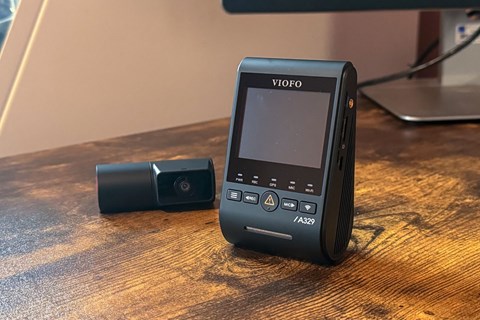
Pros: Great design, 60fps footage, impressive build quality
Cons: Large files, dark low-light footage
The Viofo A329 is one of my favourite dashcams thanks to its build quality and unusual shape. This unconventional design means the A329 can easily be mounted on your windscreen without taking up much space. It’s an elegant solution to a problem that plagues most other dashcams.
Let’s take a look the figures: 4K 60fps resolution out of the front camera that shoots with a 140-degree lens, and a 2K 30fps camera out of the back with an impressive 160-degree viewing angle. These are the sort of figures that demand attention when shopping for a dashcam.
Footage quality is top notch, but I would prefer the low light footage to be a little lighter. The dark footage at night is probably as a result of the CPL filter that is included, but I still preferred to keep the filter on during the day as it means the colours are slightly more vivid and life-like.
The build quality of the dashcam isn’t the only impressive part of the setup, even the wires are strong which means the A329 should be able to reliably shoot footage for a long time. A well-designed dashcam with a 2.4-inch screen is certainly worth considering.
Click below for great deals
Miofive Mirror 1
The best mirror dashcam
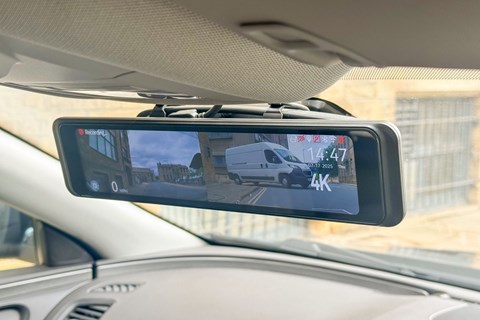
Pros: Two-in-one solution, good quality footage, accurate GPS
Cons: Takes some getting used to, rear camera installation can be tricky
I liked the idea of a mirror dashcam. They provide enhanced rear visibility for those that require it, with the added benefit of capturing vital footage and displaying it on the large screen. The Miofive Mirror 1’s screen is a massive 11.26 inches, and the 4K+2K footage ensures that even the smallest details are visibile on screen.
There are a number of ways that I could install the Mirror 1, ranging from temporarily solutions to more permanent approaches. As I was testing a number of dashcams I chose the temporary solution that meant I could remove or adjust it whenever I needed. I wasn’t a fan of mounting the rear camera to the outside of my car (near the number plate), and I didn’t like the addition of the GPS module which needed to be managed when hiding away wires.
Footage is great, especially during darker hours of the day when a traditional mirror would struggle and if your car has privacy glass. It was easy to adjust the brightness and volume using the touchscreen (I’d recommend adjusting the volume of the voice alerts), and the GPS functions were impressively accurate.
If you’re looking to buy a dashcam, but don’t want to take up vital real-estate on your windscreen, then a mirror dashcam might be the solution you’ve been looking for. Once you get used to the screen, you won’t want to go back to a traditional dashcam.
Click below for great deals
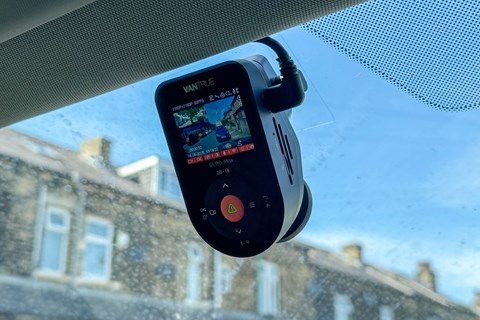
Vantrue S1 Pro Max
Best for ADAS
Pros: Dual 4K resolution, useful features, easy to set up and use
Cons: Slightly too sensitive to bumps, contrast could be improved
The Vantrue S1 Pro Max is a powerhouse of impressive features, with dual 4K and Sony Starvis 2 sensors. It even has Vantrue intelligence so ADAS features come as standard. I was very excited to test this one.
Video footage is consistent between the front and rear cameras, which means there’s no loss in quality for rear footage. This is especially important if you want to capture details all-round. My only issue with the footage was the slight lack of contrast, which meant the the image is slightly washed, but otherwise there aren’t any issues.
I’m a fan of Vantrue dashcams thanks to their easy-to-use nature. It’s simple to fit the camera with the supplied crowbar, and the calibration sequence means the dashcam can find the best angle of the lens for you. Even connecting to the app is easy since I didn’t have to create an account.
The Vantrue S1 Pro Max is a sensitive dashcam, which reacts to speed bumps, potholes, and other hazards on the road. I opted to turn off some of the Vantrue intelligent features as the alerts were too frequent. In the end, I think the S1 Pro Max is an impressive dashcam with an array of useful features. If you want more, get a Vantrue S1 Pro Max.
Click below for great deals
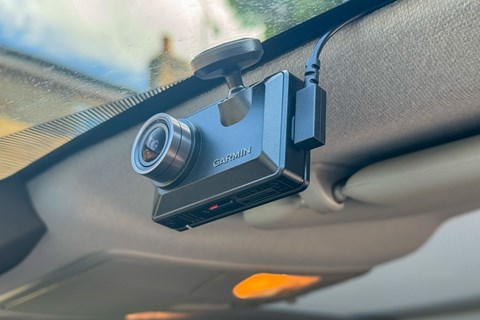
Garmin X210
Best for simplicity
Pros: Refreshingly simple design, clear footage, easy to use
Cons: Memory card sold separately, 1440p quality isn’t competitive with other dashcams
Garmin is unmistakably one of the most popular dashcam brands, and its X series of cameras offer high quality footage in a refined package. I was interested in testing the X210 as I have previously used a Garmin Mini 2 dashcam for well over a year.
The X210 strikes a lovely balance between price, footage quality, and size. It has a 2.4-inch LCD screen and can shoot footage in 1440p HD. While other dashcams offer better resolution, the Garmin offers better value.
Footage quality is as good as you’d expect, with minimal glare and a wonderfully rich image. One of my favourite features is the voice alert that warns of lane departure and speed cameras. While other dashcams might have annoying voice alert features, the X210 isn’t annoying or intrusive, and it’s impressively accurate.
I found it to be refreshingly simple, with fewer confusing wires and adhesive stickers to confuse me during the installation process. This did, however, mean that the X210 doesn’t come with a memory card or a crowbar. I particularly like the adhesive sticker that is used to mount the camera to the dashcam: it comes with a magnet feature which means you can remove the entire dashcam and replace it in exactly the same place.
The Garmin app isn’t as extensive as those offered by other brands, and less competitive footage quality and features means the X210 doesn’t top this list, but I suppose the premium brand does have reliability and build quality on its side. If you want a trustworthy dashcam that offers good value then go for the X210.
Click below for great deals
Vantrue E1 Pro
The best for rich colour
Pros: 4K quality, good build quality, easy to setup and use
Cons: Overly sensitive to bumps, electrostatic sticker isn’t the best
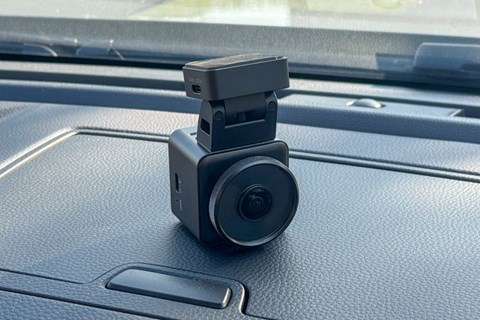
The E1 Pro is basically a mini dashcam with the added benefit of having a 1.54-inch screen. It’s the perfect size to conceal behind the rear-view mirror, but if you want to be able to keep an eye on the screen then it shouldn’t take up much space on your windscreen. I like the small cube shape, and the fact that the E1 Pro packs 4K footage and 5G WiFi.
The supplied crowbar makes it easy to install the E1 Pro, but I wouldn’t bother with the electrostatic sticker as it meant the dashcam fell off in the first instance. I will warn you, however, the adhesive is quite strong and may stick to your windscreen when removing the camera.
I can’t fault the footage quality, particularly due to the CPL filter that eliminates most of the glare, leaving behind a rich-colour image. The dashcam does detect general speed bumps as incidents and proceeds to save the footage, but otherwise I think the E1 Pro offers a feature-packed mini dashcam with lovely footage quality.
Click below for great deals
Orskey S900
The best for tight budgets
Pros: Affordable dual dashcam, decent quality front camera, intuitive to use
Cons: Poor quality rear camera, rear camera installation can be a struggle
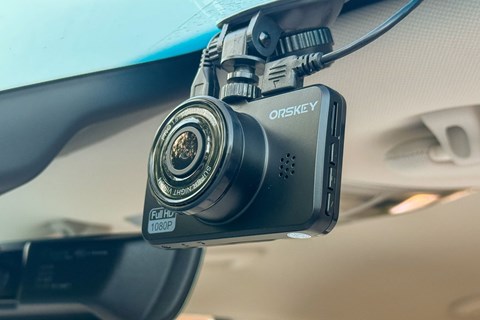
If you’re looking for the most cost effective way to own a dual dashcam and have up to 310-degree coverage then the Orskey S900 is one of the best affordable cameras available on the market. Despite its price, I believe the S900 offers decent footage quality with HD 1080p 30fps resolution out of the front.
There’s plenty of detail in the footage to give peace of mind, but at times the video can be a little blurry. Rear footage is poor, and Orskey doesn’t state the resolution, and it felt only as good as 720p. The rear camera is still worth fitting to get some coverage, but don’t expect it to compete with other dual dashcams on this list.
Installation is easy, and the Orskey comes with a few different options to mount the cameras, so I like the versatility. Similarly, the range of features are genuinely useful, like parking monitoring and motion detection, and the menu is intuitive so using the S900 is easy.
The S900 can’t compete with premium dashcams, but as a budget dashcam it suits the tightest budgets. Better safe than sorry.
Click below for great deals
FAQs and things to remember when buying a dashcam
Are dashcams worth it?+
99% of the time, having even a high-tech dashcam sitting on your windscreen will pretty much only record your everyday drives with nothing of interest to submit to the relevant parties. However, the point of having a dashcam is for that occasional 1% when a serious road traffic event occurs. Whether it's an accident with yourself or somebody else involved, having footage and proof of its occurrence can be vital later on.
Without sufficient proof, a fight for blame in a road traffic collision can be tricky to argue unless both parties agree to a conclusion. A dashcam, even if it's a little mini unit, is worth it simply because it can provide what happened in black and white. Furthermore, depending on the manufacturer and insurer, having one installed can lead to reductions in car insurance, which is always a nice thing to have as it proves your worthiness as a safe driver.
How much should I spend on a good dashcam?+
Whatever your budget is, stick firmly to it. There are enough dashcams out there, so there will be several suitable models within your price range. We believe a reasonable budget for a dashcam can be between £150-£200, but you can spend more for premium features.
But if you're considering spending under £100 for a dashcam, make sure the unit focuses on performance and footage quality rather than the number of features.
Which dashcams have good performance?+
Full HD 1080p at 30fps is the dashcam minimum. You'll struggle to find anything with 720p these days, and there are plenty of good options out there. Anything less than 30fps doesn't provide smooth footage, and vital details in an incident can become unclear.
Popular dashcam brands, like Nextbase, Garmin, Miofive, Viofo, and Vantrue all offer dashcams with 2K or even 4K quality. The Viofo A329 goes one step further by offering 4K 60fps, but for some drivers that might be overkill.
WDR/HRD or polarising filter?+
To keep footage clear in high contrast conditions, effective anti-glare techniques are needed. Wide/High Dynamic Range software helps with this by balancing the contrast in the scene that it captures. Dashcams are able to provide an easy-to-digest image by taking several images at various exposures and combining them.
Several dashcams offer polarising filters (mostly sold separately) which can attach easily to the front of the camera lens therefore capturing the video without having to digitally manipulate the footage.
What features should I look for in dashcams?+
We've yet to come across a dashcam without a G-sensor and loop recording, so we can take those as read. But what extra features are worth it? For one thing, having a Wi-Fi dashcam improves the efficiency of how the footage is recorded, stored, and transferred - and that will be useful to someone willing to pay the extra cash.
But if you're interested in security features like advanced parking modes, we would recommend you choose a dashcam that has an automatic detection setup. Other things like ADAS systems and various clever features are to the taste of the buyer. We recommend that you think carefully about what features are useful to you as the consumer.
What different dashcams are available?+
The world of dashcams is as far as it is wide. There are hundreds of dashcams available on the market, but finding the ideal one for you can be tricky. The best place to start is by establishing what type of dashcam you're after:
Regular - These are the standard single camera dashcams that can be mounted to the front of your car to shoot footage ahead of you. They offer an easy way to capture vital video and keep you covered on the road.
Dual - These are like regular dashcams but with an added camera mounted at the rear of your car. They provide greater coverage and can capture footage of vehicles behind you making them ideal in the unfortunate situation when someone has rear-ended you. Dual dashcam demand a higher cost than standard dashcams.
Mini - These are smaller units that take up less space when mounted on your windscreen. They are designed to be less distracting to drivers, often not having a screen at all. Footage can be transferred to an app or downloaded directly from the memory card. Mini dashcams are also typically easier to install.
Budget - These are the most affordable types of dashcams. They will typically come with less features and inferior video resolution. They may not even have WiFi and therefore wouldn't connect to your phone. If you find a budget dashcam (under £100) that comes with 2K or greater recording capabilities then consider it to be good value.
Mirror - These are like ordinary dashcams expect they will replace your car's interior mirror. They double-up as a mirror and a dashcam, providing an elegant solution to reduce the number of things on your windscreen to impede your view. Mirror dashcams can also serve as reversing aids, so their benefits can extend to vehicles with reduced rear visibility.
Does a dash cam reduce insurance? +
In some cases, yes, but we would always recommend checking with your insurance provider as many insurers do not offer a discount, and those that do won't automatically apply the discount.
Having a dashcam can have other benefits: like preventing fraudulent insurance claims against you, providing vital footage in the event of a claim, and potentially protecting your no claims discount by proving you weren't at fault.
Is a full HD dash cam better than a 4k dash cam? +
In short: no. 4K resolution is better than full HD (1080p) as the image is four times as detailed as HD. It is common to find dashcams with 4K resolution, but if you're not interested in the higher resolution then we'd recommend finding a dashcam with at least full HD 1080p or 2K.
You can enjoy CAR in its traditional print format, or one of the swelling number of digital editions, optimised for Apple iPhones, Android devices, iPads, tablets and desktop computers.