► How do magnetic car trackers work?
► We’ve tested them to see how useful they really are
► All you need to know about subscriptions and more
Worried about your car getting stolen? There are many solutions to this automotive endemic, but have you ever considered a magnetic car tracker? By namesake, they simply attach to metal via a magnet and track your vehicle’s whereabouts. Usually, you can check the device’s location via an app from the manufacturer and a subscription costs around £5. So, for a large cup of coffee each month, you can protect your cherished vehicle and potentially save a chunk on your insurance premiums.
You can opt for hardwired trackers, too. These require a little bit more know-how when installing, but serve exactly the same purpose. You get a constant source of power with hardwired trackers while with magnetic devices, you have to recharge them occasionally. Usually, it’s every month or two, depending on how active the device is.
The best magnetic car trackers at a glance:
The best magnetic car tracker: Rewire Security 104 Plus – buy from Amazon
Editor’s pick: SafeTag MAG 4G – buy from Amazon
The best quality magnetic tracker: PAJ GPS Power Finder – buy from Amazon
Some trackers on the market are visible when fitted to your vehicle – sometimes on top of the 12V battery itself. This isn’t ideal, especially if a thief catches sight of it. They can easily remove it and discard it before getting loading up your vehicle onto the nearest shipping container bound for somewhere far overseas. Magnetic trackers are easy to install and provided you install them cleverly, can remain discreet enough to work when they’re needed the most.
If a tracker isn’t enough for your security-conscious mind, then you can also consider proactive methods in securing your car, by investing in a steering wheel lock. We would also recommend a dashcam which could not only be useful in case of an accident but can also record suspicious activity near your vehicle. If you want to protect your vehicle from keyless relay theft, have a look at our guide on the best Faraday pouches. All these measures could be effective in ensuring your Range Rover doesn’t become another theft statistic.
There is some maintenance involved when using a magnetic tracker, and you will need to use your own initiative when installing them in a safe, discreet spot where thieves won’t find them (at least too easily). But they are a great investment for upping your car security game and depending on your provider, can even help lower your insurance premiums.
We’ve tested a few trackers out for ourselves to find out how good they really are at doing the task in hand.
How we tested magnetic car trackers
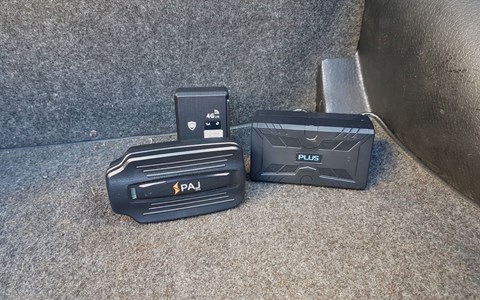
We got our hands on a few magnetic car trackers and conducted some hands-on testing to see how accurate and easy to use they really are. We tested the trackers by installing them in our own personal vehicles and judged them on the basis of ease of use, accuracy, value for money (including the subscription) and battery life.
In the best case scenario, you would hide the trackers very discreetly in a covered compartment of your vehicle. But for the purposes of testing here, we mounted them on metal surfaces in relatively easy-to-reach spots, so we could take them off again.
The best magnetic car trackers 2025
Rewire Security 104 Plus
The best magnetic car tracker
Pros
• Easy to use and track via the app or website
• 365 days worth of history available, making things very comprehensive
• Sends position updates every three seconds and is exceedingly accurate
Cons
• Subscription is required, which means extra costs added on
• Other trackers offer longer battery life
Sometimes subscriptions can be a little overwhelming, and since most trackers offer some sort of subscription, it is important to consider this aspect before buying. For the Rewire Security 104 Plus, there are a number of plans available starting at £5 per month. You can choose to pay monthly or even annually if that suits you.
What do you get with the 104 Plus? Well, to begin with, there’s the option to buy the 10Ah battery version or the 20Ah battery version for around £30 more. The 10Ah version will allow up to 90 days of tracking in standby mode, alongside 4G real-time tracking through the app and/or website.
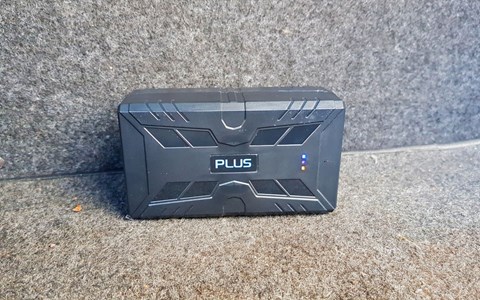
So, how well does it work? One thing that struck me straight away was how large it is. I struggled to find a decent place to put it within my car because it was hindered by either the curvature of the inner panels or there was something in the way.
It should’ve been smaller, really. And that’s a bit of a let down because to use, it’s really very good. Once you set up the app, it’s amazingly accurate and pin points your vehicle’s location down to the metre. It didn’t matter whether it was parked in a car park, driveway at home, or on the street, this is an accurate tracker that points you to the right direction.
The magnetic field is also very strong. I had no issues placing it anywhere that had a metal surface, but the chunkiness of the 104 Plus is what lets me down. If you left it anywhere that wasn’t hidden under a mat or panel, anyone could find it within seconds and immediately identify what it is.
Specifications
• Subscription fee: Yes
• Route history: 365 days
• Battery size: 10Ah
• Location accuracy: 5m
PAJ GPS Power Finder Magnetic Tracker
The best quality magnetic tracker
Pros
• Two-year warranty included, which is handy
• Very accurate location and the app is very easy to set up
• Route information available from the last 365 days
Cons
• Subscription required, adding extra costs on top of the £100 purchase
• Live tracking only updates every 30 seconds
The PAJ GPD Power Finder comes with a 365-day route history, which is great, and an accuracy of around five metres. Like some other trackers, the PAJ is rated IP64, so it can withstand splashing water and keep out dust.
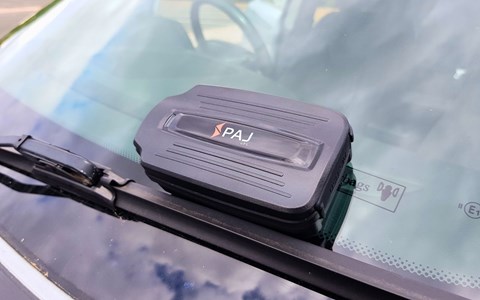
Like the 104 Plus, it’s a bulky unit to try and hide. You’ll have to pick somewhere very clever to hide this frankly huge unit. I struggled to place it even underneath the boot floor of the Volvo V70 test car.
To make matters trickier, it comes with a separate magnetic plate which only adds to the thickness. Said plate has three adhesives on it, so you have to be sure that where you place the tracker isn’t going to change. I feel this is a bit of an oversight, as you have to take the unit out after every month or two to charge it up anyway.
It is, however, incredibly accurate. Five minutes after setting up the app, and the tracker was ready to view. I left the car parked obscurely in the office car park, and it picked up exactly where the vehicle was down to the last centimetre. It was exceptionally accurate, although when on the move, you get updates every 30 seconds, to which other devices are quicker.
The battery itself will last 90 days in standby mode and 40 days with an hour of active tracking per day. There are some great features too – including geozone or “safe area”. Subscription rates run from just under £4 per month to £6 p.m, depending on your plan. The PAJ also comes with a two-year warranty for peace of mind.
Overall, it’s a competitive unit that’s built well, accurate, and built to a high standard of durability. Like the 104 Plus, I just wish it was a little smaller so it could be easily fitted into hidden compartments of a car.
Specifications
• Subscription fee: Yes
• Route history: 365 days
• Battery size: 10Ah
• Location accuracy: 5m (approx.)
SafeTag MAG 4G Tracker
Editor’s pick
Pros
• Compact device that’s able to fit in a variety of places
• Very affordable at a starting price of £35
• Accuracy is very impressive – especially for the price point
Cons
• Calibration required unlike the other tracking devices
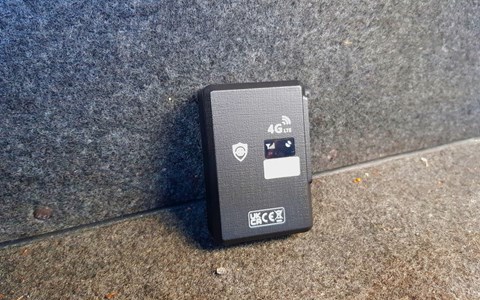
Offered in a much more compact package, the SafeTag MAG 4G tracker is able to fit discreetly in more places throughout a vehicle. It’s magnetic base also feels the strongest out the lot, so you won’t have to worry about it shifting around.
It claims to update its location every 10-40 seconds, and in my experience in testing it, it sounds about right. Sometimes it would update after around 15-seconds, and on one occasion, it updated after 30. I’ve found that it depends on whether the vehicle is standing still or moving, but nevertheless, the location accuracy is still bang on to the centimetre.
There is a downside to the smaller package: the battery is smaller. Instead of recharging it up to 90-days at a time, you have to take it out and recharge the SafeTag every 16-32 days depending on use. The other drawback is that you can’t just set it up immediately; you have to go for a ‘calibration drive’ which according to the handbook, helps it get a GPS signal. I didn’t have to do this to the others, so that was a slight hinderance.
Despite that though, it’s my favoured tracker of those we’ve tested. It only costs £35, subscription rates are low at between £5-6 per month, and it’s covered in over 195 countries. I also find the app the easiest to navigate, and apart from the subscription-free devices, I’m not sure what else you could need from a car tracker. It’s compactness and simplicity win it over for me.
Specifications
• Subscription fee: Yes
• Route history: 365-days
• Battery size: 6,800mAh
• Location accuracy: approx. 10m
Winnes TK905B
Best subscription-free tracker
Pros
• Easy to install due to compactness
• Six months of location history and great accuracy
• Lasts a long time on one charge, thanks to 10Ah battery
Cons
• Alarms might be disconcerting when they run low
• Requires a SIM card with data or subscription
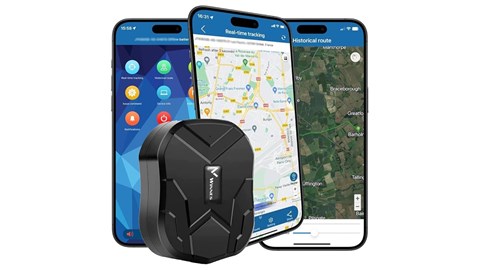
If you’re looking for the best all-round solution, then the Winnes TK905B will probably fulfil your needs. It comes with 150 days of standby and no monthly subscription if you use your own SIM card. It’s simple to use and can be installed easily to your vehicle. You can even set a geofence so you receive an alert if your vehicle leaves that area.
As long as there’s a GPS signal, you can benefit from app or SMS alerts for things like speeding, low battery, and even vibrations, such as if your car is bumped in the car park. The Winnes TK905B can store the route history for up to six months and has an accuracy of up to 5 meters in GPS tracking, which is updated every 5 seconds.
Specifications
• Subscription fee: No
• Route history: Six months
• Battery size: 10Ah
• Location accuracy: 5m
Winnes TK918C Car Tracker
The best large subscription-free tracker
Pros
• No monthly payments to worry about, reducing the overall cost
• Tracking data history available from the past six months
• Powerful battery lasts for around six months (180 days)
Cons
• Others do offer up to a full year’s worth of tracking history
• Requires a SIM card with data or subscription
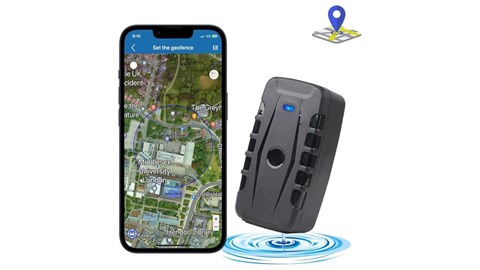
The Winnes TK918C GPS tracker offers great value at a lower price than the TK905B but with some added benefits. For starters, it comes with a 20Ah battery which is good for 90 days if you’re activating the tracking system for up to an hour per day, but if it stays on standby mode then you’ll see a massive six months on a single charge. The TK918C also comes with a IP65 waterproof rating which is handy for protecting it against the weather.
You are compromising on precision with the TK918C, however, as it can only provide an accuracy of between five and ten metres, so the TK905B wins in that area. Both trackers can upload data from the device for up to six months. The unit does require a SIM card with data, or it comes with its own, but using the provided card would require paying into the subscription. With your own SIM card, it’s free.
Specifications
• Subscription fee: No
• Route history: Six months
• Battery size: 20Ah
• Location accuracy: 5-10m
Salind GPS Tracker
The best mid-range tracker
Pros
• Sim card included and built-in, making setup very easy
• Battery status viewable from the app
• Detailed route history of up to 365 days
Cons
• Subscription required, which slightly defeats the budget aspect
• GPS tracking uses a 2G network
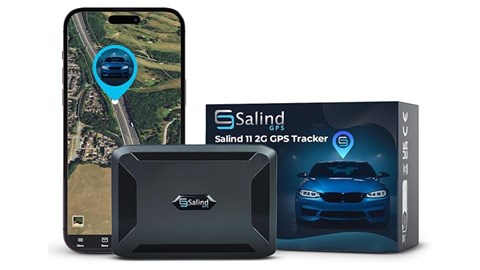
The SALIND is the most affordable magnetic tracker on our list. It offers fantastic value for its price, making it the best budget tracker available. It’s easy to install and use since it comes with a built-in SIM card, so all you need to do is register it online, and you’ll be good to go. A 10Ah battery should last you over a month between charges with one hour of tracking per day – or 90 days in standby mode – and you’ll be able to view the battery level online at any time so you can ensure you’re always topped up.
There are some areas where the SALIND falls short of the more advanced trackers – for instance, the IP rating is only IP64, which means it is dust-tight but can only withstand splashing water. It should hopefully be adequate for automotive use. The GPS network is only 2G, but you do get alerts and a detailed route history for up to one year.
Specifications
• Subscription fee: Yes
• Route history: 365 days
• Battery size: 10Ah
• Location accuracy: 5m
TruTrak Pro GAT23 4G Magnetic GPS Tracker
The best budget magnetic tracker
Pros
• Works in up to 176 countries
• IP65 waterproof rating means it can handle damp environments
• Great value for money at under £30 for initial purchase
Cons
• Not subscription-free
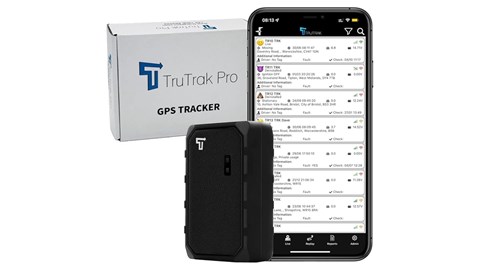
This tracker may be subscription-based, but at a low initial purchase price, the TruTrak Pro GAT23 represents excellent value for money if you’re looking for your first car tracker. Happily, TruTrak’s subscription costs are as low as £4.72 per month, so it won’t break the bank if you opt for it.
The tracker itself comes with an IP65 waterproof rating, so it’ll still assist you if your tracker’s hiding place happens to build up a bit of damp or condensation. It’s compatible to work in up to 176 countries worldwide, so if you’re travelling abroad, you should be well-covered.
Specifications
• Subscription fee: Yes
• Route history: Up to 18-months
• Battery size: 5,000mAh
• Location accuracy: Not stated
Apple AirTag Bluetooth Tracker
The best tracker for Apple users
Pros
• Incredibly simple solution for Apple users
• Easy to install, thanks to compactness
• Easy to track them from using your iPhone
Cons
• Aren’t anywhere near as comprehensive as the others
• Needs an Apple iPhone 11 or newer to operate
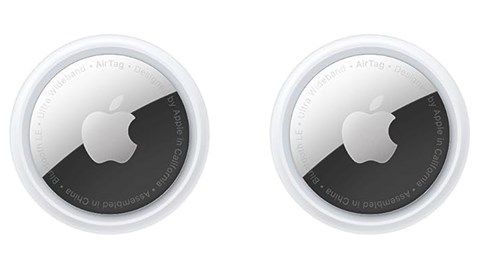
When it comes to tracker options there’s always room for the Apple Airtag. While it isn’t a magnetic tracker it does have simplicity on its side. The Airtag can be used to track almost anything – from cars to boats, luggage, and even devices. The tracking device is the sice of a 50p piece and works with an Apple iPhone 11 or newer.
This particular deal is for a two-pack, but you can also get the Airtag in a three-pack, a four-pack, or even on its own. While it won’t give you such parameters as Geo-Fencing or push notifications for speed limit breaches. Still, it will allow you to pick out exactly where your vehicle is using your iPhone. The Airtag is even IP67 rated so it can withstand dust and be submerged in up to one metre or water for up to 30 minutes.
Specifications
• Subscription fee: No
• Route history: N/A
• Battery size: 3V (coin unit)
• Location accuracy: 6-9m
FAQs and things to consider with magnetic trackers
Why should I use a magnetic tracker over a wired one?+
Magnetic trackers offer greater levels of ease when installing and operating over wired trackers. Some are as simple as plug and play, while others require set-up or registration.
Another advantage of a magnetic tracker is the ability to remove the tracker easily and place it on another vehicle. This is ideal if you have more than one vehicle but don’t want to buy several trackers. The versatility that is offered by a magnetic tracker is very useful.
How long do magnetic trackers last?+
That depends on the one you go for and how you use it. On standby mode most magnetic trackers should like between 90 to 180 days, but if you’re using the device to track for up to an hour a day then expect that same battery to last you between 40 to 90 days. Look for one with a higher battery capacity – like 20Ah (20,000mAh) – but 10Ah (10,000mAh) is satisfactory.
Since all magnetic trackers require charging it is important to keep an eye on the battery life which can usually be done using the manufacturers’ app.
Are magnetic trackers worth it?+
Provided you look after them properly and place them in a hidden area of your vehicle, where thieves couldn't possibly find them, then absolutely. Having a car tracker on the go could be the difference between locating your vehicle or losing it forever due to thieves.
It's a good idea to keep it cleverly hidden, though, as thieves will do their utmost to locate and disable any trackers installed - usually the manufacturer-installed ones. If you want to keep an eye on your car whilst it's parked outside your home, an outdoor security camera can be a great way of monitoring your vehicle if you have to be away.
Are car trackers legal?+
Yes, putting a car tracker your own vehicle is perfectly legal and you won't be breaking the law. However, it's a valid question to ask because in some cases, car trackers do come under scrutiny under a few laws.
For example, under Article 8 of the Human Rights Act, employees are guaranteed the right to privacy during work-related activities. As a result, employers must notify drivers about tracking if they're operating a vehicle with one installed and must be notified of how to disable it for personal use. Vehicle tracking in these circumstances must be for business use only.
There are also a plethora of regulations under the General Data Protection Regulation (GDPR) that cover car trackers. These include the requirement to be transparent about data being collected from trackers as well as only collecting data necessary to legitimate business purposes, and obtaining explicit consent to employees to access such data upon request.
In short, if you're using car trackers for business vehicles, you must follow these rules or risk a hefty penalty, which can be massively impactful.
Where to put magnetic trackers on a car?+
There are a number of places throughout a vehicle where you can place a magnetic car tracker. Some may opt to place it under the bonnet somewhere and others will hide it under a carpet in the boot area.
The more thorough users will hide a tracker behind a bit of interior trim - this is to make things extra difficult, should the worst happen and the vehicle gets stolen. Thieves will have a harder time finding a tracker placed in a well-secluded area than one that's easy to access.
Do magnetic car trackers work?+
Yes, magnetic car trackers do work and they're great for people who want a device that doesn't have to be hardwired. The location accuracy is excellent in our testing experience and the GPS systems update themselves in good time.
We would recommend them to anyone who wants an easy security solution for their pride and joy. You can keep tabs on it at all times, although the only commitment from the user is a subscription (if required) and to recharge the device every so often.
How to use a magnetic car tracker?+
Firstly, you need to decide which magnetic tracker you're opting for. Once you've decided, you need to set up a subscription plan in order to enable the device - these differ across the board and you can pay slightly different amounts for different time periods.
Ensure the device is fully charged before use. When delivered before testing, the devices we got our hands on were at around 50% charged. The next step is the trickiest: finding the best place to install your magnetic tracker. Larger devices are harder to hide, so it may be a case of removing an inner panel and placing it underneath.
Once you've sussed out the above as well as the app, you're ready to go. Just bear in mind that the device will need recharging every so often, and this depends on the size of the battery and how active the tracker is each day. You can always check the location of it via the GPS on the brand's app.
Additionally, magnetic trackers can also have a flurry of features on board. These can include geofencing boarders as well as speed and location history. Moreover, having a tracker installed in your vehicle can help lower insurance premiums, depending on your provider.
You can enjoy CAR in its traditional print format, or one of the swelling numbers of digital editions, optimised for Apple iPhones, Android devices, iPads, tablets and desktop computers.