► An adventure drive in the electric G
► Camping in the Kielder Forest
► Merc’s G580 goes back to nature
As the electric Mercedes G-class creeps around a corner in Kielder Forest, all I can think of is the opening scene from Gladiator. We’ve been driving for two hours through pristine forest, surrounded by pine trees stood ram-rod straight, only to emerge into an apocalyptic scene that feels like it should have Russell Crowe taking on the hordes of Visigoths.
The mist swirls ahead, revealing a scene of devastation: massive ruts carved into the earth by the unseen forces of the harvesters and forwarders; trees toppled with their splintered trunks shouting in silent agony at the violence of the chainsaw; huge roots upended and exposed, lying naked for all the world to see; countless tree stumps littering the clearing, a mournful reminder of what once stood here.
Gone are the gentle sounds of the forest, replaced by an eerie silence. Nothing moves. If ever there was a metaphor for what mass transportation in petrol and diesel cars has done for the planet…
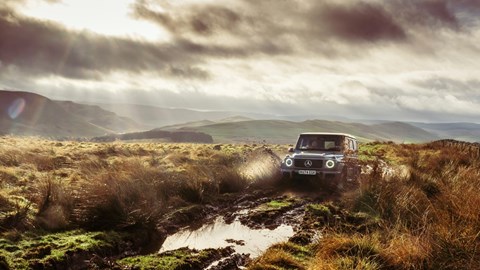
Could electrification help? Just as the Forestry Commission has already started to plant the saplings to replace all the trees its felled, so the electric G poses a question as it emerges from the forest, silently and cleanly meandering along Kielder’s tracks.
Formally called the Mercedes G580 with EQ Technology Edition One (a level of verbosity impressive even for Mercedes-Benz), the EQG is not the most obvious answer to electrifying the world’s remote areas. Weighing in at 3.2 tonnes – a figure so heavy that the car can’t even be fitted with a roof rack for fear of pushing it over the gross vehicle weight – it also costs over £180,000, has thick carpets instead of rubber mats and is unlikely to be top of any sheep farmer’s wish list. There are no ‘ker-clunk’ mechanical levers, instead they are replaced by digital screens, soft mood lighting and beautifully finshed air vents.
And yet… Mercedes has chosen to equip the car with enough off-road hardware to ensure it should be able to tackle just as much off-road terrain as its ICE sibling. Four electric motors, each attached directly to the chassis and connected to the wheels via dual-joint shafts, provide a total of 579bhp and an incredible 859lb ft (a Defender V8 has 518bhp and 461lb ft), while it still rides on the old-school ladder frame chassis (albeit modified), with double wishbone suspension up front and a rigid axle at the rear.
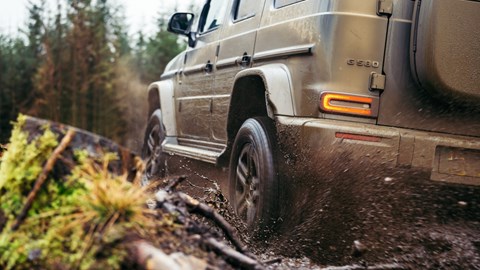
Wading depth has grown from 700mm in the ICE G to 850mm in the electric and the overall ground clearance is 250mm, which is fine but 40mm short of what the Land Rover Defender can manage . There are no diff locks but Mercedes argues they’re not needed as, via the medium of torque vectoring, the four motors can effectively operate as the same thing. It does, though, have a low-range mode thanks to a two-speed gearbox – each motor has its own transmission so can be independently controlled.
There are a few different drive modes but the ones we’re concerned with are ‘Trail’ and ‘Rock’. In the latter, you have to confirm your selection with a second button press, whereupon it turns off ESP and also allows you to select low-range. It’s also the mode you need for G-Turn and G-Steer. The electric G is definitively not a catwalk model – it might have a 21st century powertrain but the ethos remains faithful to the 1979 original.

We started our trip on-road, traversing the Scottish border accompanied by predictably raw and far-reaching vistas. I was expecting a little more oomph from the electric G given the figures – it’s fast but not EV-fast and it doesn’t rock back like a cartoon dragster thanks to the adaptive dampers. On the spectrum of rivals, it definitely feels more towards diesel Defender than AMG’s hoodlums, despite what the EQG’s 0-62mph time tells you.
On tarmac, you can feel the limitations of the chassis. It’s incredibly smooth at 40-60mph but at lower speeds the suspension can feel a bit lumpy, like the sheer weight of the car overwhelms the damping. A Defender has a broader operating range.
We carve through valleys into narrower and narrower roads, moss-lined walls and remote houses lining our route. Scattered wheely bins dot the roadside once every mile or so, hinting at what must be a hellish paper-round.
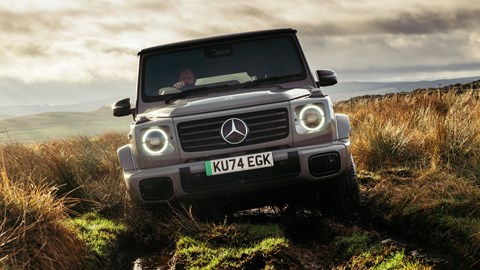
Then it’s welly-time. Past an old Roman settlement and into ‘Deer Street’ – technically a road that is maintained by a combination of local farmers and the council, but it’s unlikely we’ll meet any BMWs down this grass track. Jagged rocks are strewn across the path like a giant’s game of boule, while deep ruts will test the G’s ground clearance.
There’s also a lot of water up here. Recent snow melt won’t have helped and as I don my wellies the mud squelches softly beneath every footstep. Test number one. The G is on reasonable rubber – Falken Wildpeak all-terrains – but a wet grassy hill is the nemesis of any off-roader, with a lethal combination of zero grip and unhelpful gravity.
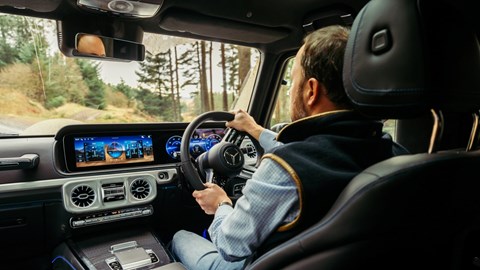
In contrast to jumping into a Land Rover product and being greeted by a myriad of different off-road modes and settings, the electric G is remarkably simple, almost worryingly so. It’s a place where you feel like you should be pushing several more buttons or pulling a couple of levers before you can tackle ‘the outdoors’.
We meet grass, we drop it in into ‘Trail’ mode. And that’s it.
But 500 yards later, Deer Street claims its latest victim. It’s not especially steep nor especially wet, but the G slowly grinds to a halt, traction control killing the power as the tyres start to slip. Bit more power. Nothing. Into reverse and back up a bit, try again. Still nothing. Back further and try to get onto virgin grass, out of the slippery mud tracks we’ve been following.
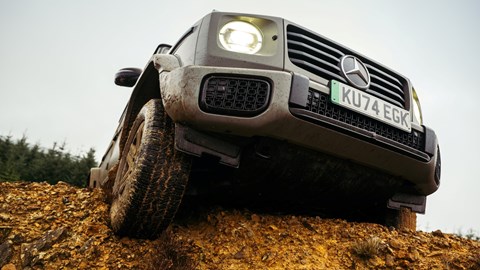
Now it slowly starts to creep forward. Increase the power levels to build the momentum to punch through where we previously got bogged down. Finally, we’re over the crest.
Better tyres would have helped – the Falken Wildpeak comes in a more extreme mud-terrain version with bigger gaps between the blocks – but Mercedes has, entirely sensibly given the G’s overall use case, fitted ours with the all-terrain, a better compromise between tarmac and mud.
It’s also a lesson in reading a ‘road’. Trail mode is probably better than Rock in this particular instance because rock, to me, implies that you’ve got grip, but what we should have done is turn off off the traction control ahead of the hill so we could better deploy the oodles of torque.
What’s more impressive about the electric G is how easy it is to modulate all the power: all the torque is available from 0rpm so it’s not difficult to creep forward with a gentle right foot. In an ICE off-roader, you’re fighting turbo lag and the overriding inefficiencies of the powertrain but in the EQG, it’s simply a case of easing along with plenty in reserve. It’s an effortless thing to blend into, not requiring as much mental capacity as a more traditional car.
And it’s silent, of course. We meet a dog walker along Deer Street and you can have a very civilised conversation without having to kill the engine, wind rustling nearby trees. It’s far more approachable as a result. The loudest thing within five miles is his Patterdale Terrier, hacking breath as it tries desperately to break free of its lead.
It’s why the G makes for a very calm companion as we head into Kielder Forest. It allows nature to breath along with you and gives you a chance to better deploy all your senses as you drive along. Window down is the best way as wafts of pine scent drift into the cabin and the tyres gently scrunch along the forest track.
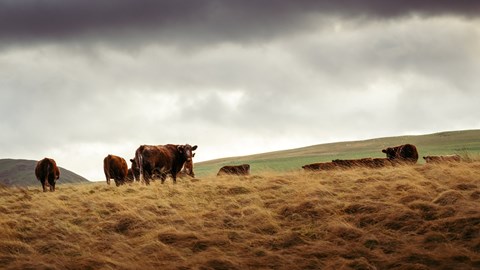
This places oozes life. Walk in a grass field and it largely feels very one-dimensional. Life is absent. A forest walk is totally different and is somewhere you can hear all the different materials – wood, moss, water, mud – compress under your feet. Water gently trickles down a gully next to the road. Even the light is more natural and softer.
In the electric G, you miss none of this. It’s an absorption chamber.
We need to test its off-road credentials more. Peacefully winding through woods restores a bit of our inner zen, but it starts to get almost too calm. Let’s G-Turn instead! This piece of tech has been the subject of hours of videos on social media where an electric G spins amusingly and entirely pointlessly within its own axis. But there is a vaguely serious point to both this and G-Steer, in that it allows the car to navigate dead ends and much tighter corners than would normally be possible.
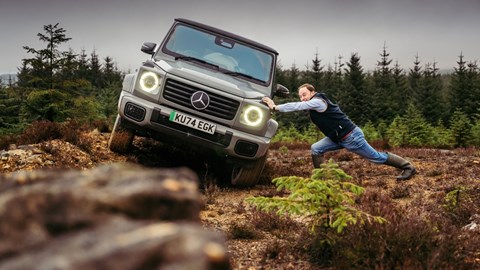
It is stupidly fun to do and stupidly simple to execute: rock mode, low range, hit the button quite clearly marked on the dash, pull the respective paddle shifter as to which way you want to turn, hit the throttle. Why is this so easy to do and yet turning off the speed warning bong is buried in sub-menus?
Two G-Turns later and the car is nearly buried up to its axles: the ground clearance is not the car’s strong point. Mercedes claims the battery is well protected, with a multi-material mix of underbody guards (including carbon, to save vital kilos off the kerb weight), but it still gnaws away at my mechanical sympathies as the odd rock catches the underside.
Endurance is also lacking. We averaged comfortably less than two miles per kWh so had to dive out of the forest to hit the nearest charge point, of which there were none. When we eventually locate one 45 minutes away, the G takes on electrons at over 150kW but it’s a painful waste of time that you wouldn’t get in an ICE car.
We continue to drive deeper into the forest, along tracks that are clearly less well-used. Trees have self-seeded close up to the side of the road and without the logging lorries to keep them pegged back, threaten to engulf the track in places. The forest gets darker and more remote – we startle the occasional feral goat that is obviously more used to hearing vehicles coming.
As the light fades, a fallen tree blocks our path. Hang on. An opportunity to use G-Turn in an actual real-world situation. Will social media ever recover? I twitch with anticipation – this could be our moment, electric G. Finger poised over the button, I’m ready to execute the move. Only for one of our group to ruin it by producing a hand saw and simply hacking the tree out of the way. Deflated, we push on.
We drive through another clearing and onto our overnight camping spot.
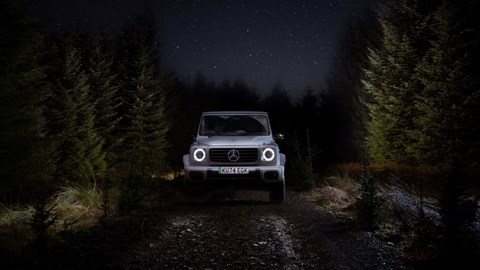
The wind has picked up and is now rocking the tops of the pine trees, who set up a chorus of creaks and whispers among themselves.
It’s pitch black when we reach our end point. Tent pitched, chilli con carne bubbling on the gas stove, it’s a chance to ponder the electric G. Hunkered down against the cold, front half of me toasty from the fire, back half bearing the brunt of this northern January night, the G stands silently nearby.
It’s a remarkable effort from Mercedes. Just as I admired the firm for sticking so rigidly to the script when it built the latest car, so I can’t help but feel we should praise it for this electric one as well. There must have been easier routes to making this thing, shortcuts that could have been taken, but the engineers ignored them all. It’s on brand – even the doors slam with the same solidity.
There are flaws, obviously. The price is ridiculous and the weight has really rammed home the limitations of batteries as an energy store, but as an object to absorb nature in every sense while also being cocooned in warmth, nothing gets close. It offers a glimpse of a calmer future.
Mercedes G580 with EQ Technology Edition One
- Price: £180,860 (£180,860 as tested)
- Powertrain: 116kWh battery, four e-motors, all-wheel drive
- Performance: 579bhp, 859lb ft, 4.7sec 0-62mph, 112mph
- Weight: 3209kg
- Efficiency: 2.0-2.2 miles per kWh (claimed), 1.5 miles per kWh (tested), 283-mile electric range (claimed), 174-mile electric range (tested), 0g/km CO2
- On sale: Now