► Ford’s Transit at 60
► A workhorse and cultural icon
► Stephen Bayley looks back
Henry being a man careful with his money, notions of economy have always affected Ford’s products. The ‘any colour so long as it is black’ approach was a money-saving principle, not aesthetic counselling. In Model T days, freshly painted cars were put out into the sun to dry and the thermal properties of black made them dry more quickly. It saved money.
And the Transit became the definitive white van, although as it became a semantically more complicated product, more sophisticated colours have been recently offered. But why white in the first place ? Because the tradesmen who bought Transits knew the resale value would be higher than if it was wearing someone’s livery. It saved money.
But blue is the other colour associated with Ford. The blue oval is blue collar, a badge irretrievably associated with working culture. In the US, the Ford F-150 truck has been the best-selling vehicle for 47 years (even if it now sells to as many college kids as lumberjacks). The Transit now has that best-selling status in the UK. And I think the Transit may be moving out of the plumber-builder sector.
The great architectural historian and academic cheer-leader for pop culture Reyner Banham once wrote: ‘If anthropologists and archaeologists continue to insist on evaluating civilisations by their artefacts, we deserve to be remembered by the Ford Transit.’ As Hoover once became an eponym for vacuum cleaner, so too did Transit become an eponym for ‘van’. How did this happen ?
The Transit was launched in 1965, the year when The Beatles sang Help! and Herman’s Hermits had five Hot 100 hits. It was also the year of the Renault 16 and the Rolls-Royce Silver Shadow, two altogether different propositions in car anthropology.
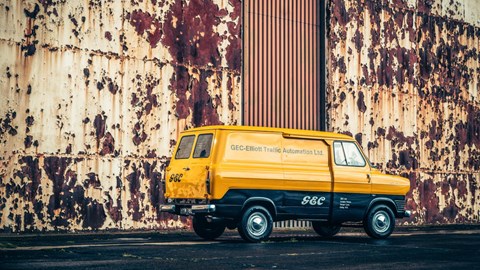
The name had been used by German Ford since 1953. Ford Koln’s FK1000 competed in European markets with Ford of Britain. The decision to rationalise all Ford vans under the Transit label in 1965 anticipated the creation of a more collaborative Ford of Europe in 1967.
It succeeded the well-liked Thames 400E Trader which had been on sale since 1957. Later versions of the 400E had design cues which the Transit inherited, notably a horizontal radiator grille often painted in a contrasting colour which separated the headlights.
This established a visual distinction between the Transit and two well-established Euro-vans, the Citroën H-Type and the Volkswagen Type 2 Transporter. But while the Citroën had corrugated bodywork inspired by a pre-WW2 Junkers 52 and the Volkswagen was born from a motorised industrial pallet, the style of the new Transit was emphatically American. Visually, its closest relation was the US Ford Econoline.
Ford’s culture, at least until recently, depended on a continuous stream of personnel traffic between Dagenham and Dearborn. The English went west to learn how to design the fake coruscating heraldry under the translucent vinyl boss of a Zodiac’s steering-wheel. Americans travelling east for inspiration were more rare.
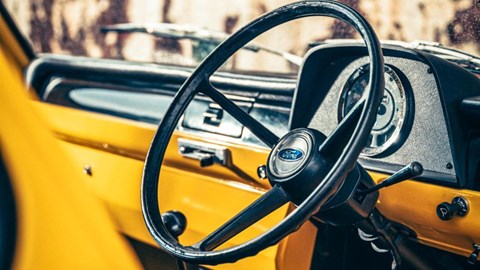
An exception was Roy Brown, an executive designer of the Ford Edsel who was banished to the Siberia of Essex after that car’s sales calamity. Brown promptly drew the car that became the 1962 Cortina, which brought the colours and flavours of American ice cream to a domestic market more used to Lyons Maid vanilla and black Humbers with brown upholstery. My feeling is that Brown’s presence influenced the Transit’s designers.
While the latest version, the fifth (?) generation (it is difficult to be precise about generations because there have been so many mid-cycle facelifts and upgrades) shares nothing but the name with the original, it seems, mysteriously, to be the same.
The original design was so appealing and functional (the short V4 engine optimising loadspace) that the first generation lived for 20 years. But it was also good to drive, at least as compared to most light commercials of the day, which rattled and crawled and conferred no form of status on the driver. These allowed the Transit to leap the species barrier and become more than just a ‘van’.
If we go to The Oxford English Dictionary, the definition of the word cites an origin in 1829 and explains that a van is a ‘covered vehicle chiefly employed for the conveyance of goods, usually resembling a large wooden box with arched roof and opening from behind’. The word then migrated from horse-‘n’-cart to the railways, where guards and mail were both accommodated in vans. But the Transit begat something else.
The extent to which any product becomes the symbol of a tribe is evidence of the power of its design, a power that reaches into the consumer psyche and twiddles all the dials. Thus, when Tony Blair wanted to sell his centrist politics to Middle England, he identified, or had identified for him, Mondeo Man. Here was a fellow in Gap chinos with a statement barbecue. (It’s been said that after Blair’s 1997 victory, the Conservatives desperately tried to buy the membership lists of the RAC and the Automobile Association to find their own Mondeo Men’)
It may be significant that Blair cautiously avoided flirting with Transit Man because here was a tribe he sensed was beyond his reach. The demotic appeal of the Transit is based on subtle evolutions in status involving the ennoblement of trade and the rising prestige of the artisan. Plumbers may be workers, but they are by no means necessarily Labour voters.
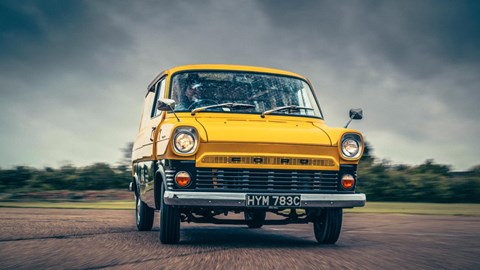
While the old Citroen H-Types have found new life as mobile pop-up bagel kitchens and the Volkswagen, no matter how many iterations followed the 1949 original, will always be associated with surfer dudes, the Transit began to occupy different psychological territory. This was the province of the notorious White Van Man, a carbon-based life-form.
By 2000, this tribe had become so established that a bewildered correspondent of Tthe New York Times felt compelled to comment: ‘In his hands he has a wheel, in his ears, rings; on his arms, tattoos; and in his heart, loathing for anyone he sees through his windshield.’ Of course, White Van Man might drive a Mercedes or a Renault, but a Transit was a better fit with his apex-predator psychology.
In the matter of cars and their tribal affiliations, we are in a discussion about witchcraft and sorcery. How can a van possess such mystique? In his the sociologist Stanley Cohen introduced the concept of the ‘folk devil’. This is Transit Man, a self-employed artisan subject to tribal rules shared only by others of his kind. This, of course, was why Tony Blair did not attempt to communicate with Transit Man: the nice pieties of New Labour were not on his agenda.
It was in 2012 that the Transit leapt that species barrier. The designer, Paul Campbell, a third-generation Ford veteran at the research centre in Dunton, told Commercial Motor: ‘We’ve rounded the corners off which makes the vehicle look smaller as it brings the initial contact point away from you. We’re not taking away from the usable loadspace, as it occurs above the usual load height. The same can be said at the front and the headlights where we’ve integrated protection into the bodywork with a cascade of protecting zones, bringing the painted areas away from any likely impact point.’
Thus, the subtleties and complexities of designing a simple van. But the Transit was no longer a simple van. It looked smaller, but was not smaller. The trapezoid grille made an association with Ford’s mainstream cars. And the Wonderland continued into the interior: the independent owner-driver now demanded car-like comfort and features, but with robust commercial durability. It’s what Campbell called ‘an uncommon driving environment’.
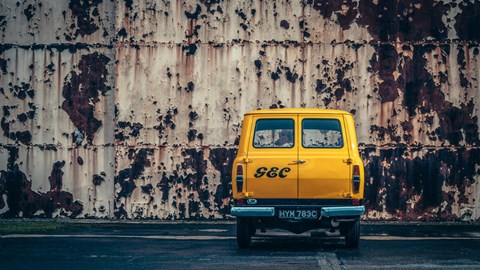
And an uncommon aspect too. Campbell ensured that his Transit had the ‘robust stance’ of its type. And in the Custom version ‘breathtaking sports design, bespoke interior upgrades and undeniable road presence’.
Meanwhile, there are two new cars on the road where I live, each equally eye-catching. The first, a peacock blue Porsche Panamera Hybrid. Second, a sea-green metallic Ford Transit Tourneo which is very shiny and excites a strange fascination in passers-by. As Ford’s wince-making marketing internal comms put it, the Transit has become a vehicle your wife will let you park on the drive. ‘Good appearance,’ Campbell says, is a ‘global constant’.
It may be hard to imagine a tattooed WVM being so gracious with respect to his wife’s taste, but Transit Man has evolved. He is no longer an enraged brute in a ‘wife-beater’ top and DMs, but a discriminating consumer in Prada sneakers. Besides, folk devils may now have their brute appetites appeased by a Sprinter or a Trafic.
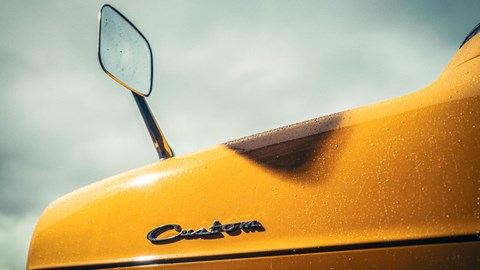
Transit is a thing apart. Since 2014, its design has been divided between Europe and the US. It is no longer a nameplate, but a sub-brand all its own. It has mutated into an entire species. It has blurred societal distinctions as well as the design distinction between a car and a van.
In his reign as Detroit’s king of kitsch, Harley Earl established an evolutionary imperative in car design. Things were to get lower and more decorated, hence more desirable. Of course, myriad hi-roof and lwb Transits are available, but the essential Transit follows precisely those vectors.
Icon is an abused term, a signal-passed-at-danger in most commentary. It is a religious concept… and brands simulate the structure of a religion. Mondeo Man has experienced an extinction-level event; so too has the working man. Sic transit gloria mundi. As they used to say in papal coronations.
But the Transit survives. Indeed, flourishes. It is more than a van. More than a brand. It’s the best evidence today of the vitality of car design.