► Jake reacts to Ford’s EV battle plans
► Universal EV Platform strategy is ambitious…
► …but is also a decade behind most major players
Newsflash, folks: Ford has announced an idea the rest of the car industry has already been doing for a decade – if not longer.
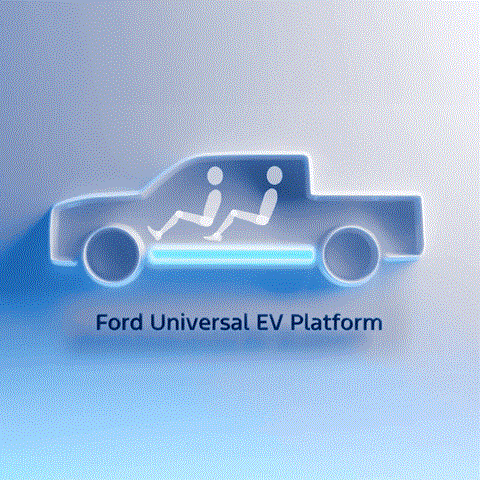
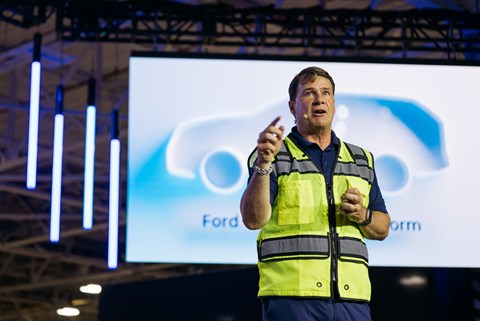
On a stage at its Louisville plant in Kentucky, Ford CEO Jim Farley enthuses about the brand’s new Universal EV Platform (UEVP) – the new battery-electric architecture that’ll be implemented in new EVs from 2027 onwards. ‘We took a radical approach to a very hard challenge: create affordable vehicles that delight customers in every way that matters – design, innovation, flexibility, space, driving pleasure, and cost of ownership – and do it with American workers,’ he says.
UEVP is one architecture to rule them all and send the competition packing. A reorganisation of manufacturing processes. A unified set of parts and powertrains with the ability to make no end of different models from the standard toolkit. One software platform to run it all. One design philosophy.
Just like Volkswagen Group has done for its ID cars, as well as countless generations of combustion cars for 30-odd years. Just like Stellantis has done since its formation, and both PSA and FCA did it before that. Just how Renault Group does it across its different brands. Just how British Leyland did it in the SEVENTIES. (Yes, alright – that last example isn’t a shining beacon of success.)
It’s not like Ford doesn’t also have history that surrounds this exact strategy. During the communications around the Universal EV Platform plan, it pointed to its work with the Model T, celebrating how it was the manufacturer that created the moving production line and made a car that could be transformed into plenty of body styles with just one toolkit of common parts.
There was also One Ford: a strategy that was designed to overhaul how it operated globally. Waste was cut. Architectures and technology were shared across regions. The cars, for the most part, were still good.
And yet Ford is passing this entire strategy off as some grand innovation that’ll completely turn the industry upside down. Beat China at its own game. Get the Blue Oval back on the front foot. It’s like the brand has some sort of corporate amnesia.
Ford is, in some ways, in a weird place. Its first EV of the current era, the provocatively named Mustang Mach-E, launched with a ‘GE1’ platform that went nowhere. The EVs that have launched since are based off very average Volkswagens and come with equally provocative names. In many of its markets, it’s shrank the number of vehicles it sells – even removing beloved and high-selling ones like the Fiesta here in Europe. And models that it does still sell, like the Puma and Puma ST, are (in our humble opinion) now fundamentally worse and more expensive cars than they are when they originally launched.
‘We’re fighting a battle globally that is, ultimately, testing our capability,’ says a Ford employee in a video promoting the UEVP. But what other car maker isn’t also fighting that same battle? What other car maker hasn’t seen this headwind coming for such a long time? Car makers have access to some of the world’s greatest analysts and future gazers, but it seems Ford’s have been looking at a rock rather than a crystal ball.
There are some good points to all of this. Strategies surrounding simplifying manufacturing are intended to lower the cost of these cars for buyers and make them much faster to build in its factories. The use of LFP batteries will also keep costs down. Ford is also claiming these new manufacturing processes will safeguard jobs at its US plants.
I’m also honestly interested and genuinely curious to see how its new generation of EVs will launch – particularly as this could be the gateway to cars like the Fiesta and Focus returning to markets that want them. The fact Ford is promising that these new cars will still be fun to drive is what separates it from most other volume car makers – and what makes the enthusiast in me excited, too.
But this supposed ‘Model T moment’ for electric cars feels like it comes a decade too late. Can Ford use that enormous delay to its advantage? Or will its glacial reaction times to global trends keep it behind the curve? That I simply don’t know.