► Half a century of the Espirit
► From the original to the V8
► Don’t mention Bond
Right. I’m going to tell this story without mentioning the Bond movie once. You know the film I mean – the one with the white car… that turns into a submarine… Gah! No! I’m not going there! I refuse to reduce this amazing car to a few seconds of flickering lights and popcorn. That famous appearance is too hackneyed now, like a 1970s rock band touring the country, endlessly performing the same old number one hit. That’s Noddy Holder’s job! I won’t do it!
So, this is NOT a story about The Bond Car. Instead, I want to talk about the Lotus Esprit.
If you think the Esprit looks good now, imagine what it was like seeing it for the first time, 50 years ago. One man who was there was Mike Kimberley, who joined Lotus in 1969 and soon became Colin Chapman’s right-hand man. Kimberley ran Lotus after Chapman’s death in 1982 and saved the company, eventually retiring in 2009. Kimberley turns 87 later this year, but both his handshake and his memory remain surprisingly grippy. Kimberley was there when Colin Chapman first met the Esprit’s designer, Giorgetto Giugiaro, at the 1971 Geneva motor show.
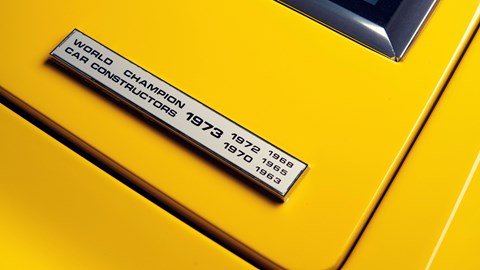
‘It was Olly [Oliver Winterbottom, then designer at Lotus] who wanted us to meet Giugiaro in Geneva, and it was Giugiaro who suggested he wanted to do a show car with us. Colin immediately said “Great idea, marvellous,” because we were looking to replace our Twin Cam Europa.’
As soon as they got home, Kimberley prepared a lengthened and widened Europa chassis and sent it down to Giugiaro at Italdesign in Turin. Chapman, Kimberley and Winterbottom then embarked on an exhausting schedule of flying to Italy two or three times a week to keep track of the project. Kimberley remembers seeing the sketches come to life.
‘Imagine, in 1972 – it was absolutely awesome!’ he says with a smile. ‘Colin and Giorgetto got on incredibly well – they were two creative, innovative people and they fed off each other. It was wonderful to be with them and see it.’
One of Kimberley’s many anecdotes goes concerns the Porsche Tapiro, a extremely wedgy Porsche concept from 1970, desgined by Giugiaro, with gullwing doors: ‘We were down there and we saw the Tapiro in the corner of a room, and Giorgetto very kindly said, “Would you like to drive it?” So Colin jumped in the driver’s seat and I got in the passenger seat and we drove into Turin. Anyway, it started to rain – and you can imagine, Turin on a busy day, in the rain, and the car’s windscreen angle was such that with the rain on it, we could hardly see out. Well, we got absolutely lost, I was navigating and got an earful from the Old Man. Eventually the Carabinieri came up, they took us back to Moncalieri (home of Italdesign). Giorgetto was outside, literally biting his nails because the car cost about a quarter of a million, a lot of money in those days! We had a lot of discussions about windscreen angle after that!’
Giugiaro’s stunning wedge was eventually displayed at the 1972 Turin motor show and it took a further three years to turn his concept into the production Esprit, launched at the Paris show in October 1975.
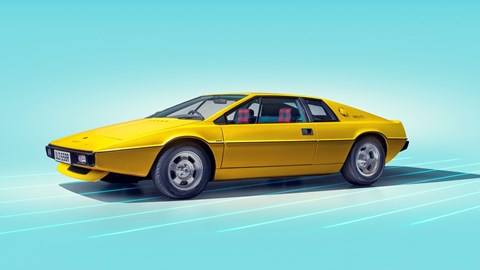
And 50 years later, when I walk out of the Lotus offices at Hethel in 2025 and see Scott Walker’s bright yellow example parked in the sunshine, I have the same shock those Paris crowds must have felt, all that time ago. ‘A graphical, rigorous, linear style’ was how Giugiaro himself described it – and the word ‘rigorous’ is crucial. The original Series 1 has the exactness of a mathematical formula and it’s as timeless as the Golden Ratio.
Scott is an Esprit specialist who originally restored this example for an American customer. It then came back to the UK and was owned by Steve Coogan for a while before Scott bought it himself. It’s chassis 39, built in June 1976, making it one of the very first production cars.
Scott starts telling me how he first fell in love with the Esprit, and before I know it he’s talking about that Bond film. ‘I first saw it on my sixth birthday,’ he tells me.
Scott, don’t go there.
‘Manchester, December 1977,’ he continues. ‘I wasn’t really into Bond and I wasn’t really interested in cinema, but that white car made such an impression on me.’
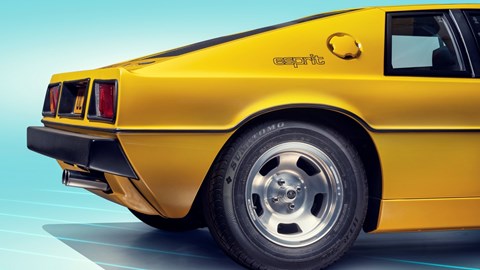
Too late. He said it.
Scott went on to work for Lotus dealer Bell & Colvill in the early 2000s, selling the Elise and Exige, and he remembers how the Esprit S1 wasn’t appreciated. ‘They just weren’t liked,’ he says. ‘You would find them in hedgerows and in gardens. In 2004 I bought chassis 34 for nine grand. Another early car in Scotland, it had been in a garage for years and had to be dragged out – I paid £4000.’
Scott became an independent specialist and then worked at Lotus as head of UK sales, but he’s always remained passionate about early Esprits. Prices have since rocketed, as enthusiasts have come to appreciate their status and rarity. Lotus only made 714 Series 1s before the car was upgraded to the S2 in 1978 – only 268 S1s were right-hand drive. Scott reckons his yellow car is now worth £100k.
And now I’m going to drive it. I open the door – which feels as light as a paper aeroplane – then lower myself into the gloriously retro-futuristic interior, clonking my head on the door frame as I climb in. The cabin is ridiculously low, but once you lie back in the pure, Giugiaro-concept, banana-shaped seats it’s surprisingly comfortable and roomy, the dashboard sloping away as steeply as the windscreen is slanting down to meet it. The mad, Space 1999 binnacle is perched on top, and only the cheap, plastic two-spoke wheel spoils Giugiaro’s sci-fi vision.
The S1’s sublime Type 907 engine deserves a whole feature of its own – an all-alloy, 2.0-litre, 16-valve four-cylinder, built in-house by Lotus in a huge effort to elevate itself above its kit-car beginnings. The 907 puts out around 160bhp, which is pitiful by modern standards, but bear in mind the S1 weighs around 900kg, a marvel of Lotus light-weighting.
I’d heard all kinds of stories about the Esprit – no torque, dodgy Citroën gearbox – but this S1 quickly dispels all of that. This revvy engine picks up with surprising verve and the gearchange feels wonderfully short-throw and satisfying. Best of all, the legendary Lotus balance is there – the feeling that the Esprit is on its tiptoes, just waiting to change direction. The unassisted steering isn’t heavy at speed but it remains resistant, so while you can drive with your fingertips it needs positive inputs to thread the car through corners. It makes you feel like you are absolutely in control, fine-tuning your position and angle by a degree here, a millimetre there. The only thing that surprises is the floaty rear end, which lacks the pinned-down sharpness of that needle nose.
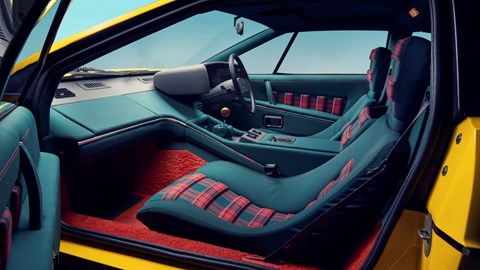
After a few laps of the Lotus test track, it’s clear the S1 is no supercar – it’s a sports car, in the ‘60s tradition, dressed up in that spellbinding shape.
Back in the pits I find another startling wedge waiting for me. Sharper and meaner looking than the S1, this is Jonathan Hackford’s 1980 Essex Turbo, one of the rarest and most sought-after of all Esprits.
Jonathan is another devotee. ‘Like many people, I went to see the Bond film and was blown away by that white Esprit,’ he tells me, as I choke on my coffee. Please don’t talk about Barbara Bach, I implore in my head. ‘More than that, I grew up in Norwich. My dad used to bring me to the open days here at Lotus and that’s where I first saw an Esprit. They were just like spaceships to a little kid.’
After owning a couple of Elises, Jonathan bought an S1 back in 2014 but he still hankered after an early Turbo. ‘I always wanted an Essex,’ he admits. ‘I just think they’re something else.’
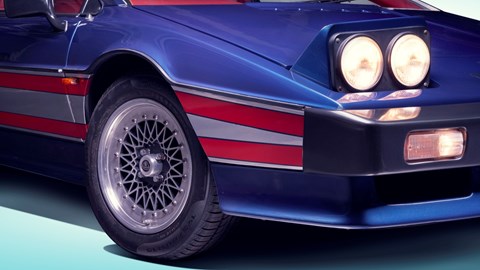
And the Essex was literally something else. The Series 2 had come along in 1978, sorting out many of the Esprit’s early teething troubles, but by then the four-cylinder 907 was falling behind its competitors. Kimberley and his team developed the dry-sump, 2.2-litre turbocharged Type 910, boosting power to 210bhp and cutting the 0-60mph time from a leisurely eight seconds to more like six. Giugiaro restyled the car with added wings and sills and the livery was taken from the F1 team’s sponsor.
But there’s more to the Essex than chrome tape and a turbo – it also had a new, galvanised backbone chassis, a wider front track and a redesigned rear suspension. It was a huge step – and was priced accordingly, at £20,000. Expensive and gaudy, the car wasn’t a big hit with customers and the planned run of 100 examples ended after just 34, before the sales effort shifted to the regular Turbo Esprit.
Of course, now we love the flamboyance of the Essex, with its red leather and its roof-mounted radio – ‘with a graphic equaliser!’ Jonathan points out. Anyone under the age of 30 won’t realise the potency of those words.
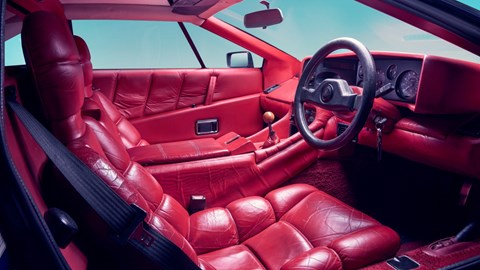
Inside, Giugiaro’s basic interior architecture is still here, but with more buttons, dials and fiddly details, plus so much ruched red leather it’s like being trapped in Liberace’s handbag. The first thing I notice on the move is the squeaking of all that cowhide. But straight away, the Essex has more urge and potency than the S1. Amazingly there is no whistle-bang turbo lag, and it accelerates with a powerful, linear surge. Kimberley tells me, their turbo installation really set new standards in its day. And while some of the delicacy of the S1 is lost, the handling has a more determined sense of purpose – the rear end is less flighty and the whole thing feels more stable and predictable.
If the Essex was a big step for the Esprit, seven years later there was a revolution. After over a decade of production, British stylist Peter Stevens was tasked with redesigning Giugiaro’s original shape. The result – which should have been the Series 4 but has always been known as the X180 – was a masterpiece in subtle modernisation. It still looks like an Esprit, and under the skin it’s mechanically very similar, but Stevens’ car looks so much more substantial, more grown-up than the delicate Giugiaro design.
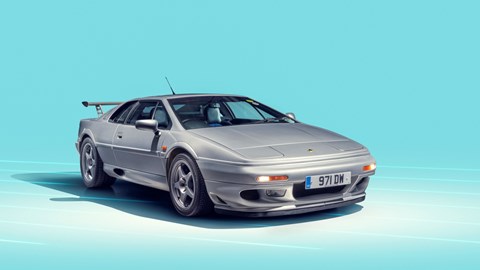
The X180 was refreshed in 1994 and it was this facelifted car – now dubbed the S4 – that finally ushered in the V8 engine that Chapman and Kimberley had always envisaged for the Esprit. The Lotus-developed engine, introduced in 1996, was a 3.5-litre, twin-turbo capable of producing 500bhp, but detuned to 350bhp to stop the gearbox eating itself.
Which brings us our third car here today, a Sport 350 from 2000, owned by former university lecturer David While. ‘I always wanted an Esprit,’ David tells me – and I know what’s coming next. ‘Partly because of Bond,’ he explains, ‘but originally it was the Europa that got me interested. Eventually I could afford to look around and this one came up for sale at a local dealer. At the time, I probably didn’t know what a Sport 350 was! I’ve learned a lot since.’
David paid £30k for his Esprit in 2005, and only afterwards discovered that just 42 Sport 350s were built. It has the same 350bhp output as the regular V8, remapped for better in-gear times, but with lighter, hand-laid fibreglass panels, better brakes, a set of gorgeous magnesium wheels and a carbon wing on the back. It weighs just 1300kg.
David admits, he doesn’t get to drive his Esprit very often, so I feel very honoured to take it out for a few laps at Hethel. It’s a very different experience to the S1 and Essex: sitting in it, it feels more serious straight away. The Giugiaro binnacle is gone, replaced by a more conventional dashboard, and the bucket seats and three-spoke steering wheel give this cabin a much more single-minded atmosphere. On the move, this engine catches me by surprise for the third time today.
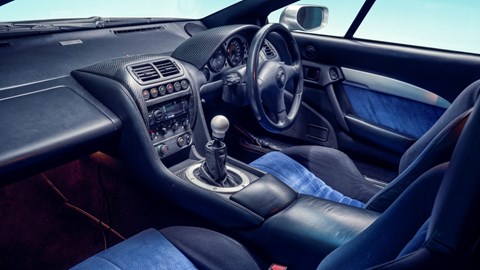
It just doesn’t feel like a V8 – it feels and sounds more like a big, smooth-revving four-cylinder, thanks to its flatplane crank and twin-turbo power delivery. But it is fast – still not lightning quick by modern standards, but impressive in the way it launches out of medium-speed corners. And despite being the only car here with power steering, it’s still incredibly communicative and direct and like the original this V8 is still so adept at changing direction through a series of esses. Compared to a modern 700bhp supercar it’s is a pussycat – but this late-model Esprit would still be amazing fun on a trackday.
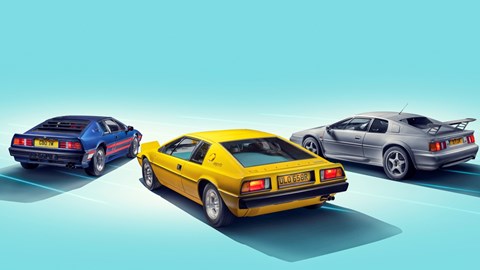
Amazing to think the Sport 350 is itself 25 years old now – it still looks so good, still surprisingly modern. It’s a theme that runs through the whole Esprit story – a car that seems to defy the aging process. Every Esprit of every era somehow remains sensational to this day – a testimony to the teams at Lotus and Ital Design who launched it 50 years ago. You could say nobody does it better.
NOOOOOOOOOOO!!!!