► CAR’s team review IAA Mobility 2025
► China’s influx of tech vs Germany’s defence
► Plus, US brand Scout’s surprising European display
2025’s IAA Mobility show – more colloquially known as the Munich motor show – has turned out to be one of the busiest and most significant in recent years, with several high-profile launches and entire brand U-turns hitting the headlines.
Curtis Moldrich, Ted Welford and Jake Groves were on the ground for CAR, manning show stands and jumping into executive interviews. This is what our roving reporters have found.
Boldy going where they’ve been before: Germany’s big three go retro at Munich
Back when I was much younger, it’ll come as no surprise that I used to collect car books. I was always taken aback by how dramatic designs like the Audi Avus, or BMW Nazca C2 concept were – but also just how exciting it must’ve been to be around when they debuted. Or even on the production side; what was it like to see the BMW E30 or the first time, or its 190E counterpart from Stuttgart?
Now, calm down. I’m not saying we’re reaching those heights right now, but it does feel like we’re reaching the 2020’s equivalent. It’s been a while since we’ve seen the three big German brands compete so directly and so differently, but that’s exactly what’s happened in Munich.
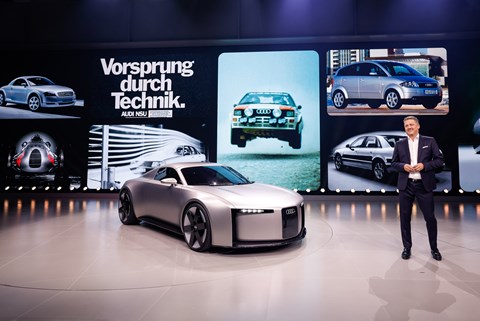
Equally retro and equally bold, the designs coming out of Ingolstadt, Stuttgart and Munich are most notable for their differences. Take the Audi Concept C for instance: a car that channels its Auto Union past but blends elements of the TT roadster and the streamliners of the 30s. It’s a mix of what’s kept Audi’s design consistent up until recently, and a far cry from the narrowing lights and flittery tech of its current Russian dolls.
Inside the Concept C there’s no let up on its geometric restraint, with an interior that focuses on buttons and shapes. It may not be to everyone’s tastes – most notably Mercedes’ design boss, Gordon Wagener who believes it’s too basic – but at least it’s doing something.
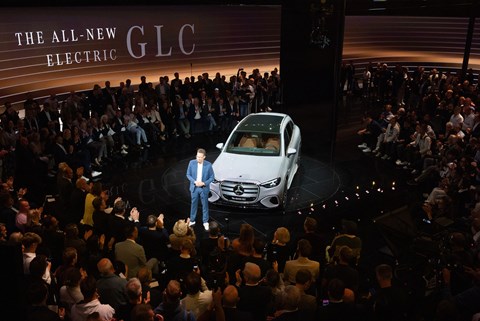
The philosophy in the GLC EV, revealed by Mercedes, couldn’t be more different. In the Benz, consumers face a gargantuan 39.1-inch screen – the biggest fitted to any Mercedes passenger car – and will use that along with significantly improved voice activation to get things done. Look up and you may even see Mercedes take on the Rolls’ starry sky: here, 162 three-pointed stars are suspended in the panoramic sunroof.
Things are equally flash outside: Mercedes styling boss Wagener has put three-pointed stars in the headlights, but they flank the biggest change of all: a new illuminated grille. Designed to hark to the past but with a strong remix that looks to the future, it’s decisive and eye-catching in its own way.
BMW has found its confidence too, with the production debut of its Neue Klasse-styling – albeit wrapped over an electric SUV first. It’s not my favourite, but a huge improvement over fussy, overly aggressive designs like the iX and the XM. Things will only get better when the new i3 arrives, though.
Inside it takes a third path, too: doubling down on a full-width head-up display that beams pretty much everything you could want onto the windscreen. BMW thinks it keeps your eyes on the road more, other brands think it’s by far the most distracting solution yet.
It’s been a while since car makers have been so divided on their solutions and the consumer has been presented with such a breadth of choice. That can only be a good thing.
As I write these, more cars and news are on the way, including a breakthrough in solid-state tech. There are also plans to keep emotional engines such as the V8, albeit with a bit of hybrid help.
Perhaps, years from now, a dusty book of concept cars will feature one of the above. And maybe it’ll foster the same interest and curiosity from a young reader. Then again, it’ll probably be on the internet – or TikTok.
Either way, who says the car industry isn’t interesting anymore?
By Curtis Moldrich, digital editor
Volkswagen’s most interesting car at the Munich motor show is the one that won’t be sold in Europe
Full disclosure, this year’s IAA Munich event was the first proper motor show I’ve been to in this job. I was meant to go to Geneva in 2020 before you-know-what put a stop to that. Even beforehand it was clear this was going to be a busy event, with Volkswagen Group undoubtedly dominating proceedings with the reveal of its new small electric car family and Audi’s new Concept C.
But the biggest surprise of VW’s traditional media afternoon was a vehicle that won’t ever be sold in the Europe – Scout Motors. I’d heard of Scout previously but had partly dismissed it as being another Bronco, Rivian, Hummer… you name it. But it’s hard to ignore the VW backing and money that has got this start-up off the ground so quickly.
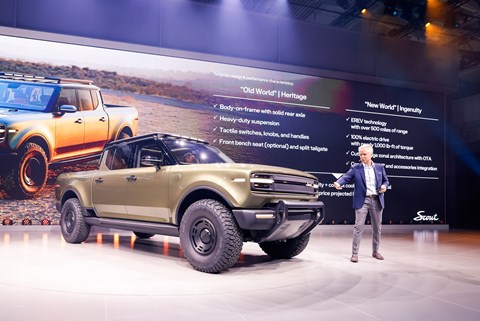
Possibly more impressive than the Scout vehicle itself is the man behind it, Scott Keogh, president and CEO of the 4×4 company. After a flurry of strait-laced German executives had taken to the stage to talk about their new products with perfectly rehearsed speeches, Keogh’s ending was a breath of fresh air. One of those people that has an aura that makes everyone sit up and listen to every word, any audience background noise stopping instantly.
Keogh, former president of both Audi and Volkswagen in the US, is a VW veteran but Americans are just generally more interesting than their German counterparts. With his slick back hair, ad-hoc speech, he spoke openly about the ‘single biggest industrial policy shift’ in America, but the opportunities that Scout Motors being US-built, designed and aimed brings.
A new factory in Blythewood, South Carolina, is already well on its way ahead of planned production starting in 2027. Following Trump’s policy changes, Keogh describes a factory as a ‘strategic asset’, and it couldn’t have come at a better time.
Americans love nostalgia and Scout aims to play on that, albeit using VW Group bits and pieces – most notably the firm’s tried-and-tested 1.5-litre petrol engine that’s joined by electric motors to become a powerful range extender.
‘A range extender basically speaks for America’s ‘we want everything approach’,’ Keogh said.
But it’s the CEO’s ability to poke fun at those within the VW Group that’s most amusing. Keogh is open that the Scout is not a European vehicle, and its size looks ridiculous on this stage, but he says ‘it’s the right thing at the right time’ for the US.
‘Americans know how to use door handles, they know how to use switches, that’s why our Scout has them,’ he jokes.
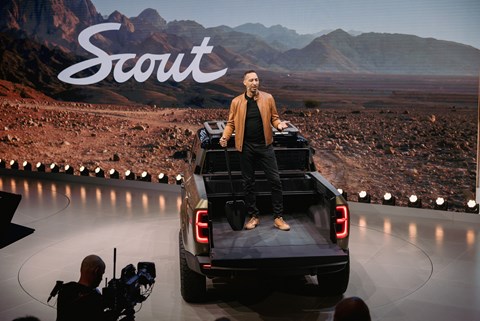
At the end of his presentation, a German journalist sat next to me, turned and said ‘why can’t Germans be this interesting? That’s where we’re going wrong.’ It’s hard not to agree, and the more I think about it, the more I can’t help but thinking that excitement is what’s missing at the very top of the German car industry.
By Ted Welford, new cars editor
Small EVs look promising, but Europe still has a fight on its hands against China
Four new Volkswagen Group cars REVEALED! Apart from, er, none of them were actually ready yet. VW Group took to the Munich motor show to “launch” its new range of Brand Group Core small electric cars that are designed to compete with China’s huge wave of new EVs entering Europe’s market. The new VW ID. Polo, the sporty ID. Polo GTI, sensible Skoda Epiq and racy Cupra Raval are all the result of VW Group sort of coming to its senses and getting its brands to work more closely again. Synergies! Cost efficiencies! Distinct new vehicles!
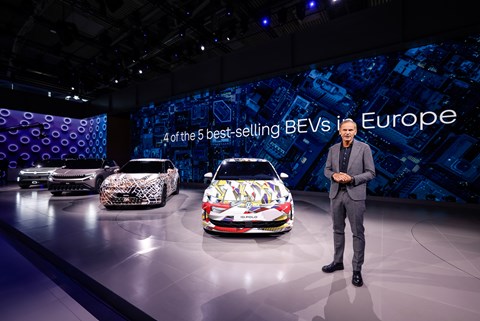
They all sound pretty promising: big car tech. Reasonable (if not amazing) range and priced to compete. They are, however, a bit late. Renault Group, for example, has had small electric cars on sale for a while now, hoovering up sales with models like the charming Renault 5.
But, while VW Group obsessed about going small and cheap, China’s confidence was on display with even techier and even more sophisticated vehicles. There were no end of brand and model launches from Chinese marques, to the point that it was a little hard to keep up.
Directly next to the Volkswagen Group stand (funny, that) was Xpeng – a cosy show area mobbed the entire media day, showing off its new flourescent green P7 four-door, as well as robots and flying cars. Nio had demonstrations of its new ET9 flagship, demonstrating its active suspension technology. BYD was gunning directly for Volkswagen with the Seal 06 saloon and estate.
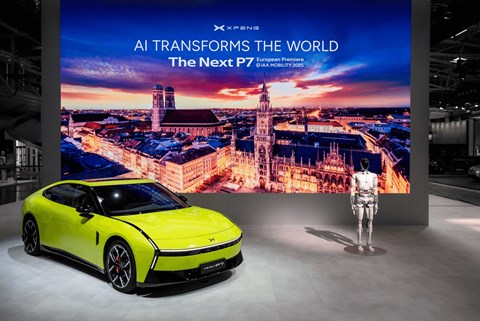
The German brands are definitely fighting back – much more than they ever have done previously. But China’s pace simply can’t be ignored. Hot take, I know – but Munich’s stands have done nothing but magnify China’s growing presence in Europe.
By Jake Groves, news editor