► VW’s van/minibus/camper turns 75
► In production since 1950
► Celebrating with huge convoy at Goodwood Revival
What do you do when you have a landmark birthday? You invite loads of your friends and family, put on your finest and celebrate with a party of course.
The VW Transporter has been in production in its various forms for 75 years in 2025, having first appeared way back in 1950. It’s won countless accolades and many more fans over that time, and plenty of those have been paying tribute in what is yet another notable anniversary year for the bus/van.
I was lucky enough to be able to join in on the latest of these, lining up on the grid at the 2025 Goodwood Revival for two laps of the track as part of a special tributary parade that took place each morning before the racing started in earnest. But it nearly didn’t happen.
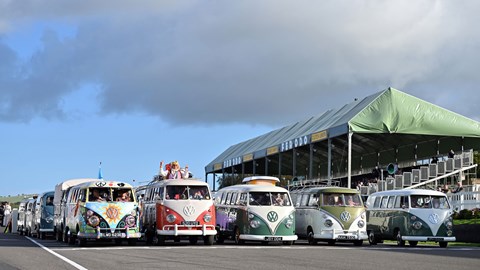
There were around 120 Type 2 vans, buses and pickups that rumbled and tooted their way around the track, with split screens and sunroofs open so passengers and drivers alike could drink in the appreciation of the marshals and early Revival attendees.
Late to the party
‘Our’ bus was a 1967 Type 2 Split Screen Westfalia pop top that started life in Ohio, USA. It spent 15 years there before returning to the UK in 1982 where it later got restored to the stunning condition it’s in today. Except on the Sunday morning it was due to be lapping Goodwood’s track, one element was not in quite such good condition as the rest of it, as the engine was doing what vehicles approaching their 60th birthday (and their drivers) sometimes do and was refusing to get going in the morning.
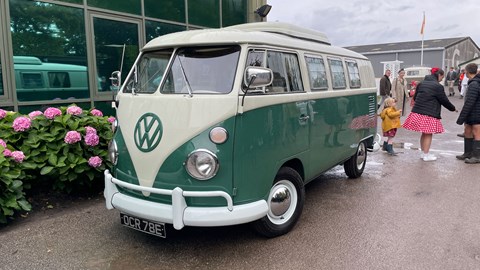
We couldn’t have been in better company, though, with a team of German mechanics over and on hand to tweak and fettle the immaculate looking but reluctant 49bhp 1.6-litre engine. The time we had to be on the grid edged ever closer as the likelihood of our joining the throng diminished. Plans were made for a back up, with two spaces apparently available in the mechanics’ own bus, but this would leave our youngest passengers without a ride.
With around a minute to go, the engine burst into life once more and sounded like it was going to last more than a fleeting moment this time. My German is rusty but I still understood the instructions of ‘Keep the revs high and don’t let them drop when changing gear’ before they were translated.
Out to join the fun
We leapt aboard and were one of the last few vehicles to make it onto track, with the revs and adrenaline both high. I’d love to pretend that the latter eased as we cruised around, but that would be a lie. I was driving an unfamiliar and immaculate classic – that had mere moments previously been not working – around a track with witnesses primed should I stall at the far side of the circuit. The shame would have been too much to bear.
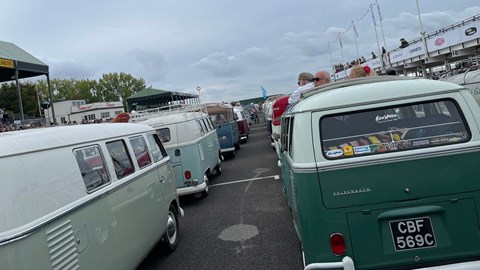
Mercifully we passed the start line, waved to friends and family and even made it into third gear. No-one was moving particularly quickly, though, choosing to drink the atmosphere in rather than rush around and have it end sooner.
Following lap two, on which we even overtook someone to the delight of the youngest passengers, we peeled into the pits, delighted we had been able to pay tribute in such esteemed company with the bus not putting a foot wrong.
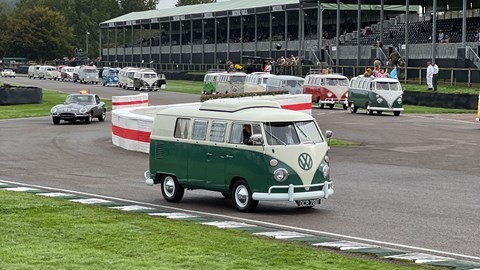
We’ll overlook the fact that it chose to shut down and refuse to restart before we had pulled to a final halt – it must have known its work for the day was done. Given the quality of the care it had before we set off, it was in fine hands it won’t have been long until it was running again soon.
The history of an icon
VW was still under British military supervision in 1947 when the idea was first mooted. A couple of mock-ups were rejected but a panel-van prototype was shown in 1949 and in 1950 production began on the Mk1 (which became known as the T1, although it wasn’t actually called that at first, in much the same way that the Beetle wasn’t initially badged Beetle). It was made as a panel van, passenger van and eight-seater.
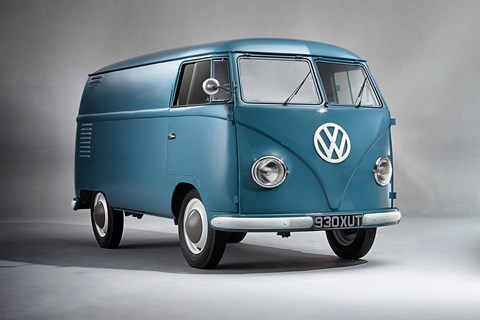
It used the engine and gearbox from the Beetle and had the same rear-engined, rear-drive layout, but was in fact aerodynamically superior to the Bug. The real magic was the low, flat floor, combined with VW’s open-door approach to collaboration.
Soon there were mobile-shop, tipper-truck, fire-brigade and ice-cream van versions from outside companies. By 1954 there had already been 30 variants, including 1951’s influential Samba – with windows all round and a folding sunroof – and in 1953 Westfalia offered for the first time a fully-fitted camper.
Both pioneering and convention-following
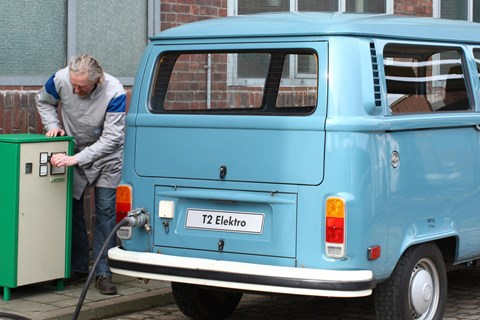
The T1’s split windscreen was replaced for 1967’s T2, dubbed the ‘bay window’ version, which also had a sliding side door as standard. In 1972 an electric version was available – four years before VW tried an electric Golf – although most Transporters retained a simple air-cooled petrol engine.
Liquid-cooling arrived in 1983, during the reign of the wider-bodied T3. The all-wheel-drive Syncro model turned out to offer desert racing potential.
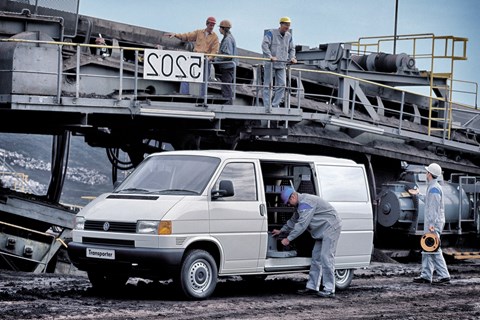
The biggest change came in 1990 with the T4, which kept the Transporter name but ditched everything else in favour of front engine and front-wheel drive. It was, however, still available in a wide variety of styles, including a custom-ready bare chassis, and a choice of wheelbases.
Present and future
This is where things have started to diverge somewhat. The Transporter van remains on sale, but is no longer a Volkswagen strictly speaking. This is certainly the case as far as its engine, gearbox and other fundamentals are concerned, but likely in the eyes of its legion of fans too.
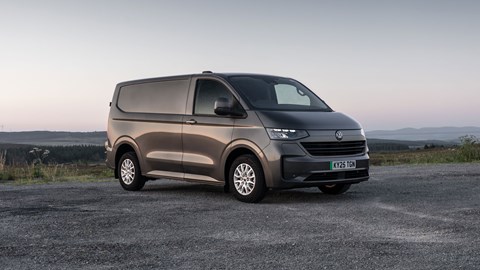
A partnership with Ford means that the latest Transporter is one of several vehicles that has been theoretically co-created with the brand’s traditional biggest rival in the UK. However, Ford was the lead partner in the medium van project so the Transporter is basically a Transit Custom with a few tweaks, using Ford’s engines, gearboxes and much more.
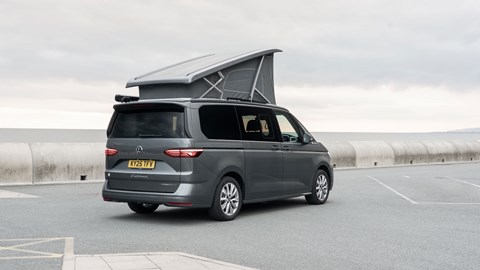
All is not lost for VW van fans, though, as the California campervan is no longer based on the Transporter van, having shifted to being a Multivan underneath and therefore sitting on the same MQB platform that also forms the basis of vehicles such as the Golf hatchback and Caddy Cargo small van. This brings benefits in terms of layout, comfort and driving ability, but there is also the possibility that VW knew its fanbase wouldn’t have much truck with one of its most adored models being a Ford underneath.
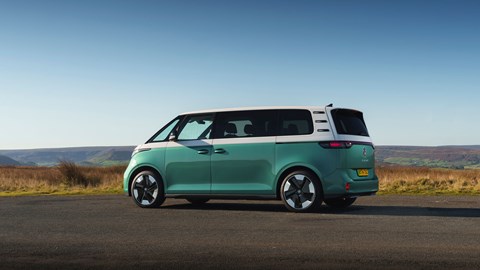
There is also the VW ID.Buzz, which comes in bus and Cargo formats. This is electric only but channels a lot of the original van’s looks and design features. There’s no version fitted with beds and kitchen etc as yet, but it remains a possibility, so long as there is a market for a battery-powered camper.
So things have changed a little as far as VW’s famous bus has concerned, but the spirit of its 1950 original carries on to this day.