► We drive the last V90
► From the factory to the museum
► And we also drive an early 960
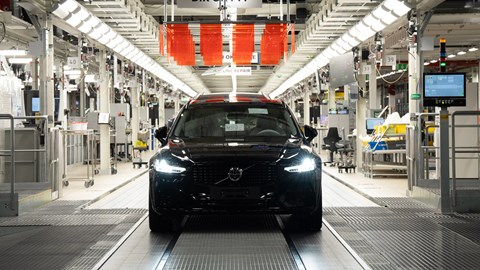
It starts like a journey in any other V90 – a twist of the knurled ignition switch followed by a delicate pull of the ornate crystal gear shifter. Only this isn’t any V90, it’s the last one ever made – and I’m about to drive it off Volvo’s Gothenburg production line for the final time. Soon I’ll get the signal from the shift manager to pull away, and then that’ll be it. The end of the line for one of Volvo’s most celebrated wagons.
Inside, the Volvo’s usually minimalist interior is coated in protection, with the wheel and switchgear covered by bits of paper and cloth. The touchscreen beams red warnings and the clock reads 3km. This V90 won’t do too many more, as we’re taking it to the World of Volvo where it’ll remain as an exhibit.
For years the Volvo estate has been an automotive signpost for the leftfield, alternative or honest. Taking over from the ‘Saab’ vibe, Volvos’ blocky looks have them the transport choice of anti-heroes, mavericks, architects and moody loners – those not interested in the obvious choice of a German wagon. Or British one. There’s a reason DCI John Luther, Simon Templar – and even Gavin & Stacey – all travel in a Volvo, though not the same one. Obviously.
So why is this happening? Because Volvo isn’t just about estates – and in 2025, it’s barely about estates. Its current business plan is a sensible reaction to the times: models like the EX30 are on trend, while others like the EX90 SUV and ES90 hatchback-thing cater towards the evolving needs of consumers. Premium wagons like the V90 simply don’t fit into this strange new world, but it doesn’t make today any less sombre.
‘I think we peaked at around a third,’ Volvo’s Martin Hamlet, vehicle product lead of 90-series says. ‘The volume of V90 has not reached half of the XC90,’ he adds, as we stand next to the last V90. And the XC90 isn’t even Volvo’s top-selling car. That honour belongs to the XC60, which recently surpassed the iconic 240 estate with over 2.7 million units sold since its introduction in 2008. It’s taken two years less than the 240, which was produced between 1974 and 1993. There can be no better sign of the times than that.
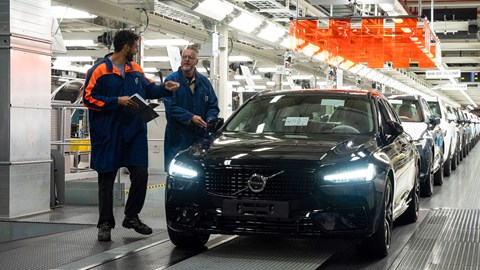
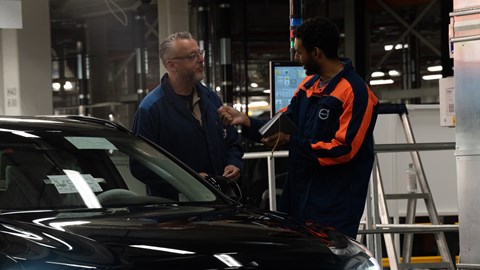
Earlier that morning I’m plodding around the Gothenburg factory, jewellery off, and draped in the almost ceremonial orange and blue Volvo workwear. The mood is heavy, and not just because of the factory boots I must wear instead of trainers. Much like an amicable break up, necessity and sadness hang in these fluorescently lit corridors: Volvo doesn’t want to part with one of its most celebrated models, but it’s just not making sense anymore.
The strategy works on paper, but its natural conclusion, here on the factory floor, is gut wrenching. I feel it later as I gingerly edge the V90 off the whirring production line and drive just a few feet, parking it next to a pristine 145 estate. A crowd has assembled, clapping, but also acutely aware of the paradigm shift this event represents. Who knows what sort of Volvos this factory will be making in a decade.
While the Volvo V60 continues, the discontinuation of the V90 leaves a huge hole in Gothenburg’s range. Originally called the 960 (changing to the V90 in 1997) Volvo’s first range-topping wagon launched into the premium, executive market in a way the 240 and 740 simply couldn’t. Rear-wheel drive, elegantly sprung and meticulously finished inside, it maintained the blocky, practical signature of previous estates, but combined it with a new level of luxury.
Full disclosure: I grew up in Volvo estates; first peering out of a metallic blue 740 GLE (March 1986, no longer on the road) and then from the back of a green metallic 850 T5 with a tan leather interior. Both cars were unlikely pillars of my car enthusiasm, with all Volvo estates having a pull over me ever since.
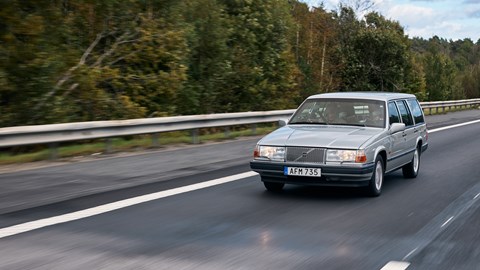
That’s why I take the time to drive one of Volvo’s classic 960s the day before. Part of the pristine heritage fleet, the 1990 car I drive is an intricate brick. It’s finished in metallic silver with an interior finished in a similar hue to Volvo’s new oxblood red colour. The boot is stupidly wide and low, the doors thin but sturdy, and all shut with a satisfying thunk. Inside the car feels like a mixture of the old and the new.
Electric door switches are arranged like vintage hi-fi switchgear, but the physical cockpit dials feel very 90s, and identical to that in an 850. Just above the transmission tunnel there’s an engine timer to warm-up the car before use – essential in Sweden. There are no touchscreens here, but you don’t miss them. What I do miss are Volvo’s ‘see through’ headrest with detachable cushions, which I’ve come to admire greatly in recent years.
Riding shotgun is Volvo’s head of heritage, Hans Hedberg, and despite driving the car countless times, it remains a special experience for him. ‘I must say it’s quite of a unicorn of the 960 just this example, actually,’ he explains. ‘This model originally belonged to company CEO, Pehr G. Gyllenhammar.’ Made in 1990 and with just 152,000 miles on the clock, it could’ve rolled out of the factory across town just hours ago.
‘It’s not off the shelf car,’ Hedberg tells me. ‘It’s very hand handmade more or less for the family of our third CEO. That makes it even classier.’
The belt line, rises just past the hips and make it feel as though I’m almost sitting on top of the car, surrounded by a glasshouse like a Swedish Popemobile. Visibility is second to none and peering over the expanse of bonnet isn’t remotely stressful. A commanding driving position is widely cited as one of the many benefits of modern SUVs – but here it is, alive and well in a car first produced in 1997.
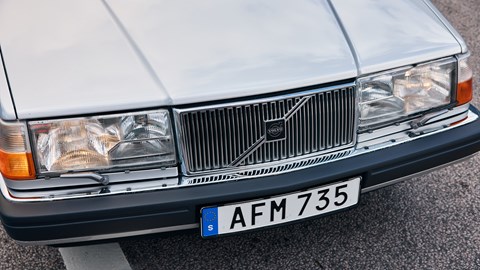
Twist the ignition and the Volvo’s 3.0-litre in-line six-cylinder gently rumbles into life. It’s louder than the near-silent systems of Volvo’s twin-engine range, but it’s more refined than I expect. Once we get going it just feels like a class act.
We’ve a choice of gears, but Eco is the most refined (Sport is a bit too eager to kick down) and when selected the car feels smooth, compliant and ready to put in the miles. In this mode I can feel the latent power under my right foot, but it purrs in normal traffic and motorway speeds.
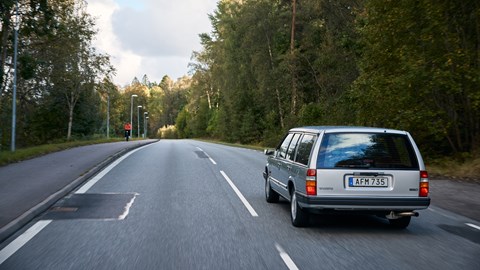
‘It’s almost like an electric car, when you have lot of power, but you don’t use it,’ Hedberg remarks next to me.’ You get very comfortable – you know you have it if you need it.’
The steering has play but less than you’d expect for a car of this age, and the only real sign of this car’s 35-year-old life is its braking performance which is predictable but relatively weak. The only light illuminated on the dash is for the ABS, so we’ll let that one go.
Fast-forward 35 years and one day, and the Volvo V90 has become arguably the best estate Gothenburg has made. ‘We pushed the boundaries’ says V90 project lead Jörgen Svensson, looking back at the car on the factory floor.
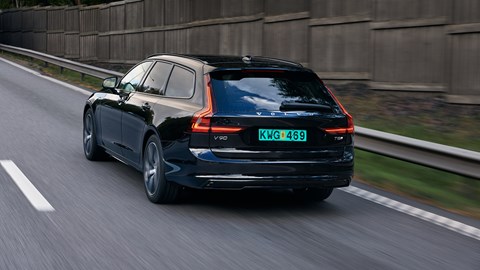
‘If you look at the earlier estates, they were, we should be practical. It should be versatile, and stuff like that – but at the expense of design,’ Svensson explains. ‘With the current V90, we took a huge step towards with the design, and we prioritized it much, much more compared to the earlier ones.’
Credited with taking Volvo to a new level, the V90 still carrying the DNA of the Volvo’s I’ve grown up with – understated, classy and somehow just needing a few kids and a dog in the boot to make everything okay again. But even the boot wasn’t safe from revision:
‘For the rear end of the V90 we had that was a huge discussion of how much slope you should have actually,’ he adds. A more angled cut-off meant more athletic looks, but less loading space as a result.
As I edge out of the factory and make my way to the World of Volvo, I speak to my co-pilot Hans about the car I’m driving. ‘I’m really fond of how this car behaves over a long distance,’ he says. ‘Driving a car like this on icy road in northern Sweden. Maybe with studded tires. It’s just excellent transport,’ he continues.
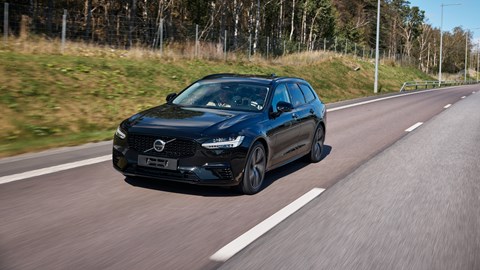
Equipped with the T8 engine the Volvo V90 still feels fresh, but as we drive on to the museum, we pass Polestar’s alien-like ‘cube’ HQ. A new brand designed to tackle head-on the electric, sustainable landscape it’s a reminder that Volvo – with all its heritage and history – must also adapt or die.
Some quiet roads give me a chance to revisit the V90’s ride, handling and refinement – and have a peek under some of the protective layers. The T8 puts out 449bhp, does 0-62mph in 4.8 seconds and is capable of 52 miles in EV-only mode. Here it feels more than enough, and with all the benefits of an EV in town, and a petrol-powered car everywhere else.
Inside, the V90 is ageing but not in a bad way. Like the Polestar 2, it straddles a pleasing balance between digital and tactile, with a touchscreen (now considered small) flanked by air vents you can move – with your own hands. It’s a far cry from Star Trek-like set up of my Polestar 4 long-termer.
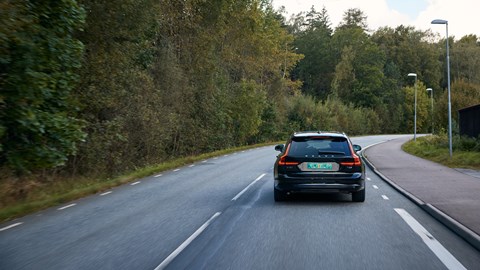
The handling too, is just easy and intuitive with no hint of the 488-litre boot behind me. The T8 trim this car is in gives you adaptive dampers and rear-air suspension which provide it with a touch of waft that you can dial out in Sport mode. It’s the same touch of waft as the V90 I drove just 24 hours before.
With just 32km on the clock, I’m beginning to settle into the V90’s relaxing driving experience, but Hans points out the looming silhouette of the World of Volvo – the bright, airy building that’ll be its home from now on. It’ll sit here alongside other relics such as the 850 T5 R, C70 and the first-gen XC90, which Hans himself drove here years ago.
As we park up, I spend a moment taking in what could be the last true Volvo estate. This drive is etched into my memory now, just like the trips in the blue 740 all those years ago – or those quicker ones in the 850 T5 that came a few years later. Perhaps this is an end of a chapter for me, as much as Volvo.
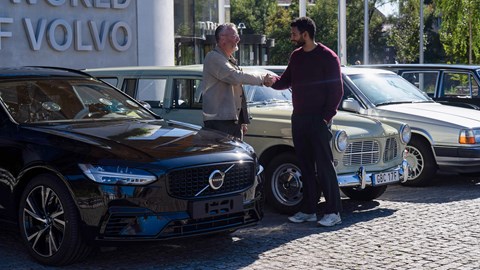
As I hand over the keys, a Mulberry Red ES90 catches the light in the lobby – odd, elevated stance, sensor array and all. It points to where Volvo is going; but whether it will be remembered as fondly as the cars gathered here is a question for another time.