► The R4 E-Tech is rather good
► How does it compare to small, clever Renaults?
► Twingo, Clio, R5 and an original meet up
Some unnecessarily intricate things: making tea with loose leaves, shaving with a cut-throat razor, cricket, pipe organs and Renault interiors. All these things have simpler, more automated, synthesised alternatives, but why would you? Here we have five Renaults spanning more than 50 years, and even the simplest, most conventional interior here is a treat for the eyes, ears and fingers.
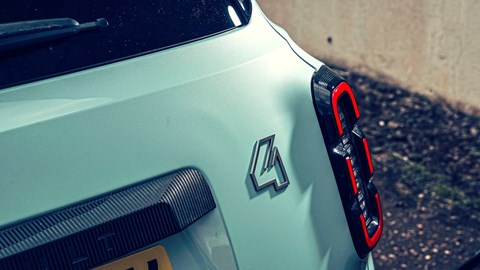
The retro electric 5 project clearly started with the exterior, and a great job they did of it. But the new electric 4 is a subtler affair, a car that only really makes sense when you’re inside it. Here you can appreciate the extra space and versatility – the sensible advances over the slightly smaller 5. But there’s also a lot that’s not particularly sensible, which is where the 4’s full glory becomes apparent, and its real connection with Renault tradition.
For the driver, a textured dashboard that you want to stroke, and metallic buttons for adjusting the temperature. For the passengers, a bobbly roof. In the boot, tricolour-motif stretchy bands to hold small items of luggage in place. And so much more. Everywhere you look, the details make you smile; make you glad they’re in your life. Unlike most small, cheap cars, which have interiors built down to a price, and then down a bit more, the new Renault 4 has fabrics and features you’d be delighted to have in your home.
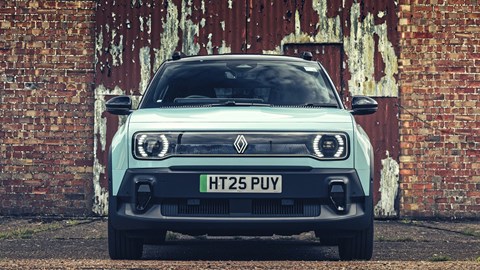
The earliest model represented here is the original 4, although this one is actually from quite late in the 4’s long and very successful production run. Many details evolved during that time but the overall idea didn’t deviate one jot.
We also have a 5. Not any old 5, but one that’s utterly original – super-low mileage, zero restoration work – and quite breathtaking to look at, inside and out.
And of course a Clio. Still with us, the Clio was originally conceived as Renault’s replacement for the 5, although the 5 was in no hurry to step aside. Through its five generations (and counting) it’s been a collosal success.
Then there’s the Twingo. It’s been through three iterations, two of them exceptionally peculiar, and is about to follow the 4 and 5 by being reborn in retro electric guise. If that new Twingo EV follows in the same spirit as the 5, it will not only satisfy those with fond notstalgic memories of the original, it will also be sufficiently striking and effective to win over buyers with little or no recollection of the goofy original, or the Clio-lite Mk2, or the mid-engined Mk3.
So, interesting times in the world of small Renaults. Although, having spent a day in the company of these cars’ owners, it seems that the world of small Renaults is always interesting. These owners have a formidable level of knowledge and enthusiasm, accompanied by an infectious degree of good humour. (And, without exception, they all have great knowledge and enthusiasm for various non-Renault cars too.)
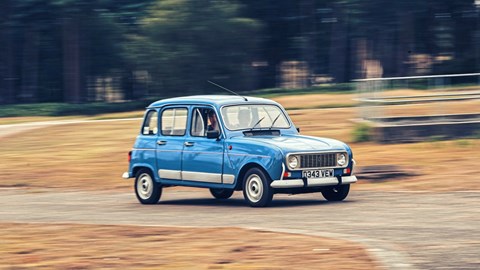
First, the old Renault 4. The tiny old Renault 4, when you park it next to the new one. Oh how we laughed, or at least raised an eyebrow or two, when Renault announced it was following the brilliant retro electric 5 with a retro electric 4, and showed photos of a car that was almost as anonymous as the 5 is distinctive, and considerably bigger (and, being electric, heavier). Take the badges off and it might not be possible to tell it’s a Renault, let alone a Renault 4.
But upon mature reflection it’s not the heavy-handed cash-in that it might first appear. There are connections between the old and new 4, in terms of its looks (tenuous, if you’re being generous) and its ethos (totally).
It was created as Renault’s response to the Citroën 2CV, but was in reality much more substantial and always had liquid-cooled four-cylinder engines. People didn’t buy them for reasons of style or excitement, but to use them. It’s by spending time in an original 4, and talking to owner David Cunningham, that I’ve come to appreciate the new 4.
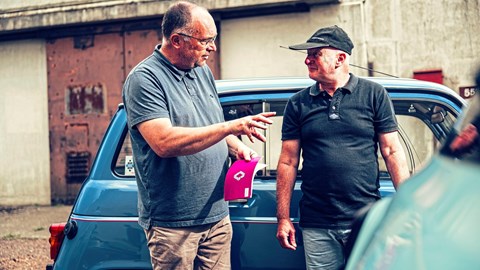
Cunningham’s car is part of the family. It was bought brand new by his mum in September 1986 – one of the last right-hand-drive 4s. It was her fifth and final Renault 4; she also had a 5. And who did the pre-delivery inspection at Swan Street Motors in Spalding, Lincolnshire? David Cunningham himself, who worked at two Renault dealerships (and later moved from the workshop into sales; he’s currently part-time at BMW dealer Sycamore in Peterborough).
‘She kept it three years and sold it to a family friend, who had it four or five years. But then one day my wife noticed it parked outside their house with a “for sale” sign. Apparently it had only been there for half an hour, and it was quite by chance that she was driving past – it wasn’t her normal route.
‘My wife had it quite a while. Then we sold it to a guy in Windsor. We randomly phoned him 24 years ago and asked how he was getting on, and he said he’d just bought a Renault 5, so he didn’t need the 4 any more. So we bought it back, again.
‘By now it was starting to show signs of wear and tear. I took it to a bloke who did only Renault 4s. He sorted the rust and the brake lines, and then we had it painted.’
It’s a GTL model, so quite upmarket, with the 1108cc engine, heated rear window and mouldings along the side of the body. It’s mostly either original or ‘as original’, but with a few exceptions. For instance the wheels were originally silver, but he’s painted them cream to match the bumpers. He’s also added some sound deadening.
Cunningham says his car is often the only 4 at car shows. Occasionally other owners will query the twin pinstripes; they were a dealer-supplied extra. And they’ll query the diamond-shaped indicator repeaters on the sides: these were genuine original Renault fitment, but not on many cars.
To drive, there are echoes of the electric 4, in that it’s a car not designed to be hurried, instead majoring on comfort. And where the electric 4 baffles everybody here today with its lack of a P mode on the drive selector stalk (you’re meant to just put it in neutral and engage the electronic parking brake), the old 4 has a dash-mounted gearlever that, if you’ve not used one for a couple of decades, takes a few years to get the hang of. Still, lovely and roomy, and delightfully uncluttered with its sliding windows and manually-operated interior light. And great for a tip run, he insists.
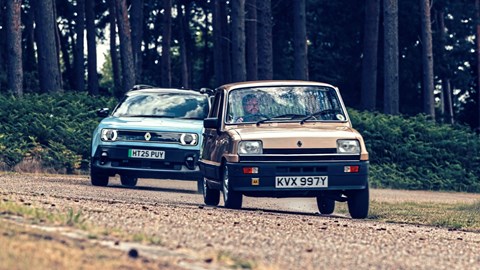
Like David Cunningham’s 4, the Renault 5 you see here also has a ‘keep it in the family’ back story. The 5 was a hugely popular car for a long time, selling more than five million in Mk1 guise between 1972 and 1985, and appealing to all sorts of people – a bit like the Mini and the Golf. But eventually it faded away, and most examples aside from the wild 5 Turbo and GT Turbo met their inevitable destiny. There’s recently been an upswing in interest, and in values, triggered in part by the electric 5, and restoration is back on the cards, rather than the scrapheap.
But this particular car is not a candidate for either scrapheap or restoration.It has become a remarkable time capsule though the simple expedient of doing nothing. It’s completely standard. That includes the very of-its-time lack of certain features that were extras back in 1983. So this car has no passenger-side mirror, no radio and no headrests (but the slots are in place should you choose to upgrade). Bear in mind this is an upmarket GTL version from 11 years into the 5’s life, with a relatively perky 1108cc engine.
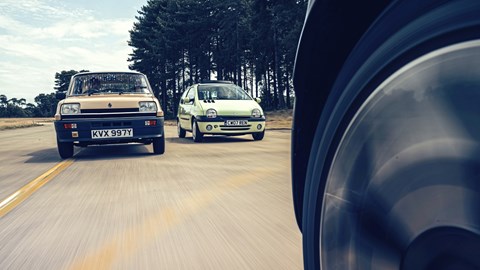
Perhaps more than any of the other cars here today, this is the one that sums up Renault’s ‘surprise and delight’ approach to interiors. The fabrics, the shapes, the ergonomics: everything is just that little bit better than it needs to be. It feels special, and is a packaging masterclass, helped by the lack of clutter that is harder to achieve in more safety-conscious times.
It’s owned by Ben Harratt and his dad Nigel, who run William Hodge and Sons, a dealership in Much Hadham for 100-plus years. The business supplied the car new in 1983 to a local school teacher, and they bought it back in the year 2000 with 26,000 miles on the clock.
‘We’d looked after it, serviced it every year,’ recalls Ben.’We bought it back on a whim – it had no value at that time, there was no demand for the 5. But it seemed too good not to. In the last few years it’s come into its own, although there’s still much more of a community for the 5 Turbo, not the standard one.’
There are, at the time of writing, only 28 GTL-spec Renault 5s on UK roads.
‘We don’t think you’ll find one cleaner than this,’ says Ben. Hard to believe he’s wrong. Even that glorious paint – 161 Champagne, swatch fans – is original. ‘If you do neeed parts, you can get them, usually from France.’ Not that it does many miles – its main job at the moment is sitting in their dealership, pulling in passers-by.
The 5 was replaced by the Clio, although the two overlapped for five years or so. The example we have here is much less immaculate than the 5, having only just been acquired by owner Krish Kumarasinghe, an engineer from Warwickshire.
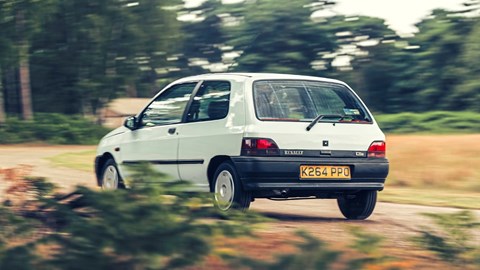
Krish is embarking on a process of upgrading and restoring his Clio, and disagrees with my contention that the Clio is at its best when it’s a bit rough around the edges. The Clio to this day encapsulates an unpretentious approach to daily transport, combining surprisingly roomy interiors with hoon-friendly chassis. You don’t need a Williams or RS version to have fun driving a Clio – they’re just fundamentally right.
Krish bought this 1993 three-door after watching its price slowly creep down over the course of a year. It’s the rare surviving Phase 1 (1990-1994) version. He was a big Renault fan as a child – watching Damon Hill in his Renault-engined Williams, and Lagunas in the British Touring Car Championship. And his mum has a 5, a 12 and a 21.

‘But I didn’t have Renaults myself growing up. It was with the 5 EV concept that I reconnected with Renault, and then I got two 5 TLs in quick succession. I bought the second one, a left-hand-drive car, largely for the bumper. It was only ever supposed to be a donor car. But it was too good, so I went looking for a bumper to replace the one I’d taken off to use on the other car…’ And that’s how the madness takes over.
But back to the Clio. In much the same way that the 5 can be overshadowed by the steroidal GT/Turbo versions, so the more basic Clio tends to play second fiddle to the glamorous and dynamically advanced Williams versions.
‘There are very few old non-Williams Clios around – people tend to get them and pull them apart when they’re rebuilding Williams Clios. But I find the simplicity of the non-Williams cars appeals to me.’
Like everyone here today, he speaks very highly of the Renault Owners Club, which embraces all post-War Renaults, and benefits from the active support of Renault UK. And the magic of the internet means that if there are ‘new old stock’ parts lying around, sooner or later someone will put them up for sale.
He beams: ‘The wheel trims I bought the other day are original, brand new, in the original bags. And I managed to find an original cigarette lighter from my local Clio Mk1 specialist.’
He loves the simplicity of it – no central locking, manual winding for the sunroof and windows, 1.2-litre engine, five-speed manual gearbox – but doesn’t love its currently tatty state (although it drives really well).
‘There’s a few things I want to do. It’s only done 18,000 miles, so clearly it’s been sat around for a while, which causes some problems. Today’s three-hour drive is the longest I’ve ever been in it. If it’s got through 32 years without anyone stripping the seats for a Williams, it deserves preserving.’
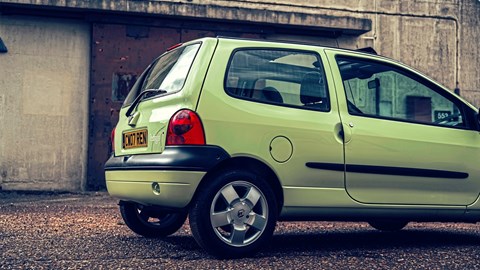
Whereas the 4, 5 and Clio have all been huge sales successes, the Twingo has been more of a cult car, an impression enhanced in the UK by the fact that the 1993-2007 Mk1 was never officially imported, so the few you saw were left-hand drive. For me, the Twingo is the one I’m least familiar with and least excited by. I nearly bought a Mk2 (the one that’s like a Clio but smaller), and once had a good time driving a Mk3 (the mid-engined one that was a rebadged Smart ForFour, or vice versa), but the Mk1 always seemed a bit silly.
Fortunately, the owner of today’s Twingo, Londoner Chris Williams, more than makes up for my lack of enthusiasm and knowledge. He currently owns three of them (one yellow, one green, one van), among other cars, and is so passionate about the Twingo that he’s become mates with Renault’s design chief from that time, Patrick Le Quément, and the pair are collaborating on a Twingo book.
He remembers quite clearly where this attraction to the Twingo began. ‘I was aged seven or eight, on a family trip to Disneyland Paris, and a very early green Twingo was in the car park. It made quite an impression.
‘Then, much later, in the pandemic in 2020, I had too much time on my hands and imported a zany 1993 model, shipped over from France. That was the start of the real obsession for me. But this car is one of the very last, from 2007. It’s had one previous owner, and there are plenty of creature comforts, for instance the glass sunroof, power steering, air-con, and the seats and engine are shared with the Mk2 Clio.’
It’s remarkably clever inside – I really shouldn’t be surprised by that in a small Renault – with so many neat, well-thought-through details. The seats can be folded completely flat – enough to sleep in (and Chris is not a short fellow). The rear seats slide. There’s the option of a canvas roof.
‘It’s done just 30,000 miles and is in beautiful condition, although the previous owner didn’t think anyone would want it. It would been off to the crusher if I hadn’t bought it, although I didn’t know that at the time.’
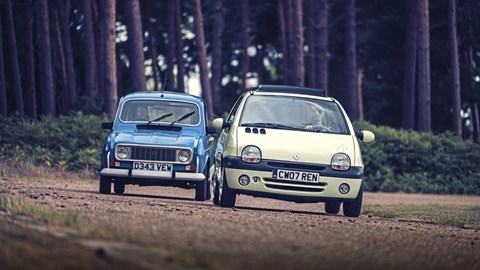
He adds: ‘Apparently a lot of people at Renault hated it. But the guy in charge at the time gave Patrick carte blanche. I love that it wasn’t ever launched here, because it reminds me of holidays. It was built down to a cost, so although it sold 2.3 million it wasn’t a massive money spinner. It’s totally capable on the motorways, although it can get a bit noisy.’
Like the other owners, he’s been pleasantly surprised by the availability of parts and know-how. There are 240 Mk1 Twingos still registered in the UK, and Chris reckons about half are still on the road. ‘Prices leapt up when the car hit 30 years old.It’s easy to maintain, and parts and knowledge are readily available.’
Did anyone anticipate 30 years ago that the Twingo would become an in-demand cult car in 2025? The ebb and flow of automotive fashion can make a fool of anyone who ventures to make a prediction, but it’s very hard to see today’s new Renault 4 being buffed and admired by our successors of 2055.
Not because it’s lacking as a car; far from it. But because it’s electric, and that’s a challenge on two fronts. One, there’s no reason to think that people will become emotionally attached to EVs the way they do to combustion cars, with the noises and vibrations and leaks that can make them seem like elderly pets. Two, the technology is changing so quickly that keeping them running in their current form for three decades might be more trouble than it’s worth. We’ll see.
The owners of our modern classics all took a turn driving the new 4, and were all pleased enough with how it drove. Between them, they also had a few observations and reservations. It’s not much like the old 4. It’s not that much bigger on the inside than the old 4. Some of the body’s bulges and cut lines seem weird, and contrary to the classic Renault habit of everything being there for a reason.
They were also on the whole pleased that it’s not crazily quick off the line like a Tesla, and that (for now at least) it’s just single-motor, two-wheel drive, which seems to be in the right spirit.
They all hated the absence of a P setting on the drive selector stalk, but were all pleased to see that the 4 has a version of the steering column-mounted audio controls that Renault has used for decades. They’re unfussily tucked away, the whole point being that you don’t need to see them in order to use them, just flicking and pulling with a couple of fingers of your right hand to change volume, channel, track and source. Not everyone loves them, but they’ve become an emblem of the slightly quirky but mostly user-friendly Renault way of doing things – the attitude that’s made it a world-class heavyweight when it comes to making lightweight cars.
Renault 4 E-Tech
Retro-adjacent, more practical sibling to the smash-hit electric 5
Price From £26,995
Years built 2025-
Powertrain 52kWh battery, e-motor, front-wheel drive
Performance 148bhp, 181lb ft, 1462kg, 8.2sec 0-62mph, 93mph
Renault 4
Function-first family transport that can double as a farm hack
Price £3495 GTL in 1988 (£5k-£15k now)
Years built 1961-1994
Powertrain 1108cc four, four-speed manual, front-wheel drive
Performance 34bhp, 53lb ft, 720kg, 24.0sec 0-62mph, 75mph
Renault Twingo
Cheap and small, but big on character
Price FF55,000 in 1993 (£2.5k-£10k now)
Years built 1993-2007 (Mk1)
Powertrain 1149cc four, five-speed manual, front-wheel drive
Performance 74bhp, 77lb ft, 905kg, 11.7sec 0-62mph, 104mph
Renault Clio
Win-win boomer choice: this or a 205?
Price £7190 then (£2k-£4k now)
Years built 1990-1997 (Mk1)
Powertrain 1239cc four, five-speed manual, front-wheel drive
Performance 54bhp, 66lb ft, 842kg, 14.5sec 0-62mph, 93mph
Renault 5
Before the Golf, made hatchbacks ubiquitous and desirable
Price £4399 GTL 1983 (£2k-£10k now)
Years built 1972-1996
Powertrain 1108cc four, four-speed manual, front-wheel drive
Performance 43bhp, 63lb ft, 530kg, 18.1sec 0-62mph, 84mph