► CAR’s epic Vauxhall Frontera adventure
► Can the EV live up to its name?
► From the UK’s highest point to its most northerly
The team in Mountain Warehouse have seen it all before, got the synthetic wicking T-shirts. We’re obviously nervous and obviously clueless. You can see it in our inappropriate M&S food shop, nervous giggling and recent browsing history. (FYI, on the question of ‘Is walking up Ben Nevis hard?’, the internet is divided, obviously.)
‘Do you have layers?’ asks one assistant, smiling a concerned smile. No, why? The forecast’s mild. ‘That’s at the bottom. Let’s have a look at the summit… Yep, so, 40-50mph winds. Minus two degrees, feels like minus 13.’ T-shirts any good? ‘Not really. Cotton stays damp, and damp is cold. Do you have torches? Map and compass?’
Better, I suppose, that our credit cards meet with oblivion today than we do tomorrow.
Fast forward to the next morning and it’s near freezing as we drive to the bottom of the Mountain Track – the novice-friendly route up the UK’s tallest peak – glad of the Frontera’s space, easy comfort and lag-free heated seats. The sky’s an inky purple, the peaks to the east dark against a brightening pre-dawn horizon. As we kit up and move out, trailing Nature Valley crumbs in our wake like Theseus’ thread, the line of slumbering campervans in the car park is still silent.
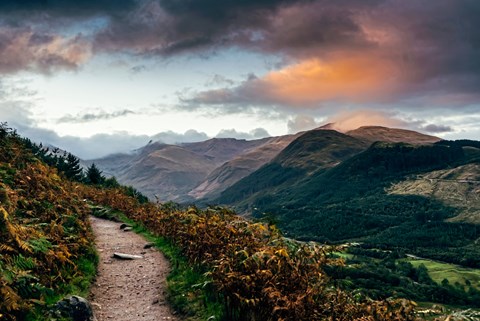
Half an hour later, toiling uphill as the sun finally climbs above the ridge line, the track’s weaving through glades, across bridges over roaring water and right through magnificent waterfalls. We can no longer hear anything of the world below, just the burbling of streams, the thumping of blood in our ears and the happy chatter of birds. Early on, you’re hungry for progress reports; to know how far in you are. But soon, like settling into a long drive, you learn to relax and let go of the present, with its Strava data and ‘Hey Siri’ elevation checks. You enter a serene state defined only by the right here, right now. Your breathing, the movement of your feet across the world – these, together with the warmth of the sun on your face, are all that matter.
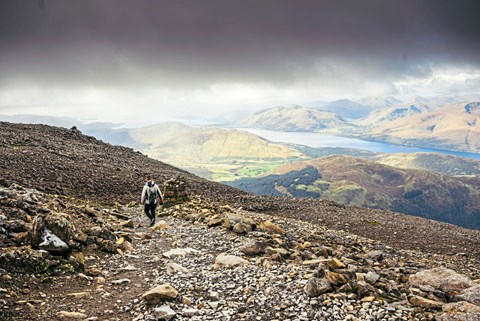
Eventually we leave even the hardy Highlands grass behind, the path – still obvious across the never-level expanse of scree – curving up into a mostly inorganic world of broken stone and patchy sky. The dazzling 30-mile views that for hours have dragged our gaze from the ground at our boots are gone, stolen by the blinding cloud. False summits come and go. The wind, bitingly cold and ruthless in its pursuit of gaps in your layers, never lets up, sculpting the cairns into abstract statues furred with frost.
And then, at last, the gradient lets up for the first time in five hours, levelling off onto a broad plateau bordered by gloomy crevasses, and we’re there. There’s a shelter on the top of a big cairn, an old observatory’s ruined walls and a point 1344 metres above sea level. You’d have to travel more than 450 miles, east to the Scandinavian mountains, to be this high again with your feet on the ground. The endorphin-charged euphoria is present and correct, but tempered with anti-climax. Perhaps it’s because the views are lost to the murk. Perhaps it’s because the descent is little easier than the climb. Perhaps it’s because it’s freezing and no one remembered whisky.
Or perhaps it’s because the job is only half done. After all, where do you go from the top of the United Kingdom – from a frontier of unrivalled otherworldliness, given its proximity to home? Where next if you still long to explore wild and empty hinterlands? Easy. You walk back down Ben Nevis, jump into a car named for extreme limits of land, and make your way to Aberdeen. From there, via no fewer than three ferries, you’d travel to Unst, the most northerly of Shetland’s three main islands, and follow this adventure to the UK’s highest frontier with a journey to its most northerly – an even wilder place of mercurial weather, few souls and a lighthouse on a remote island called Muckle Flugga. If that doesn’t scratch the itch, nothing will. And if the new Vauxhall Frontera proves equal to the task, then it surely deserves to wear the name.
Having started our climb just before 7am, it’s gone noon before we drop out of the wind, out of the cloud and back into a world that feels like one in which you’d quite like to exist. The panoramic views are back, as is the feeling in our faces, and we’re sky-high and smiling as we work our way back down the zigzags to the red burn, the Mountain Track’s halfway point. By 1pm we’re back at the lake. By 2pm we’re sweating in the afternoon sun, losing layers and trying not to turn an ankle. And by 3pm we’re back at the Frontera. Never has a car – seats, shelter, effortless autonomy and wireless CarPlay, bundled together for our convenience – looked so good. The sunshine turns to showers again but it’s too late; we’re safe from the elements, the weight’s off our feet for the first time in eight hours and the Frontera’s bearing our broken bodies directly from the UK’s highest mountain to the nearest McDonald’s drive thru.
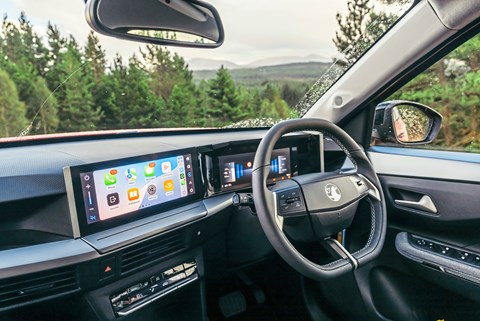
If the Frontera name summons visions of a lacklustre 4×4 from the early ’90s, well, you and me both. Great name, though, hence its return. Replacing the Crossland, the new Frontera sits on Stellantis’ Smart Car platform (see also the excellent Fiat Grande Panda and Citroën C3, though the Frontera gets bespoke suspension and steering calibration) and arrived offering cost parity between its all-electric and mild hybrid powertrain options – a UK first at the time. Then the electric car grant made the EV even more affordable.
As befits its focus on value, the Frontera Electric has no drive modes, no battery pre-conditioning (not unusual at this price point; it’s coming to the bigger Grandland) and a modest 44kWh battery (a 54kWh version is on the way, with a 249-mile WLTP range, more weight, no more power, superior efficiency and a £29,195 with-grant list price). Throw in a 100kW DC rapid charge ceiling and a 186-mile WLTP range and our 44kWh Frontera is not an obvious adventurer.
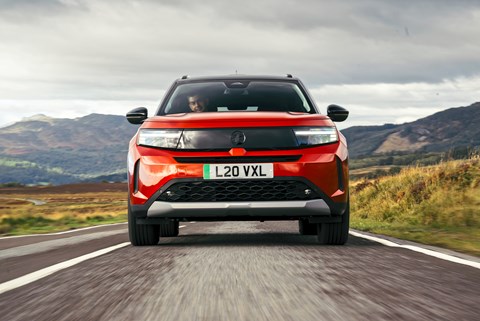
But the entry-level Frontera Electric costs just £22,495. The mid-tier GS is a £168 per month PCP proposition (with a 20 per cent deposit), complete with a £500 wallbox contribution and 10,000 miles of free home charging (a collab with energy provider Octopus). The 44kWh Frontera is the spiky bit on the end of Vauxhall’s affordable EV spear. It’s the version people are buying, a sweeter drive than its piston-engined sibling, and it will – like all big-selling Vauxhalls – become a part of the UK’s landscape. Even in new Ultimate trim (heated steering wheel, heated screen and heated seats, plus LED fog lights and roof rails) it still comes in at just £25,695. Our car adds £650 Canyon Orange paint for a £26,345 total.
Performance is modest, space very generous. The single electric motor develops just 111bhp and 125lb ft of torque, and if that sounds tepid in a 1514kg crossover then you’d be right. Is it an issue? Not really. In the same way the Panda uses charm, instant torque and decent acceleration at real-world speeds to mask its on-paper lack of go, so the Vauxhall always feels fitter than its 12.8 second 0-62mph time and 88mph top speed would suggest. In town, on the motorway, whizzing through forests of pine – never do you feel under-gunned. And for a small-ish car the Frontera is big inside. The five-seat cabin is spacious in every seat, with plenty of legroom for second-row adults, and dropping the rear seats takes the 460-litre boot (bigger than a Golf or a Renault 4) to 1600 litres.
On the two-hour, post-hike drive to Pitlochry, the Frontera’s easy pace and pliant ride – allied with the breathtaking Highlands scenery – transform what should be an exhausted slog into a relaxed and contemplative decompression. The steering – nicely weighted, light on feel but accurate – requires no conscious corrections as we cruise east, first on the A86 to Dalwhinnie and then the faster A9.
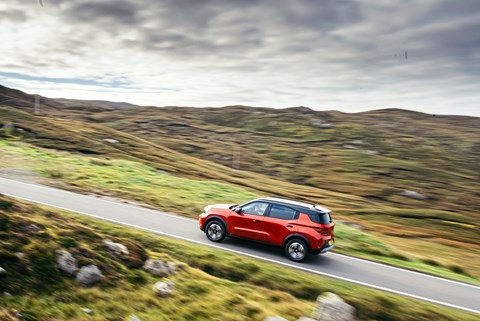
A Land Cruiser, er, cruises past on a stretch of dual carriageway and I find myself contemplating the theoretical trade, were it offered. A big part of the motor car’s stranglehold on our imagination has always been its speed and stamina – just ask Tracy Chapman. So long as you can stay awake and fill the tank, you can keep moving. With stops for ferries and fuel, the Toyota could be in France by tomorrow morning, Spain by tomorrow night and Africa the following day. The Frontera’s WLTP range is 186 miles on a full charge, but our real-world efficiency’s hovering between 3.1 and 3.4 miles per kWh, suggesting an actual range of more like 140, perhaps 150 miles. Fair to say it’d take us a little longer to get to the souks of Marrakesh. But it surely makes more sense to choose a car based around what you’ll do with it, rather than what you could but likely never will? (I know; tell that to anyone with a Rolex Submariner – safe to a depth of a 1000ft – but no PADI licence.) It’s proving straightforward to keep the Frontera topped up, armed with the Electroverse app and RFID card. Cheap, too, with 11kWh charges costing as little as £2.99. And where filling a Land Cruiser’s tank might put a £120 dent in my credit card, tonight’s charge to full will cost us precisely nothing on a Tesla destination charger.
A Porsche convoy is holding a nice pace along the old military road to Glenshee the next morning, slaloming between snow poles as we enjoy the scenic route to Aberdeen and the Shetland ferry. The views never let up in their IMAX-esque scale and wonder, and yet there is next to no one here. The ski station’s cable cars run empty.
In the Frontera we’ve secured loose luggage (elasticated straps to hold cups of any size and shape help here, as does a rubber charging pad off which your phone is unlikely to skate, even when you’re running with 911 GT3s), knocked off the air-con and temporarily put hypermiling on the back-burner. We haven’t the Porsches’ grunt or punch but neither is it difficult to cling to their coat tails, the Frontera’s ready grip, easy steering and reassuring composure making short work of the climb into the Cairngorms. The stitched wheel feels good in my hands, the brake pedal is more convincingly resolved than on most cost-conscious EVs and the Bridgestones are unfussed whether the tarmac’s wet or dry. Unusually, the Frontera defaults to the higher of its two regen levels, perhaps because that’ll be the more efficient option in urban use. But prodding into free-wheeling Comfort feels better on these big, open curves.
Would a Renault 5 be more fun up here, for more or less the same money? It would. But we’d also likely be bored of the small boot, the cramped rear seats and the occasionally abrupt ride. When there are more than two of you, none of you have packed light and the coming days promise everything from scarred Aberdeen streets to rocky tracks, lumpen lanes to sandy beaches, the Frontera really works. Renault’s 4 is the closer rival, of course, but even that struggles against the Vauxhall’s combination of space and value.
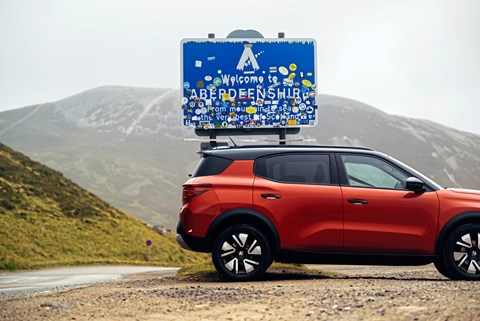
The ferry from Aberdeen to Lerwick on Shetland’s Mainland is reassuringly huge. We roll on, glide down a narrow ramp and are soon packed away in its bowels. The next morning we meet with Shetland-born Calum Grains, chief executive of the Lerwick Port Authority. Just as the Frontera offers mild hybrid or all-electric power, so Shetland sees opportunities in both the decommissioning of North Sea fossil fuel infrastructure and our renewable future.
‘Shetland’s been a part of North Sea oil and gas operations right back to the early stages, decades ago,’ explains Grains. ‘At Dales Voe [an ultra-deep-water quay just north of Lerwick] the water’s 12.5 metres deep at the quayside, and the quay’s strong enough to handle the structures being decommissioned; the biggest it’s handled so far weighed 14,500 tonnes. These projects are a big opportunity for Shetland. There’s a lot of equipment still to come out; equipment that’ll need cleaning and recycling. Being an island is a huge advantage. We’re close to the oil fields and we can ship the material straight from Lerwick directly onto the international metals market.’
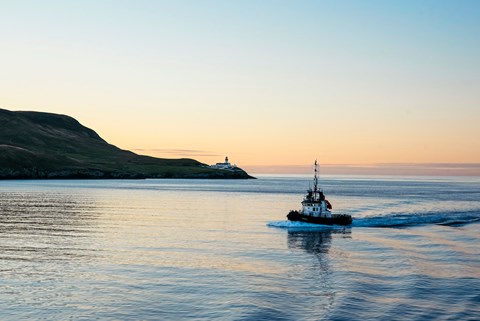
Oil and gas may yet be at least a part of Shetland’s future, however, as well as its past. Controversial Rosebank, the largest undeveloped oil and gas field in the North Sea, lies just 80 miles off Shetland. It holds an estimated 300 million barrels, and was green-lit by the UK government in 2023. A court subsequently ruled that approval unlawful, and the developer has re-submitted its assessment.
Several renewable projects are in their infancy, including offshore wind farms and green hydrogen production. A vast onshore farm, Viking Energy, began generating power from its 103 turbines last year. But for now energy remains expensive on Shetland – we see the price per kWh leap from 28p to between 46p and 59p on public chargers – and many locals resent the scale of the Viking Energy farm and its imposition on this otherwise timeless landscape, particularly when so much of its output leaves via a new sub-sea connector for mainland Scotland.
Clearly, it’s a complicated picture. ‘We have to be very careful to balance the needs of the community, the environment and industry,’ continues Grains. ‘That’s quite a debate around Shetland right now. Everyone knows we can do it, but we’ve got to do it the right way.’
Our first inter-island ferry, from Mainland to Yell, is modestly sized, the boat from Yell to Unst smaller still. As you wait to sail you can look across the water to Unst: a 46-square-mile chunk of rock surrounded on three sides by thousands of square miles of water.
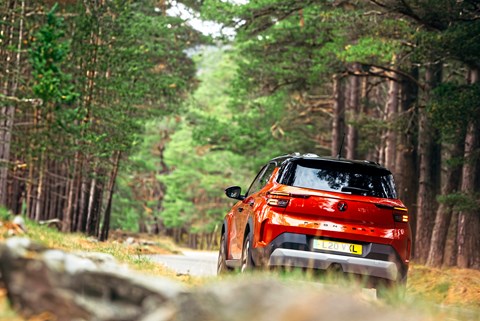
In moments we’re on the move, sweeping up steep curves onto the island proper. The road, the A968, simply runs north, the expansive views on an entirely different scale to most in the UK. The sun and clouds paint shifting masterpieces on the windswept grasslands, the browns, greens and oranges daubed with a Pollockian energy that makes this landscape feel anything but static. A gusty breeze toys with the Frontera’s seals and buffets its boxy form.
The land to our west begins to rear up, gaining elevation as it forms a rugged, lop-sided spine for this tough little survivor of an island. At Baltasound, the only settlement of any note, landmarks are few and far between. There’s an airstrip without regular flights, a bus shelter (Bobby’s, with a chair, a dressing-up box and a lot of books about bees) and a spaceport, Saxa Vord, without regular spaceships.
At Haroldswick, the A-road dissolves into a web of single-track lanes, and we make for Skaw beach. That road ends at a tiny farm, a gate and the most beautiful arc of empty white beach. It is not warm but nor is it cold, and the low afternoon sun and the thin, ever-shifting cloud collaborate their way through a dozen moods every minute. Surface run-off the colour of strong tea cuts its own little drainage channels in the sand. The surf – apparently gentle, welcoming even, close to shore – becomes sinister in its very obvious power a little further out, where the ocean runs free.
Up on the hill, the Spaceport’s a reminder of just how far north we are. This corner of the UK might seem like the weirdest place in which to assemble infrastructure as ambitious as that required to launch satellites into polar orbit (and the truck drivers we meet who’ve hauled hotel modules here from Tilbury would likely agree), but Unst – as far north as St Petersburg, and with open ocean on three sides – could have been designed for the job. Its location offers unrestricted trajectories and its latitude, at 60º north, means rockets heading for the heavens are less burdened by unwanted eastward velocity, making launches more fuel-efficient. (The closer to the equator your launch site, the more fuel you must burn correcting for the Earth’s higher rotational speed.) Carefree, munching grass and living what must be about as idyllic an existence as it’s possible for an earthbound creature to achieve, a rabbit fixes me with a look that says: ‘Why would you want to leave this place for the cold vacuum of space?’ Taking a drink of purest mountain water, collected from the UK’s highest frontier just a couple of days ago, I couldn’t agree more.
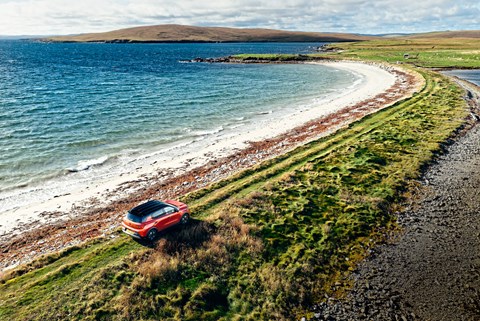
Sand in our shoes, cheeks bright from the breeze, it’s a short drive round to the radar station, the climb – to nearly 1000ft – single-track and steep. Front-wheel drive it may be, but the Frontera breezes it. Built during the Second World War, expanded despite the challenges (Shetland’s ferocious winds have claimed more than one radar array over the years), decommissioned in more peaceful times and brought back online in 2017, the station’s gatehouse buildings are a post-apocalyptic collection of shattered windows, ravaged concrete and rusted chain-link fence. Fortunately, we can skirt around, get a little further north and hopefully leave with a less austere final image.
Muckle Flugga should be an unknown place; a forgotten, two-word footnote on the unknowable enormity of the face of the Earth. But there’s a ring to the name (CAR writer and drive story pioneer Phil Llewellin referenced it in his book title, of course) and the island is a ticks-all-the-boxes icon of remoteness. At once stoic yet fragile-looking, it’s an affecting expression both of our urge to conquer frontiers and of the elemental solitude of this place.
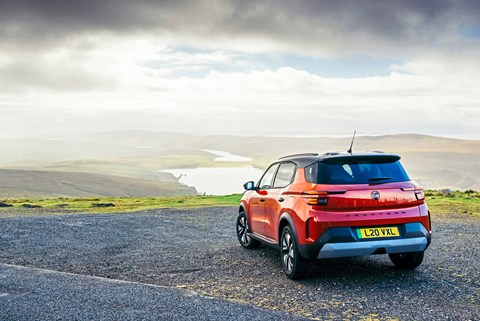
The clouds have cleared. Autumn sunshine has turned the rolling seas into a patchwork of brilliant aquamarine and deepest indigo. Behind us, Burrafirth Beach basks in late-afternoon amber. Like the deep, bassy rumble of an ever-breaking storm, you feel the ocean as much as hear it, the only other sounds the whisper of the wind and the screech of gulls. Remote and isolated by UK standards, it should feel lonely here. It’s just us, the Frontera and the sea. But it doesn’t. There’s tranquillity where you might expect unease. And that makes sense, right? Because for all its otherworldliness, this is still home – for us and for the car we came in.
With thanks to Promote Shetland (shetland.org), NorthLink Ferries (northlinkferries.co.uk), Lerwick Port Authority and Belmont House