Roof tents such as the TentBox Lite 2.0 were once the preserve of an overland expedition, but now, like an automotive Dryrobe, you see them popping up in all sorts of unlikely places and on all sorts of unlikely vehicles.
Three things have contributed to their overnight success – the rising expense of a holiday abroad, the fact a campervan now costs as much as a second home, and the annoying and uncomfortable nature of a ground tent.
How does a roof tent solve these problems? It is a genuinely useful adventure enabler, or just another way to signal your active lifestyle? As with all the latest automotive hot topics, CAR is here to investigate. We’re going roof tenting.
Want one? The TentBox Lite 2.0 is currently £200 off during Black Friday
What’s the point of a roof tent?
Adventure is by its very nature spontaneous – and having a weekend-break solution that is packed up and ready to go at the drop of a hat is very attractive. That’s why day-campervans are so popular, after all.
Arguably, you could just throw a tent into your car boot, but then you’ve lost a big chunk of your luggage space. And that’s before you arrive at your coastal break to discover all your pegs are bent or the airbed has a hole in it (both of these have happened to me).
A roof tent aims to combine the packability of a ground tent with the convenience of a camper van, all without taking up an extra space on your drive. Just rock up at the campsite, unfold the thing, and you’re good to go.
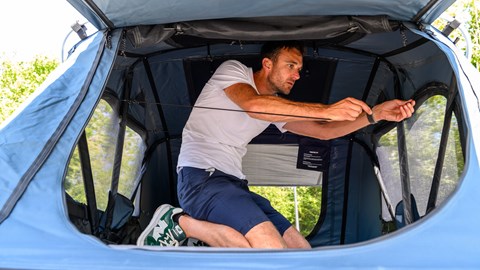
Most have a proper mattress already installed and some have space for you to leave bedding folded away inside too. The speed of deployment versus a regular pole tent is unmatched, and when it’s time to go home, the whole lot folds back over just as quickly.
How does a roof tent affect a car’s fuel economy?
Not as much as you’d imagine, but definitely more than the aforementioned tent-in-boot solution. Then again, if you do that and want to claim back some lost luggage space by attaching a roofbox to the car, that advantage is gone.
To do some real-world research we got hold of a TentBox Lite 2.0 attached to perhaps the least likely (but also most likely when you really think about it) camping car, a Skoda Octavia vRS Estate.
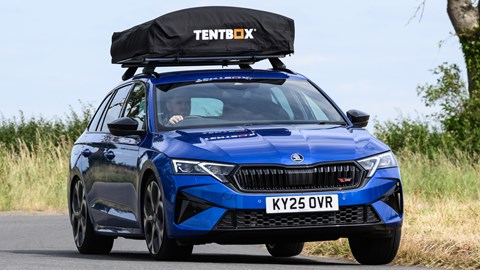
TentBox says you can attach their products to almost any vehicle, and like me you’ll probably have seen them on all sorts, from vans to superminis. The one we’re testing weights 50kg, which is about half a passenger, and that doesn’t sound a huge amount.
The issue is the location of that weight. We talk a lot about electric cars and the positive effect their heavy battery has on stability, because it is mounted low down. A roof tent is the opposite. You’ll also need to add the weight (and cost) of a set of roof bars into the equation too.
For a second opinion we spoke to Oli Reed, Group Editor of our publisher’s outdoor titles. Bauer Media’s Bear Grylls. A man who is no stranger to adventures by roof tent.
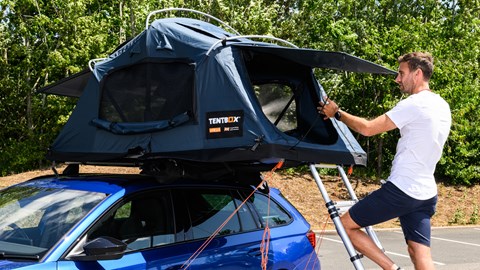
He said: “I’ve never noticed any kind of drag in terms of the car’s performance, or a huge jump in fuel consumption, as a result of using a roof tent.
“I’ve driven some big distances with a roof tent on my car and the best compliment I can give it is that I forget it’s on there until we reach the campsite. If you’re a frequent camper, you’ll save yourself so much time over the course of the summer if you do it this way.”
What about acceleration, wind noise, and handling?
The Octavia vRS is not exactly short on power to begin with, so that’s worth bearing in mind. But I can confirm (having driven a lot of vRSes in my time) that it had zero effect on its ability to accelerate to motorway speed, overtake on country roads, or get away from a set of traffic lights.
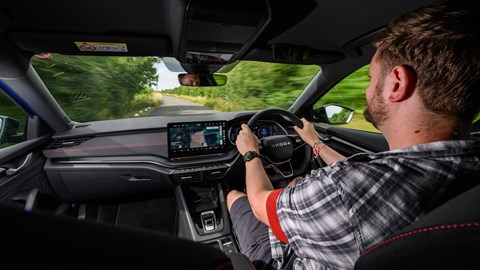
There was more body movement – in all directions, under hard braking, cornering, or acceleration – but only if I really went looking for it. Under normal driving conditions, I barely knew the tent was up there.
Maybe that’s more of a testament to the car itself than the TentBox. The Octavia is, by its nature, a very useful vehicle, with a massive boot and acres of rear legroom. The sportier variant with its firmer suspension strangely makes more sense as a car to attach at roof tent to.
I did find it a little bit noisier on the motorway, but not to the point of annoyance, and certainly not loud enough that I’d have to remove the TentBox as soon as it wasn’t in use anymore.
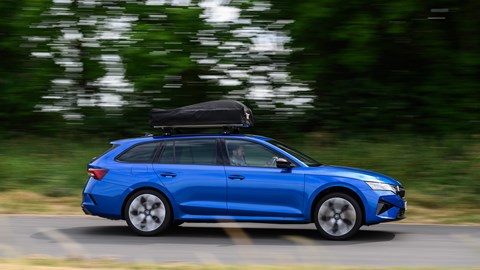
The fuel economy also ranged between 30-35mpg, which is roughly what I would get in my old Octavia vRS with a roof rack attached, which would also encourage me to be lazy and leave it attached.
What’s a roof tent actually like to camp in, though?
The TentBox Lite 2.0 is the one to go for if you want the smallest footprint (the range includes Lite, Lite XL, Go, Classic, and Cargo models) and is also the second cheapest in the line-up. Between us and our outdoor title Live For The Outdoors, we’ve tested most of these models.
Whichever you choose, you can expect an easy installation and set-up. The construction and materials used in the Lite 2.0 feel impressively durable and build to last more than just one summer.
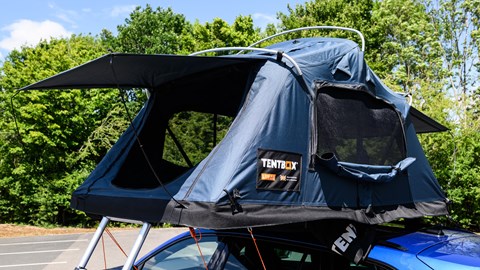
It is a bit smaller this time around – the 2.0’s sleeping area measures 133cm by 220cm – which is 7cm narrower and 20cm shorter. It’s still fine for two adults to sleep in, and more than big enough for solo camping.
The windows are bigger though, and the weatherproof flysheet easier to install, but the biggest improvement is the cover, which now has a zip all the way around rather than fiddly Velcro straps.
Inside there are long side pockets to store phones and car keys, one small hanging pocket, some storage straps under the base, plus a separate bag for the poles.
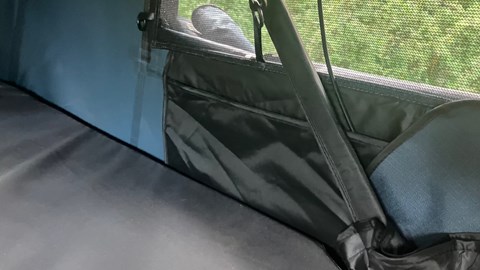
Oli (who owns the predecessor to the Lite 2.0) took the newer version away to the Norfolk Brickyard campsite with his family to give it a proper shakedown.
He said: “Never mind the best roof tent, the TentBox Lite 2.0 is up there with the best tents we’ve ever used. It’s practical, durable, and will inject adventure into your life.
“The 2.0 mattress may be slightly smaller than its predecessor, but to put it bluntly, it is about 1,000 times more comfortable than any camping air bed we’ve ever used.
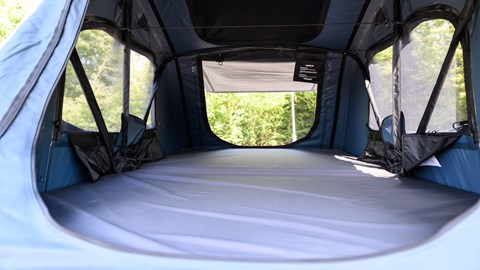
“The interior still feels very spacious, with plenty of room to sit up and move around when you’re not snoring soundly flat on your back.
“The TentBox Lite 2.0 is also an event in itself – it’s a nice place to be, elevated off the ground with multiple windows and openings, so you can relax and absorb the surroundings much better than on the ground.”
Verdict
Are we sold on roof tenting? I’ve always had the opinion that the less annoying you make something, and the fewer friction points there are along the way, the more you’ll end up doing it. A roof tent doesn’t revolutionise camping, but it does take away an awful lot of small, associated inconveniences.
After just one week with the TentBox Lite 2.0 I was sold on its usefulness and was already thinking about how I’d restructure my summer holidays to include more frequent and shorter breaks away with one.
The main benefits are the speed and simplicity of pitching. It can be unfolded and ready to go in five minutes and then packed up again in the same time frame. If you’ve ever faffed about trying to get a soggy air tent into its bag after a weekend of little sleep, you’ll relate.
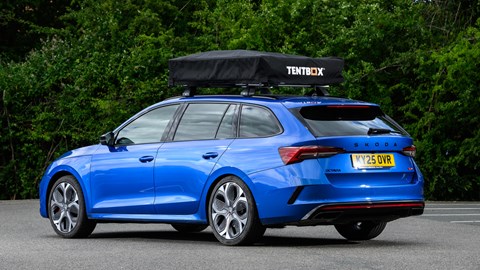
There is a larger time investment at first (certainly more so than just chucking a tent in your boot) in the form of the installation process. Weighing 50kg, you’ll need two people and the best part of an hour to lift it up and secure it to the car.
The best bet is to leave it up there for the duration of the camping season. The Lite 2.0 isn’t cheap, but it’s a market-leading product with a reputation that speaks for itself. That does at least explain why you see so many of them going up and down the M1.
Roof tent top tips:
• Measure up to ensure compatibility first – roof bar spread, crossbar width/shape and clamp type compatibility. TentBox has a vehicle checker too.
• Double check your vehicle’s roof load (static and dynamic). Factor in the roof tent weight, plus occupants and kit.
• Practice fitting and pitching at home before taking it on a trip – don’t leave this job to the morning you plan to go away.
• Invest in a mattress topper or warm sleeping bags for colder months to improve comfort too much bulk.
• Check the torque rating for all installation bolts before tightening and use thread-locker if recommended.
• Measure the folded height of your car. Factor in the additional bulk for garages, car parks, ferries and drive-throughs.
• Always consider warranties, spare parts availability and dealer support when comparing roof tent models – buying cheap often means buying twice.
Roof tent FAQs
How long does setup and pack-down actually take in real conditions? +
We found it super easy to fold and unfold. Five minutes tops, in either direction, even if you’ve never used a roof tent before.
Will two adults sleep comfortably in the TentBox Lite 2.0? +
Despite the slightly smaller dimensions compared to the previous TentBox Lite, there’s plenty of space, weather-proofing, and mattress comfort to ensure a good night’s sleep for two.
What is the impact on fuel economy and motorway stability? +
Negligible on both counts, in our experience. Two of us tested the Tentbox Lite 2.0 on a Skoda Octavia vRS Estate - the MPG dropped a bit, and the weight was noticeable when driving quite spiritedly, but otherwise it was easy to forget it was there.