► Inside Rivian: the wave-making EV brand
► First came the setup and the R1
► Now, it’s going big and mainstream
There are a couple of well-established ways in which to try to track the breakneck speed with which your kids grow up; pencil lines on door frames, memory boxes, happy/sad photo montages on your phone.
Or, like Robert ‘RJ’ Scaringe, Rivian’s founder and CEO, you could start a car company – a car company with which you’re so hands-on (‘Design, software, electronics and our AI and autonomy teams all report to Scaringe, with hugely experienced ex-Volvo operator Javier Varela now in charge of body and chassis engineering] that its story becomes indistinguishable from yours children’s. Father-and-son weekends driving California’s trails become inseparable from the suspension-wrecking development drives, and your kids’ names find themselves immortalised as next-generation powertrains (the Rivian R2’s new motor unit is dubbed Maximus after Scaringe’s middle son).
‘I kind of look the same in pictures, so it’s harder to see the passing of time when I think about the development of R1 [the twinned SUV/pick-up with which Rivian arrived] and R2 [due on sale in the US in 2026]. My oldest was four or five when we were working on R1, so I’d take him with me on prototype test drives. We’d break down sometimes, so he has these amazing stories, which are so much more vivid because he remembers everything through the eyes of a kid. He’s like, “Remember that time we were on the trail and the car got stuck and we had that huge line of cars behind us and you were underneath it…” I remember it, of course, but all I could think about was someone taking a picture and the story being, “Rivian CEO tries to fix car on trail!”

‘It was a really early R1 prototype, up on Santiago Peak. The kinetic system drained somehow and the air suspension was shot, too, so it had zero suspension. It was on the bump stops and I had to get down off this mountain. I had my brother get out and walk way behind on the trail so no one could get close to us and get a picture. I’m just bouncing my way down with these metal-on-metal noises… My son will never forget it. My kids love Rivian; they’ve grown up with it.’
Scaringe was barely any older than his eldest is now when he first thought he might like to start his own car company. ‘I don’t think I really knew what that meant, but it informed everything from there forward.’ He studied mechanical engineering with an automotive focus before completing a masters and a PhD at the Massachusetts Institute of Technology. The company that would become Rivian started life back in 2009, first as Mainstream Motors and then as Avera. The name Rivian emerged in 2011 and, after a sportscar-shaped false start, Scaringe’s childhood dream really began to acquire momentum around 2015/2016 – just as Tesla unveiled its mass-market third model, the Model 3.
‘When you’re thinking about starting a brand, a sports car is the obvious place to start. But almost immediately somehow was bothering me; I had this itch in my stomach. Unintentionally, the strategy and the car we were creating had too many parallels to what Tesla had built. So, we put that idea on the shelf and, honestly, it was a pretty long and wandering journey to identify the positioning for the company. We wanted to make sure we were creating something that didn’t exist. That led us to this brand positioning, adventure, and then rethinking the idea of a pick-up and an SUV. That’s where R1 came from.’
Like almost every start-up, Rivian has stared oblivion in the face on more than one occasion. ‘The closest this came to not happening? Probably the first ten years – that period,’ he grins. ‘You just have no money. When I look back it’s almost comical. Investors ask, “Okay, so what’s the company?” Well, it’s a car company. “What’s the product?” We’re still figuring that out. “Okay, well, tell us about your technology.” Well, we don’t have a lot yet – we still have to develop it, and we need capital to develop it. “Hhow about a brand?” Well, we haven’t figured that out yet. “Alright, well, you must have an amazing set of supplier partners.” We don’t have any of those yet, and we hope to buy or build a plant some day…’
But with R1T, Rivian began to click. The vehicle, when it went on sale in late 2021, was a landmark EV: against all the odds, Rivian had beaten the likes of Ford and Chevrolet in the race to electrify that all-American icon, the pick-up truck. Good-looking and seriously capable, the R1T did for trucks what the Model S had done for big saloons: proved all-electric was at the very least a desirable (and wildly powerful) alternative. Rivian was off and running, if far from out of the woods. And Scaringe, like it or not, was becoming a Musk-esque poster boy both for Rivian and the electric revolution – a departure from ‘the small team making cars in a cool brick garage’ dream he’d had as a kid.
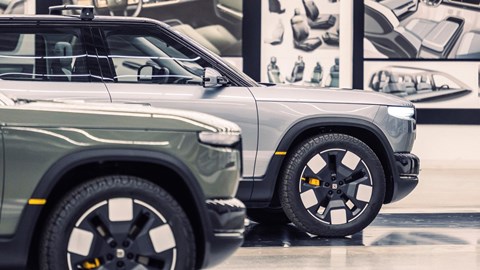
‘It’s not something I expected, but I love talking about what we do. And it’s exciting: when you start there’s so many things you don’t know. I hadn’t led a large team before. I wasn’t used to giving investor pitches. I didn’t know how to do earnings calls. You just learn a lot of things. I did a PhD, but I never had a class on how to be the chairman of a publicly traded company.’
A decade ago, California crawled with bright, young EV start-ups. Some are still with us, having successfully played the high-stakes game of snakes and ladders required to put in place the foundations of car making: investment, a supply chain, a plant, more investment… All with the aim of becoming balanced; of selling cars in the volumes required to pay the big bills an R&D-intensive company of some 17,000 is very good at racking up.
‘You have all these interlinked needs, and you have none of it in the beginning. It’s really hard to fit the puzzle together. What’s the first thing to unlock? It’s not linear and it’s not sequential. Everything’s running in parallel, and you have these working assumptions that are often wrong. You become comfortable in high-risk environments – with crumpling up the piece of paper and starting over. That’s very different to a large company, where layers of decision-making and management make taking risks much harder. One of the reasons we’ve been able to develop our software stack and our electronics, which are so unique – outside China, it’s really only us and Tesla that have an architecture that’s completely vertically built – is that a big company wouldn’t be comfortable with such a high cost of failure. In a big company you couldn’t say, “I’m going to try this thing for three months. If it doesn’t go well, screw it, start over.” It just doesn’t work like that.’
To say Rivian’s first decade has been a wild ride would be an understatement. For all the uncertainty, Scaringe has fulfilled a childhood dream (R1s are commonplace on the streets of LA), masterminded a successful IPO (in 2021) and tasted life as a billionaire. And now the pieces really are slotting together – with that software stack right at the centre of the puzzle. It’s that, over and above the cool branding and the great looking cars and the 1000 horsepower powertrains that underpins Rivian’s market capitalisation of circa $14bn (August 14 2025). That and a call from the VW Group – a call and subsequent conversations with chairman Oliver Blume which have since blossomed into a joint venture between Rivian and the VW Group. The agreement netted Scaringe’s company a $1 billion equity investment in June; just part of an up to $5.8 billion deal that’ll see Rivian’s software stack at the heart of a new generation of software-defined VW Group cars, kicking off with the VW ID. Every1 in 2027.
‘I grew up a huge fan of Porsche and VW, so it’s wild that, of all the brands that we end up doing a big partnership with, it’s the ones I loved as a kid. To know that upcoming Porsche products and VW Group products are gonna have our tech at the centre of them… it’s cool. After the deal got done, I called my dad and he said, “Well, this is great. This means I can buy a Porsche again!”’
How does a deal like that even happen? WhatsApp messages? A flight and a quiet beer in a dark bar?
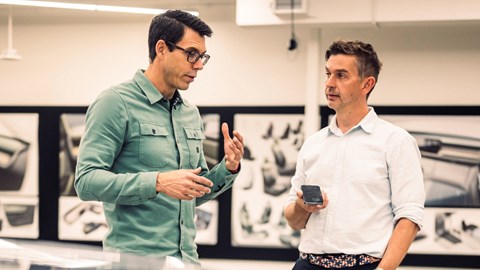
‘We had a couple interactions back and forth, and then Oliver [Blume] and I got together,’ explains Scaringe. ‘We quickly realised we’re both really into cars, which is important – if you’re not into the product in this business it’s very hard. I think he quickly realised I really loved the product, I saw the same in him, and we started to explore some of the things we’ve done from a technology point of view. The initial discussions were looking first at Porsche. Then we realised the strength of what we were building, such that it could be applied across the whole Group, and so we ended up doing a deal that extends to the whole Group.’
Scaringe doesn’t see the joint venture as a tacit admission by one of the world’s biggest car makers that it failed to spot the software-defined direction of travel and react accordingly. It’s more about history and inertia, he says.
‘If you were to start from a clean sheet and design a car with a lot of compute capability, would you design 100 little computers built by many different companies with different software stacks running on them, none of which are consistent or holistic? No, you wouldn’t. You’d got for a couple computers – maybe one in the back, two in the middle and one the front – and they’ll do everything in that area of the car. Sounds pretty straightforward, but if you’re a business that’s grown over decades it’s just a completely different architecture. Even your software teams are structured in a way that promotes that legacy architecture. And if you’re a supplier selling ECUs, you would much prefer that our architecture didn’t exist? It takes thousands of dollars of costs out, and those thousands of saved dollars are in the form of fewer ECUs.
‘What makes the VW deal so powerful is that the teams were really excited to work together. The technical folks on the Group side were saying, “This is a great architecture – it can help us move faster.” They really respected the technical strength of our team, and at that point we were off the races.’
Built around its Rivan tech, the ID. Every1 promises be more profitable than it’d be otherwise and, unlike the troubled early years of the ID. 3, gremlin-free. ‘That car’s really cool because it’s taking our concept and simplifying it even further, because it’s physically a small car, so it’s really cost-effective.’ Given the size of the car, will it be a single-zone stack? ‘We haven’t announced the architecture, but this will be one of those vehicles where every car company in the world will buy one, take it apart and be like, “Holy shit this is cool.”’
Scaringe and I are taling in early May, a little over four months after Trump’s second inauguration. Scaringe was cautiously optimistic, pointing to the administration’s pro-US stance on manufacturing. ‘100% of our manufacturing is here, nearly 100% of our workforce is here and we’re a US centric company. But we are having to navigate changes to the trade around components we’re buying outside the United States. Those are new environment but we’re managing.’
Since May the Trump administration relaxed the penalties on failing to meet emissions targets, hurting the revenue Rivian had been receiving from the sale of regulatory credits to car makers struggling to meet the targets. Then there are those tariffs and an announcement that the $7500 federal tax credit for EVs will go in September. Given all that, it’s no surprise that in a statement detailing its Q1 2025 financial results Rivian stressed the good news around the R2, with significant progress both on validation builds and on the expansion of the plant that’ll build it, in Normal, Illinois. The R2, effectively Rivian’s Model 3, promises to be transformative – the company can’t remain a boutique builder of big-money pick-ups and SUVs. It has to go to the next level, from circa 50,000 cars per year to circa 150,000. But as with Tesla’s Model 3 growing pains, the next phase won’t be easy.
‘It’s actually an easier step than zero to 50,000 cars,’ counters Scaringe. ‘The first car costs a lot of money. But we’re seeing progress. We hit positive gross margin in Q4 2024 [as it did again in Q1 2025]. The cost of making the vehicles and the price we’re selling for is finally getting into the right zip code, but it requires some scale. R2 will really help us step change to a much higher level of profitability. Being so vertically integrated hurts you in the beginning, because all these fixed costs and no volume to absorb them. But it’ll give us a long term structural cost advantage. We build our motors, we build our inverters, we design all the electronics, we design the entirety of the software stack. You can’t do that with a 100-person engineering team. It takes a team of thousands.
‘If you were to look at us, our engineering team is just gigantic for a company selling 50,000 cars. But the engineering team wasn’t sized to sell 50,000 cars. It was sized to develop this technology platform that is then going to exist across our three existing vehicles plus R4 and R5. This is core to the strategy. And big engineering team’s are expensive. If you’d told me when I was 12 that it was going to take tens of billions of dollars I’d have been like, “Oh boy, that sounds like a lot.” But if you’re intellectually honest about what it takes to compete with established, incumbent OEMs and actually go mass market, you need a lot of money. And that wasn’t a surprise. We knew.’
Rivian’s existing plant in Normal has a capacity of 215,000. It’ll build R2 (around 155,000 units per year), R1 and the van, the EDV. Then Rivian will bring its second plant in Georgia on stream, in two phases. ‘First we’ll build R3 and then it’ll build R2, and some variants of R2 we haven’t announced yet. Capacity’s another 400,000.’
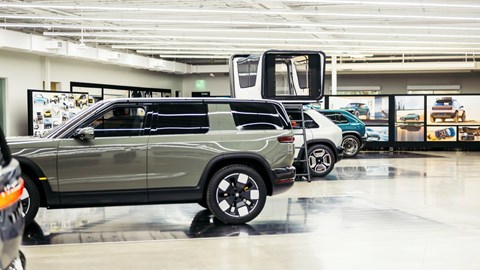
We leave Rivian’s Irvine headquarters and walk to a pilot plant just over the road, which is both perfecting R2 production and creating the prototypes required for crash testing and further development work. As we take a look around, RJ’s wide-eyed at times – the look on his face that of a 12-year-old boy with his own car factory. ‘I didn’t think Rivian would ever exist in a plant this big – and this is just a teeny pilot plant!’ he smiles, pointing out myriad examples of where learnings from the past will inform the future.
‘R2 is dramatically lower in terms of cost – it’s about half [of R1]. The bill of materials is around half that of R1, as is the time it takes to put the cars together. It also uses larger diameter cell, simplifying the battery pack with fewer connections [the cells are made by LG, in a plant in Arizona]. So it’s just a much cheaper vehicle to build but without compromising capability – the rear-wheel drive base car is still a really nice experience. I drove one last week and it’s a really nice package. It’s simpler than R1 but the car is much smaller, so dynamically it’s just really fun.’
Driving the wheels off prototypes on Arizona proving grounds – just another unforfettable moment the 12-year-old Scaringe would be beside himself to experience but that the man will likely struggle to recall next week, the 24/7 challenge of running a car company washing away the memories like footprints on a beach. ‘I don’t do enough when it comes to appreciating these moments,’ he admits. ‘Half the time I don’t realise this stuff is happening. Then you stop and think and you’re like, “Oh, wow, that really happened.”’ It really did.
R2: the volume-selling second album
The R2 is a supremely logical follow-up to the R1, specifically the R1S SUV. Indeed, while designing the R1, Rivian opted to go with the R2 concept its future design team was working on at the time, so ‘right’ did it feel. Smaller, far cheaper to build but with much of the R1’s style, vibe and capability still intact, it’s the Rivian brand promise for normal people – go on adventures, make memories and save the planet while you’re at it.
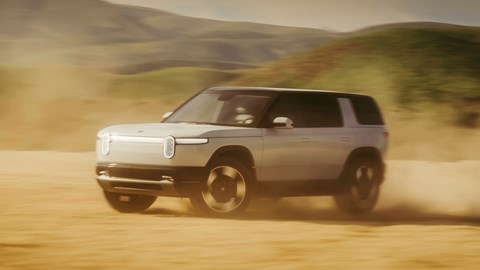
As with the R1, multiple powertrain derivatives will be offered, including single-motor rear-wheel drive and dual- and tri-motor all-wheel-drive set-ups. The headlines are 340+ miles of range, 0-62mph in under 3.2sec (far faster than a Model 3 Long Range All-Wheel Drive), a big front trunk, a simple yet classy interior with Rivan’s own OS and next-gen steering wheel (the big thumbwheels on each wheel spoke, with haptic feedback, are a neat interface) and powered rear glass that drops to let in the sounds and smells of the Pacific/M25.
‘R2 is a really important product – a vehicle at that $45,000 price point that’s really interesting and compelling,’ explains Scaringe. ‘People ask, “Is it going to pull sales from the Model Y because they’re priced similarly?” Electric vehicles are 8% of new car sales in the US United States… Can it pull sales from the other 92%? That’s the much bigger opportunity.’
‘This is our second vehicle, our second album if you will, and we wanted to take what’s great about R1 and distill it down into a smaller package – one that’s much more affordable and that’ll also reach a different demographic,’ explains chief design officer Jeff Hammoud. ‘Key to the design process was reducing cost. Where R1 was built with addition, R2 was designed through subtraction, which is a much harder thing to do. But we embraced what might have been considered constraints, so we’re reducing the cost without taking away content. The cut line on the hood is a good example. It’s on the side of the vehicle, to give us enough compressible structure for European pedestrian protection regulations, but it also looks good – we took a design constraint and made it a design element.’
R3: the Group B EV we didn’t know we needed
We all remember where we were the first time we saw Jeff Hammoud’s R3, Rivian’s third, Group B-inspired model. Due on sale in a couple of years’ time, R3 details are scant but it’ll be the most affordable Rivian when it lands (well under $45k in the US) – and, being so clearly inspired by European rallying royalty and hot hatches, R3 will back up R2 in Europe when Rivian starts selling cars here.
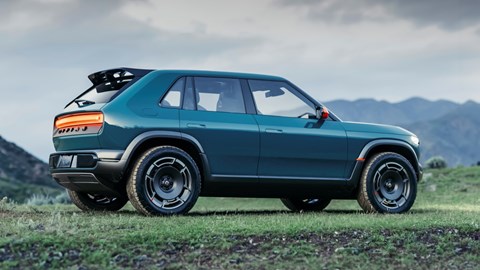
‘We plan to go to Europe, and initially we’ll export, at least to establish the brand,’ affirms Scaringe, while studiously steering clear of precise timeframes. ‘Very soon after that we’ll launch a production facility [in Europe]. But the nature of that, where that plant’s going to be, do we work in conjunction with a partner – all those are not yet decided. ‘Europe’s a really interesting market. The products fit – we designed the product [R2 and R3] to fit the market really well. And R3’s really interesting because it doesn’t fit in a normal classification. I think we’ll see someone driving a sports car decide they really want an R3X, or someone driving a bigger car suddenly wanting something smaller – and the R3 fits.’
The R3’s been shown in two flavours; a road-focused hatch and the on/off-road R3X. Both are cool as cucumbers – chunky, stylish, simple and so shot-through with petrolhead nostalgia the urge to jump in and get loose down a gravel stage is strong. As Scaringe puts it, ‘You see it and you just want to drive it.’
‘We knew R3 wanted to be more capable on-road but still have some off-road chops,’ explains Jess Hammoud, Rivian’s chief design officer. ‘And when I think about a segment that combines those two attributes my mind went straight to Group B rally cars – one of the coolest eras of performance vehicles. We were inspired by things like the Delta Integrale and Quattro coupe. I’ve heard people reference Lada Niva, too, and Golf. There’s a lot of inherent nostalgia in there, which was on purpose. People just gravitate towards that era of vehicles, and as a result a lot of genuine car guys, real petrolheads, have said, “If I was going to buy an EV, I’d want this one. That’s important, I think – designing something desirable and it doesn’t really matter what the powertrain is.’