► The latest on Porsche’s 718 Cayman and Boxster
► Delays, development and moving goalposts
► Will also now include combustion AND electric versions
Porsche CEO Oliver Blume has confirmed that the brand’s next-generation 718 Boxster and Cayman cars won’t just be electric. In an investment call on 19 September labelled as a ‘strategic realignment,’ Blume announced the news as the brand rolls back from its hard and heavy electrification push.
‘We will expand and refine our line-up of ICE models to meet diverse needs and regional market requirements during the transition phase – including newly developed ICE and plug-in hybrid models,’ he says during the investor call (presentation slide pictured below).
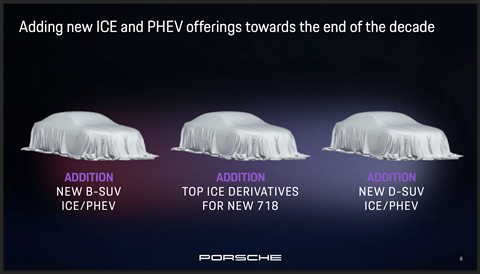
‘That includes an SUV above the Cayenne in both ICE and PHEV variants, highly emotional ICE derivatives at the upper end of the model line-up to complement our future BEV in the 718 segment, and life-cycle extensions for existing ICE and PHEV models such as the Cayenne and Panamera well into the 2030s,’ adds Blume.
‘These will not just be upgrades but new products with substantial innovations.’
Models ‘at the upper end’ as described by Blume, likely means GT versions like the GTS and GT4 versions of the Cayman and Boxster will be the ones to still feature combustion engines – and will run alongside the upcoming electric versions of the two cars.
These two cars have had an extremely drawn-out and much delayed development process. While in the midst of its electric-only strategy, Porsche has had to deal with two battery suppliers fighting insolvency. That, plus other supplier delays have meant the next-gen 718 cars are launching much later than planned. In a way, that’s ended up working out for Porsche as it widens its reach with the new cars and ‘realigns’ its priorities. For example, as well as new combustion versions of the 718 twins, Porsche has confirmed that a combustion and hybrid SUV to sit alongside the Macan will also be developed.
‘We have seen a clear drop in demand for exclusively battery-electric cars, and we are taking that into account,’ says Blume during the September 2025 investor call. ‘That’s why we are pushing back development of selected fully electric models.’
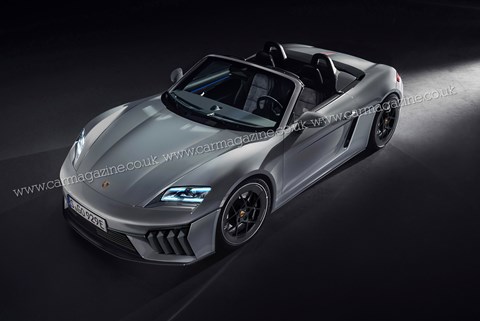 CAR’s vision of how the electric Porsche Boxster could look, illustrated by Lars Sältzer
Had it stuck to the original schedule, the electric Boxster roadster and identically engineered Cayman coupe would have had the D segment of the electric sports car market all to themselves. Now they must share the terrain with newcomers led by the MG Cyberster, priced between £55k-£60k – aggressive numbers Porsche cannot possibly match. We don’t know how much exactly the two-seaters from Stuttgart will cost, but they are not going to be less expensive than the outgoing range.
That said, the electric twins are expected to come with a significant power boost. The combustion cars’ outputs are in the 300-500bhp bracket, whereas the electric S models will develop around 380bhp and 440lb ft; GTS spec will be a twin-motor affair with around 490bhp and 550lb ft available. Like the Taycan and electric Macan, there will be versions badged Turbo, too, with one source claiming around 600bhp and 650lb ft.
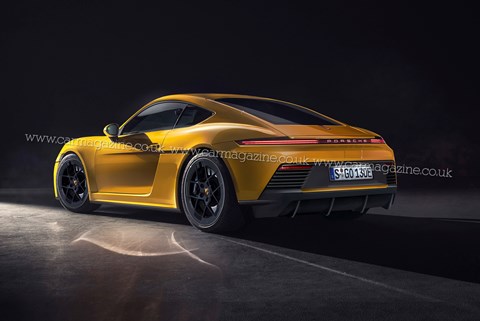 CAR’s vision of how the electric Porsche Cayman could look, illustrated by Lars Sältzer
S and GTS are said to feature 89kWh batteries; only the Turbo is claimed to use a more potent 99kWh energy pack. While the rear-wheel-drive model reportedly features two e-motors – one for each rear wheel – the all-wheel-drive derivatives add a third motor that drives the front wheels. According to a Scandinavian colleague who has spoken to a couple of factory test drivers, the rear axle is dynamically remarkable, offering extreme torque vectoring for rapid cornering and real slideability.
We know that the twins run an 800-volt electrical system for ultra-rapid charging, extended driving range and exceptional efficiency, but we know very little about that new battery except that the cell format is prismatic, not round. The battery performance apparently combines high repeatability and low degradation, 15-minute fast charging and an official WLTP range of over 325 miles. It’s also, we hear, good at coping with wide temperature variations.
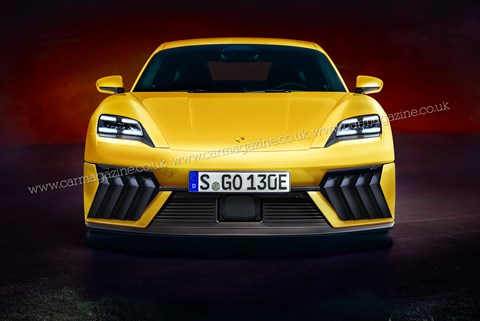 CAR’s vision of how the electric Porsche Cayman could look, illustrated by Lars Sältzer
But there are rumblings of discontent about the consistency of the quality of the Northvolt batteries, and the battery company’s worsening financial situation means it’s not yet clear where exactly the Porsche energy packs will be built. There are also unanswered questions about what, if any, input there has been into the 983 from the Croatian EV and software wizards at Rimac, who contributed to both the Taycan and the 911 GTS T-Hybrid.
What precisely are the underpinnings? The original plan had been to base the 983 on SSP Sport, the lighter, stiffer, sportier derivative of the VW Group’s upcoming Scalable Systems Platform masterminded by Porsche and Audi. But then SSP got pushed back to 2028 or even 2029, dragging the Volkswagen brand’s prestige Trinity project along with it. Frustrated by the slow pace of this group-wide project, Porsche broke ranks and created its own architecture named Mission R after the 2021 concept.
Until quite recently it looked likely that these same underpinnings could be used in cars wearing VW, Cupra and Audi badges. VW was toying with a modern successor to classics such as the Karmann Ghia and Scirocco, and Cupra pitched the DarkRebel as its new halo car. Audi is the only one looking certain; its Concept C previews a future electric sports car that launches towards the end of 2027. Volkswagen and Cupra’s plans, meanwhile, are a lot less nailed on.
Spy shots of the electric Boxster and Cayman show familiar design cues and evolutionary proportions. The wheelbase seems to have grown by 10-15cm to make room for the electric version’s T-shaped battery stack, which occupies the space between and behind the seats, not under them.
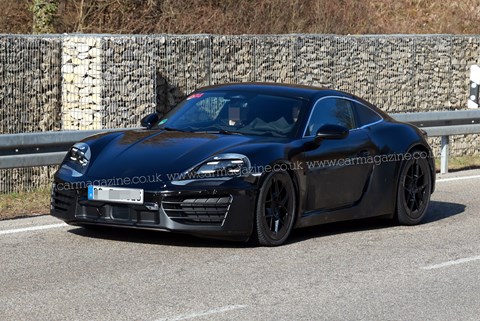
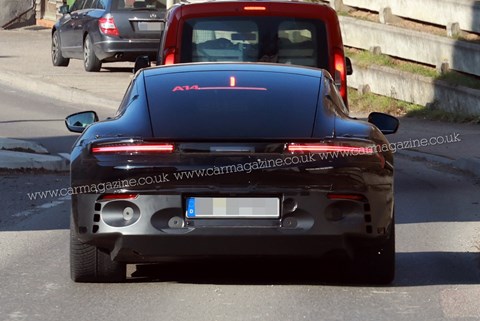
The considerably wider rear track can accommodate bigger tyres, while the higher and longer rear deck should be able to compensate for the loss of luggage space in the frunk. Those spy shots show an EV charging port positioned in the centre of the rear end, like a futuristic counterpart to the mid-mounted exhaust tailpipe. We expect wheel and tyre options to go up to 911-spec sizes for those customers willing to pay extra.
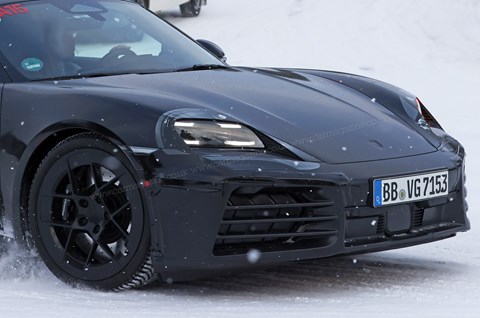
The front is slightly longer and a little more pointed than before, and sits closer to the road. It houses three automatically adjusted air intakes, suggesting a mix of low drag resistance and strong cooling performance. The four-point LED-matrix headlamps used throughout the Porsche family appear here, and at the back the light runs the full width of the car; pay extra and you can have the word ‘Porsche’ illuminated. Images also show a vertical third brake light.
Staying entirely true to Porsche tradition, the 983 interior is functional rather than sexy. There are three round instruments, which can be personalised with whichever combination of information you favour, the same as in the Taycan. Thumbs up to the modified switchgear, which brings back physical climate controls, a real knob to adjust the volume, two programmable diamond rocker switches high up on the dashboard, the traditional rotary drive mode device on the steering wheel and an optional passenger display.
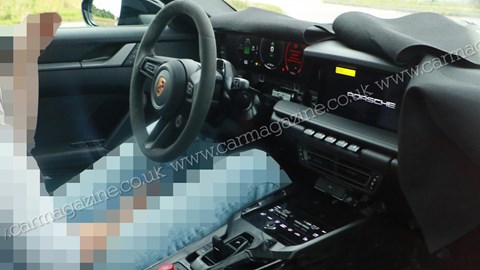
The gear selector – forward, neutral, reverse – is a short upright stub in the centre console next to the parking brake (as illustrated by spy photographer images above), itself a button rather than a lever. Most of the switchgear will look familiar to anyone who’s driven any Porsche recently. You can, as before, specify the Chrono pack complete with stopwatch. The sound system is scalable to the depth of your pockets. Massage seats are not on offer, and nor is a more compliant Touring suspension system.
Perhaps not at first, but at some point during the 983’s early life it should be possible to buy a lightweight Weissach pack, 3D bodyform seats, ceramic composite brakes and an aero kit that should enable some combination of going farther and faster.
In a way, Porsche will not perhaps be terribly upset by the lateness of the electric Boxster and Cayman’s arrival. A wait of 32 months might sound bad, and it might seem as though a lot of potential sales been missed, although the reality is that there are still no direct competitors on sale if you exclude the softer Cyberster. No electric replacement for the BMW Z4 or Toyota Supra, and no sight yet of the much-discussed electric sports cars from Lotus and Alpine. The market might in fact be more ready for the Porsche duo in October 2025 than it would have been in February 2023.
After all, EVs still are not an easy sell, and this experience is rocking premium brands more profoundly than volume manufacturers. Innovations are happening so fast that any investment in expensive yet fast-dating high-end products is increasingly risky rather than a smart buy.
The Taycan proved Porsche can make an excellent EV, and it’s still highly impressive today. But there has been a brutal drop in the used values of Mk1 Taycans, and demand for the Mk2 has not been as strong as Porsche had hoped, despite positive reviews. Through no fault of Porsche’s, the appetite for EVs just isn’t so strong as it was back in early 2023, when the Boxster and Cayman were originally due, not least because there are growing doubts, fed by the US election result among many other factors, that the combustion engine may be around for longer than was previously thought.
The only way Porsche can break this negative downward spiral is by offering more sustainable and more emotionally appealing EVs that have strong statistics to back up the undoubted dynamic excellence. Charging times need to be quick and the distances between stops need to be long. They also, being Porsches, need to be able to stand up to the intense demands of trackdays.
Can the 983 meet these targets using the hardware and software currently available to Porsche? Potential game-changers such as solid-state batteries, smarter software and significant weight-reduction measures will have to wait. Given Porsche’s strong record and high standards, it’s probably safe to assume that the 983 will make excellent use of today’s technology. But many of the target buyers remain firmly attached to engines, so the Cayman and Boxster are unlikely to find them a pushover.