► We reveal the best hybrid estate cars
► ICE/electric efficiency with big practicality
► Small, medium and large estates covered
The best hybrid cars are a smart way of trimming your fuel and tax bills without going the whole hog and getting an electric vehicle (EV). Among those hybrids are numerous hybrid estate cars that use an electric motor to supplement a petrol or diesel engine – and still pack a large boot for ferrying all the clobber of family life.
Whether you need to transport a ton of luggage, sales samples, children’s pushchairs or precious pets, there’s a hybrid estate car for you on this list. If you’re looking for something bigger, check out our list of the best hybrid SUVs.
The best hybrid estate cars at a glance
- Best all-round hybrid estate car: BMW 330e Touring – find out more
- Best hybrid estate car if you want a big boot: Toyota Corolla Touring Sports – find out more
- Best hybrid estate car for driving fun: BMW M5 Touring – find out more
- Best hybrid estate for long EV range: Skoda Superb iV Estate – find out more
Estates aren’t as popular as they once were, and the number of hybrid estates is dwindling – in putting together this list we counted a total of just 21 cars available to buy with that powertrain/body combination. This list offers a cross section of the options, covering a range of sizes and budgets. If you need more space, don’t forget to check out our list of the best 7-seater cars or the best hybrid family cars, while those with specialist mobility needs may find our best hybrid Motability cars guide useful.
The best hybrid estate cars in 2025
BMW 330e Touring
Best hybrid estate for pretty much everything
Pros: Great to drive, strong efficiency, strong performance
Cons: Smallish boot, every flooring salesman has one
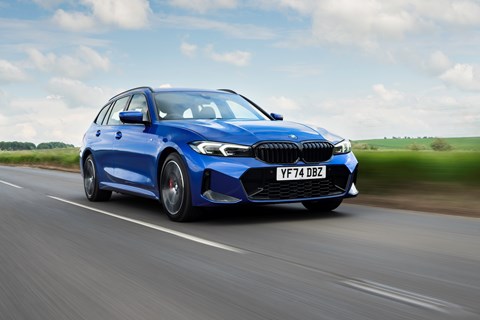
The BMW 330e Touring received a raft of revisions in 2024 that bolstered its position as the go-to plug-in hybrid estate. A bigger 19.5kWh battery was plumbed in, increasing range from 37 to 60 miles; 11kW AC charging’s now possible, allowing a full recharge in 2 hours 15 minutes. Fuel economy’s rated at 313.9mpg on the WLTP cycle, with CO2 emissions of 20g/km. There’s little to tell the 330e apart from other 3ers, just the charging port flap on the front left wing.
There’s barely any difference from behind the wheel, either. It’s not quite as entertaining as a petrol Three, but it still beats all its rivals in the fun stakes. It’s quick too, 0-62mph taking 5.9 seconds when you tap into the 287bhp XtraBoost function by flooring the throttle. There’s less boot litreage – 410 versus 500 – but that’s a comparatively small penalty for what’s the sweet-spot in the whole 3 Series range.
For a more in-depth look, read our BMW 330e review
Skoda Superb iV Estate
Best hybrid estate for lugging loads of stuff
Pros: 85-mile EV range, huge passenger space, great on a long haul
Cons: Not especially quick, engine’s harsh when pushed
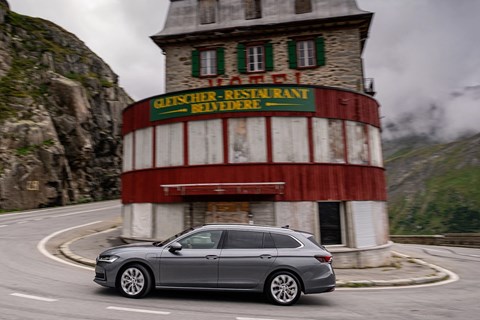
The current Skoda Superb iV (now in estate form only) has a VW Group’s latest plug-in hybrid powertrain, centred around a 148bhp 1.5-litre petrol engine, 116bhp electric motor and 25.7kWh battery. Total outputs are 201bhp and 184lb ft – modest numbers but the trade-off is an industry-leading 85 miles of EV range, plus up to 235.4mpg and 7g/km. That’s a huge plus for company car drivers.
The engine’s coarse when pushed, but the Superb’s an extremely comfortable and refined cruiser. That’s reflected in the precise and composed handling, but this is ultimately a car that excels on motorways. Skoda thankfully hasn’t gone down the button-free interior route and the signature vast rear legroom’s unaffected by the hybrid system. Same can’t be said of the boot, which loses a whopping 180 litres, but 510 is plenty for most. The Volkswagen Passat e-Hybrid is virtually the same car, but we prefer the Skoda’s vibe.
For a more in-depth look, read our Skoda Superb iV review
Mercedes-Benz E-Class Estate
Best hybrid estate for covering big distances in comfort
Pros: The only diesel PHEV, better to drive than E saloon, usefully long EV range
Cons: Loses a huge chunk of boot to the battery, interior tech can overwhelm
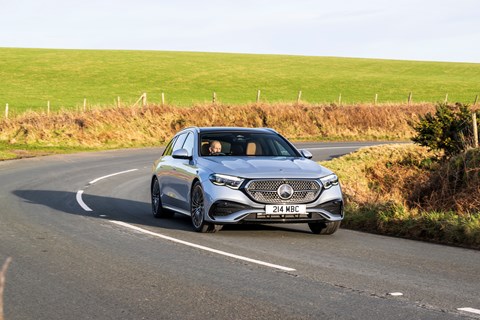
There are no less than the three plug-in hybrid options in Mercedes E-Class Estate range – petrol E300e, diesel E300de and high-performance AMG E53. We think the E300de is the one to go for. There’s 67 miles of EV range from its 25.7kWh battery, up to 166.2mpg and 45g/km. Plus, when the battery’s flat, it should still be able to do 50mpg-plus – much more than other PHEVs.
Standard rear air suspension and extra weight mean the E-Class Estate has a more settled ride than the saloon – it’s hugely comfortable. The diesel has a total power output of 308bhp and 516lb ft, enough to do 0-62mph in 6.5 seconds. Unfortunately, a big chunk of boot space is lost to the battery – from 615 litres down to just 460, killing one of the E Estate’s key selling points. But it’s still a great car for doing big distances, especially if you like a tech-forward interior.
For a more in-depth look, read our Mercedes-Benz E-Class Hybrid review
BMW M5 Touring
Best hybrid estate for travelling at huge speed
Pros: Huge speed, low company car tax rates, genuinely practical
Cons: Huge size, huge cost
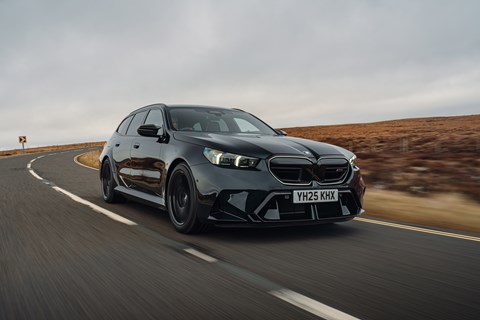
Though the BMW M5 Touring’s plug-in hybrid system boosts power output to a huge 716bhp and 738lb ft of torque, it’s not just about performance. BMW quotes an EV range of 41 miles and average fuel economy of 60mpg, so it can be relatively cost-effective to run. Especially when you take company car taxes into account – CO2 emissions are rated at 39g/km.
Of course, it’s a huge car that’s hugely heavy (2550kg!) but the chassis tech keeps everything in check, and it can be fantastic fun. It’s not quite as quick as its predecessor, but 0-62mph in 3.5 seconds is really very fast by any measure. The 500-litre boot’s big enough for most needs; amusingly, the M5 can also tow 2000kg. The cooking 530e and 550e Tourings are also fine options if you want something less extreme.
For a more in-depth look, read our BMW M5 Touring review
Toyota Corolla Touring Sports
Best hybrid estate for value-conscious bargain hunters
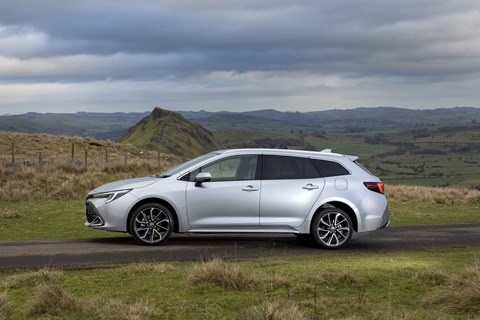
Pros: Biggest boot on this list, undemanding to drive, easily does 60mpg-plus
Cons: Engine’s coarse at high revs, you’ll be mistaken for a taxi
Perhaps surprisingly, the Toyota Corolla Touring Sports is the only self-charging hybrid estate currently on sale. It has found its niche across much of the country as the taxi of choice but there’s much to recommend it to private buyers, not least you can actually match – even exceed – the official 60mpg-plus fuel economy figures. Though CO2 of over 100g/km makes it less competitive for company car drivers.
There’s not a trace of fun to be had while driving the Corolla, but it’s competent enough and very comfortable. The CVT transmission takes the edge off refinement when you clog the throttle, but it’s otherwise very quiet. We’d go for the 2.0-litre engine; its 175bhp is nearly 40 more than the 1.8 and you can feel the difference. There’s plenty of passenger space and – surprisingly – the biggest boot on this list at 581 litres. Well, it doesn’t have a huge battery to cart around.
For a more in-depth look, read our Toyota Corolla Touring Sports review
Peugeot 308SW Plug-in Hybrid
Best hybrid estate for taking big loads to awkward places
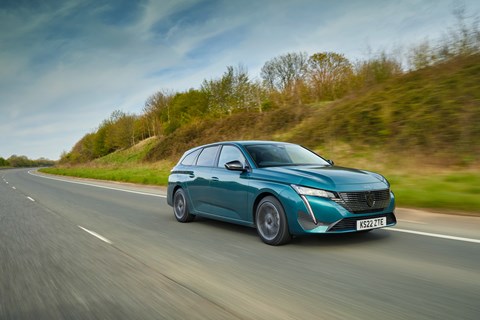
Pros: Compact size, very big boot, ride quality
Cons: Multi-level dashboard doesn’t suit everyone, powertrain integration
The Peugeot 308SW was previously available with two plug-in hybrid powertrains, both centred on a 1.6-litre petrol engine with a choice of 177bhp or 221bhp power outputs. The range has now been rationalised into a single 192bhp model. We’ve yet to drive it but we hope the integration of engine and electric motor is better resolved than in the old versions, which were rather dim-witted. The new one at least posts decent WLTP figures of up to 53 miles of EV range, 113.0mpg and 15g/km.
The 308SW is a nice thing to drive, feeling just as lithe and agile as the hatchback. The ride’s more settled, as well, thanks to the considerably longer wheelbase. The multi-level dashboard remains controversial – some of our testers simply cannot get on with the driving position. But the main reason it’s on this list is the vast (for a PHEV) 548-litre boot. All PHEVs are compromised for practicality, but Peugeot has done a really good job of resolving the packaging issues here.
For a more in-depth look, read our Peugeot 308 review
Mercedes-Benz C-Class Estate
Best hybrid estate for looking classy
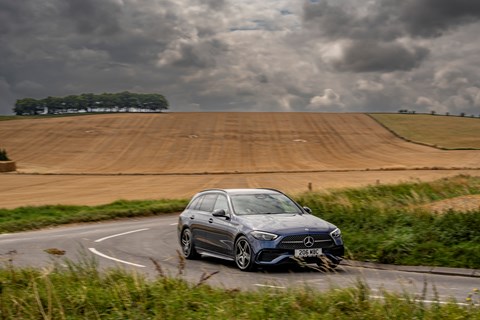
Pros: Surprisingly entertaining to drive, pretty quick, over 60 miles of EV range
Cons: Not much back seat space, tiny boot
In many ways the Mercedes C-Class Estate is basically a smaller version of the E-Class discussed elsewhere on this list. Indeed, both the petrol C300e and diesel C300de use exactly the same plug-in hybrid powertrains as the equivalent E-Class and return identical EV range and MPG figures. In the case of the C300e that’s 68 miles, 122.9mpg and 46g/km.
There’s decent power in the C300e, a total of 308bhp and 516lb ft, which gets it from 0-62mph in just 6.1 seconds. It feels as quick as those numbers suggest and it’s a generally smooth and refined system. Add in the comfortable ride and surprisingly engaging handling, and things are looking good for the C Estate. But the boot’s a miniscule 360 litres, a loss of 130 litres from non-hybrid models.
For a more in-depth look, read our Mercedes-Benz C-Class review
Cupra Leon e-Hybrid Estate
Best hybrid estate for getting into small spaces
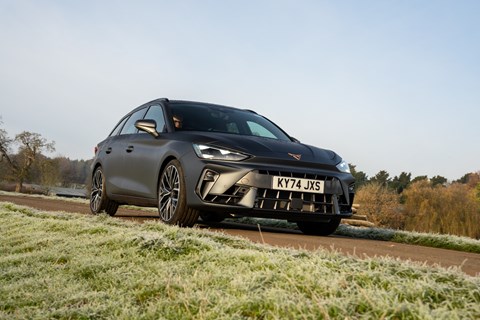
Pros: Convenient size, sprightly performance, 75-mile EV range
Cons: Getting long in the tooth, firm ride
Pickings are slim if you need a smaller hybrid estate and the Cupra Leon Estate is the only one that offers a sporty take on the format. It’s available in two flavours, both powered by a 1.5-litre petrol engine and 25.8kWh battery, with 201bhp or 268bhp. The latter’s a sprightly performer, breaching the 62mph mark in 7.1 seconds, while delivering 75 miles of EV range, 189mpg and 34g/km.
Inevitably, the Leon e-Hybrid isn’t as much fun as its 300bhp-plus rangemates, but it still feels precise and agile from behind the steering wheel. There’s plenty of space, too, though the battery takes up 150 litres of boot. Still, the 470-litre capacity you’re left with is more than the Mercedes E-Class Estate PHEV has.
For a more in-depth look, read our Cupra Leon e-Hybrid review
Volvo V60 T6
Best hybrid estate for carrying lots of stuff in style
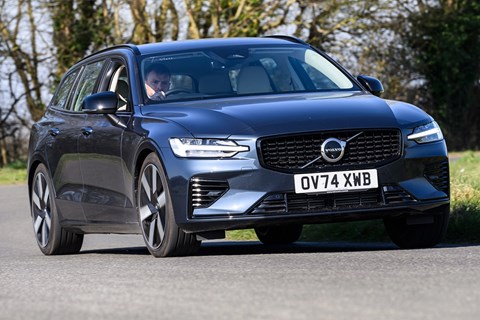
Pros: Still looks great, very strong efficiency, big boot
Cons: Getting on in years, probably won’t be around much longer
Volvo tried to kill off its estate cars in the UK, but such was the outcry that it brought them back – briefly, as it turned out. At the time of writing, the V90 is only available from stock so how much longer can the smaller Volvo V60 hold out? In the meantime, the T6 is a fine choice with up 68 miles of EV range, 353.1mpg and CO2 emissions of 17g/km.
It’s quick, too. There’s a total of 345bhp and 258lb ft coupled to all-wheel-drive (the e-motor powers the rears) which translates to a 0-62mph time of 5.2 seconds. The handling’s best described as sure-footed – not really sporty but you can easily keep up a rapid pace cross-country. The interior’s serene, there’s plenty of space – the boot measures 519 litres – and the safety tech’s largely unannoying.
For a more in-depth look, read our Volvo V60 review
Audi A6 Avant e-Hybrid
Best hybrid estate for smooth operators
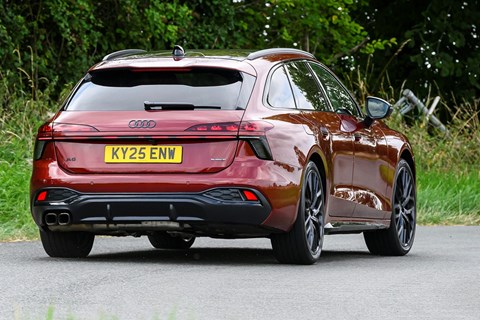
Pros: Smooth powertrain, useful performance, ride comfort
Cons: Boot should be bigger, reliability concerns
The latest Audi A6 Avant may be all-new, but the e-Hybrid’s plug-in hybrid powertrain’s carried over from the previous generation pretty much unchanged. That’s no bad thing as it’s a fine system. It’s smooth and refined, switching between engine and battery power pretty much seamlessly. And it’s 294bhp and 332lb ft are muscular enough to swiftly haul the thing’s 2.1-tonne heft.
The official figures show up to 63 miles of EV range, 123.0mpg and CO2 emissions of 52g/km – all right on the money for a car this size. Not so much boot size, though, which is just 404 litres, a loss of 62 litres. But the A6 is a lovely car to do big distances in. The ride on smaller wheels and standard suspension’s really comfortable and there’s loads of tech to ease the strain, although said tech has proven rather glitchy in our experience.
For a more in-depth look, read our Audi A6 e-Hybrid review
A hybrid estate car to avoid
Mercedes-AMG C63 S E-Performance Estate
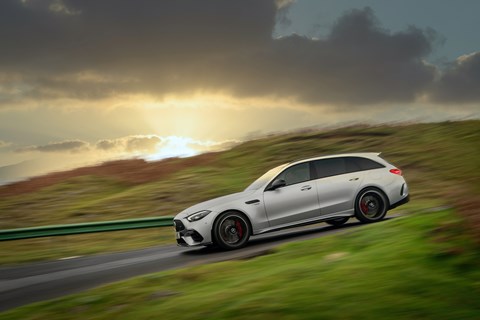
Pros: Immense power, immense speed, surprisingly athletic,
Cons: Rowdy engine, hopeless efficiency.
Mercedes’ decision to switch out the AMG C63’s scintillating V8 for a four-cylinder plug-in hybrid powertrain was hugely controversial and, by Mercedes own admission, a failed one – the V8 will return in due course. Why has it failed? Well, it can’t be the power. There’s 670bhp and 752lb/ft on tap when everything’s fully lit; 0-62mph takes just 3.3 seconds. It’s not the handling, either. Despite weighing 2.2 tonnes, the chassis tech allows you to dance the C63 through corners at any angle you want. It’s loaded with tech, and perfectly comfortable, as well.
No, the powertrain’s the problem. Despite its power, the engine’s a charisma vacuum (it can certainly sound like one) and the car’s nowhere near efficient enough – 7 miles of EV range, 31.5mpg average and 205g/km. When you see the numbers the BMW M5 Touring can achieve, you have to wonder what on earth Mercedes was playing at here.
For a more in-depth look, read our Mercedes-AMG C63 S review
Hybrid estate car FAQs
What are the pros and cons of hybrid estate cars+
Hybrid estates – particularly plug-in hybrids – have come a long way in recent years. Back in the early days, the hybrid system was just shoved in as a shortcut to lower carbon dioxide emissions, with little thought about integrating it with the rest of the powertrain.
Now, though, many hybrid estates are models of refinement, without the jerkiness of early ones as they transition between engine and battery power. They’re much more efficient now, as well. The best are able to match the fuel economy of diesel equivalents and have a genuine 50 miles-plus of electric-only range.
There are some downsides, though. Some hybrids cost a lot more than petrol models and they can’t get anywhere near the often preposterous official MPG figures. They usually have less boot space than a petrol model, too, because the battery takes up some of the space.
Which is better – hybrid or diesel?+
There’s still a place for diesel estate cars, even as sales and the choice of models available dwindles rapidly. They remain better suited to high mileage use because of the long range that’s possible from a single tank of fuel. They usually have a bigger boot than a hybrid equivalent and can tow more weight.
However, some hybrids are catching up on range and, of course, plug-in hybrids give you the option of driving silently and smoothly on electric power, potentially for your entire commute. They also cost a lot less to tax, particularly for company car drivers.
Which hybrid estate car has the longest EV range?+
That accolade goes to the Skoda Superb iV, which has an official WLTP electric range of up to 85 miles – depending on model. The closely related VW Passat eHybrid also breaches the 80-mile mark, as does the Cupra/SEAT Leon.
At the other end of the scale, there’s the Mercedes-AMG C63 S E-Performance, which manages just seven miles on a full charge, underlining that its hybrid system is there purely for performance. By contrast, the BMW M5 Touring can do 41 miles. Every other PHEV estate currently on sale exceeds 50 miles of EV range.
Which hybrid estate car does the most MPG?+
According to the official WLTP figures, the BMW 530e Touring does the best combined average fuel economy of any hybrid estate, achieving 403.5mpg. The Volvo V60 T6 comes second on 353.1mpg, and the BMW 330e Touring is third on 313.9mpg. It’s not until you reach 12th place on the 21-strong ranking that the figures drop below 100mpg.
Of course, you’re unlikely to get anywhere near the official figures in the real world, unless you can maximise your use of the car’s battery power. Still, many hybrid estates can comfortably do 50mpg-plus – similar to an equivalent diesel.
Are hybrid estate cars good for long journeys?+
The traditional argument’s that diesel remains the better option for long journeys, rather than hybrids. That’s because you burn through the battery range within 50 miles or so, at which point you’re left with a petrol/diesel engine lugging round a few hundred extra kilos of hybrid system. The engine works hard against that weight, worsening fuel economy.
That’s still broadly true, however manufacturers are starting to introduce systems that better manage the balance between battery and engine power on a long run. It’s a particular strength of the BYD Seal 6 Touring, which has theoretical total range of around 800 miles.
How we tested the cars listed here
Each of the models listed here has been driven extensively by our exceptionally experienced team of leading motoring journalists and specialist writers. Take a look at our page on how we test cars to find out more.