► Volvo returns to saloon market with ES90
► Long range and impressive charging speed
► But can it beat the Germans?
There’s good news if you aren’t a fan of SUVs, the big Volvo saloon car has made a comeback with the new ES90. It’s the first electric car from the Swedish firm that’s not an SUV and is an indirect successor to the S90, which got the axe a couple of years.
Now ready for the bad news? It uses the same cursed SPA2 platform as the flagship Volvo EX90 and Polestar 3, both of which were delayed by software issues. In the end they were rolled out while still being a bit unfinished, with all kinds of software niggles reported. One example, they were launched with a 400-volt electrical architecture, but less than a year later they’ve already been upgraded to an 800V system.
But now that Volvo’s beta testing is over, the ES90 should be properly ready for customers, and it’s equipped with 800V from the start. Is it the answer to the anti-electric SUV prayers?
At a glance
Pros: Supremely refined at speed, long electric range and ultra-fast charging, very spacious in the rear seats
Cons: Terrible rear visibility, annoying touchscreen-centric design
What’s new?
The ES90 is another electric hatchback masquerading as a saloon car, as though it has the rough profile of a sedan, it has that elevated driving position that countries such as China – the expected largest market – expect. It shouldn’t come as any surprise to learn it’s also made in that corner of the world.

With a 3.1m-long wheelbase, it’s more in tune with a conventional luxury car than it is with executive cars in its core class, such as the Audi A6 e-tron and BMW i5. But I’ll dash your hopes early, unlike those two cars, there won’t be an estate variant of the ES90.
What are the specs?
The ES90 is available with three powertrains, labelled Single Motor Extended Range, Twin Motor and Twin Motor Performance, and each gets a slightly different battery, 92kWh, 106kWh and 111kWh respectively.
Let’s start with the entry-level version, which gets a single motor on its back axle. It’s the only version Volvo had available to try on the launch, producing 328bhp and 354lb ft of torque, enabling a 0-62mph time of 6.6 seconds. As with every Volvo, except for police cars, the top speed is limited to 112mph. Despite using the smallest battery, Volvo still claims 400 miles of range.
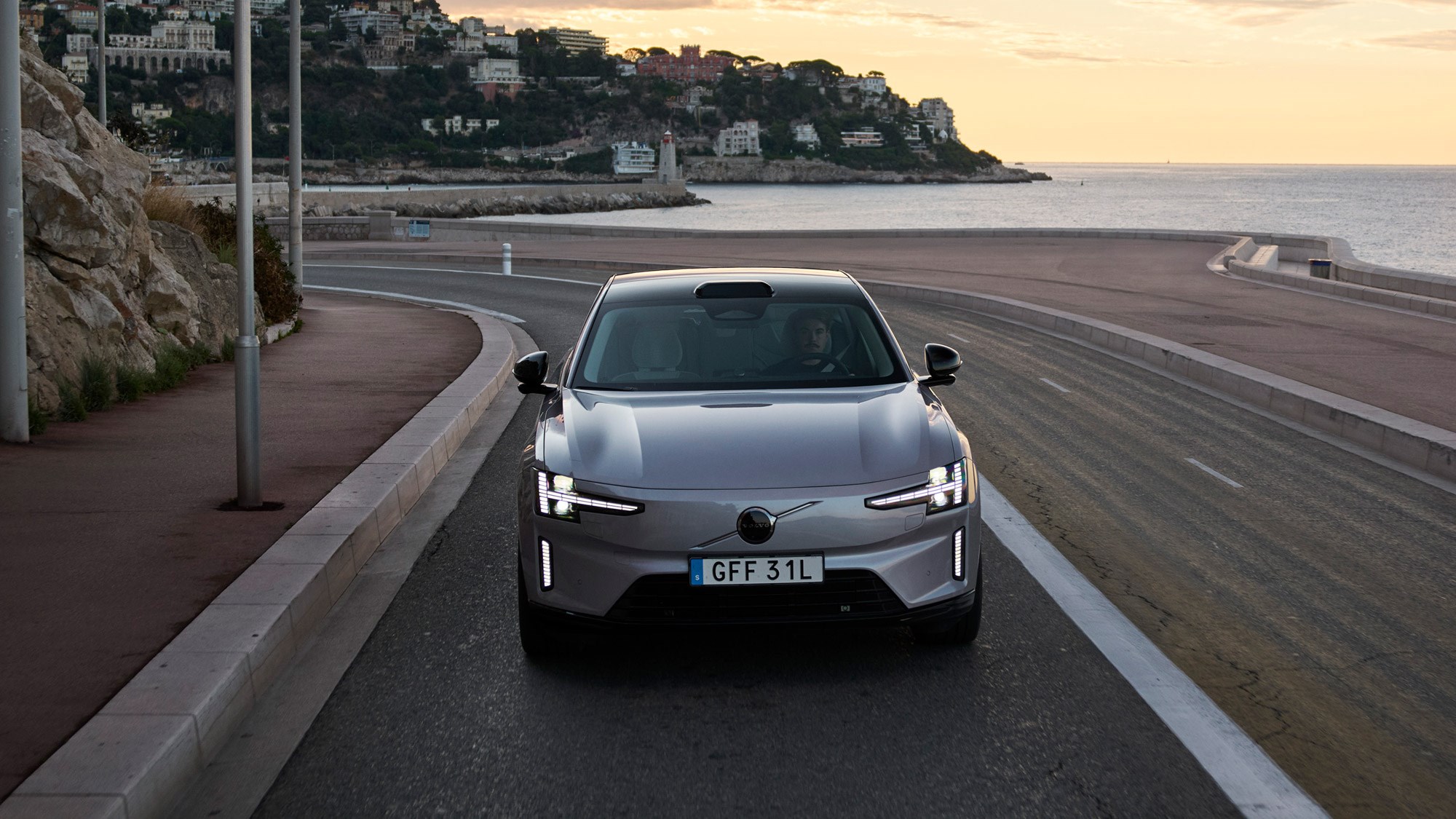
Twin Motor models see power increase to 443bhp and torque to 490lb ft, knocking the 0-62mph time down to 5.4 seconds. At the top of the range, the Performance version puts out 671bhp and the same number in torque, reducing that 0-62mph time to 4.0 seconds. If it doesn’t sound all that fast for a car with that power, it’s worth noting the ES90 weighs 2.5 tonnes in twin-motor form, around 200kg heavier than the equivalent i5, which doesn’t exactly compete in the lightweight category.
Despite the extra performance, Volvo claims a 435-mile EV range for them both, while maximum 350kW DC charging speeds mean a 10 to 80 per cent charge can be completed in just 22 minutes.
How does it drive?
With comfort and refinement at the top of the order list, the ES90 drives a lot like we expect a modern Volvo to. Impressive wind and road noise suppression makes the ES90 a very quiet car to travel with, while a variety of driver assists also makes it an ideal car for piling up the miles in an easy fashion.
It’s a pity the rear visibility is so poor, though, with its combination of a letterbox-like rear screen and a centre rear headrest that completely blocks the view out of the back. You can’t help but wonder if the blanked-out rear window and cameras of the Polestar 4 aren’t so stupid after all, though why can’t cars just have good visibility again?

Passive suspension is standard but we’ve only tried the ES90 so far in top-spec Ultra guise, which comes equipped with air. It does a great job of softening the many sharp speed bumps of our Nice test drive but can still struggle on more broken surfaces. The weight factor certainly doesn’t help.
Elsewhere the ES90 drives predictably but with minimal thrills, as to be expected. This rear-wheel-drive version provides more than enough pace for a refined executive car like this and any more would seem overkill. Pedal response is good but the brakes are unusually sharp, the first few presses of them not too dissimilar from doing an emergency stop. It doesn’t roll much through the corners, but the vague steering means this isn’t a driver’s car. Both the BMW i5 and Audi A6 e-tron are much more engaging.
What’s it like inside?
The ES90’s interior is a real mixed bag of top-notch materials and pure frustration that comes from almost all controls being handled through the touchscreen.
Starting on a positive note, a combination of soft Nappa leather seats, real wood detailing and some outstanding detailing, such as Swedish flags etched into the metal work on the dashboard and a crystal volume controller, make the ES90 seem at first more like a luxury car than an executive one.
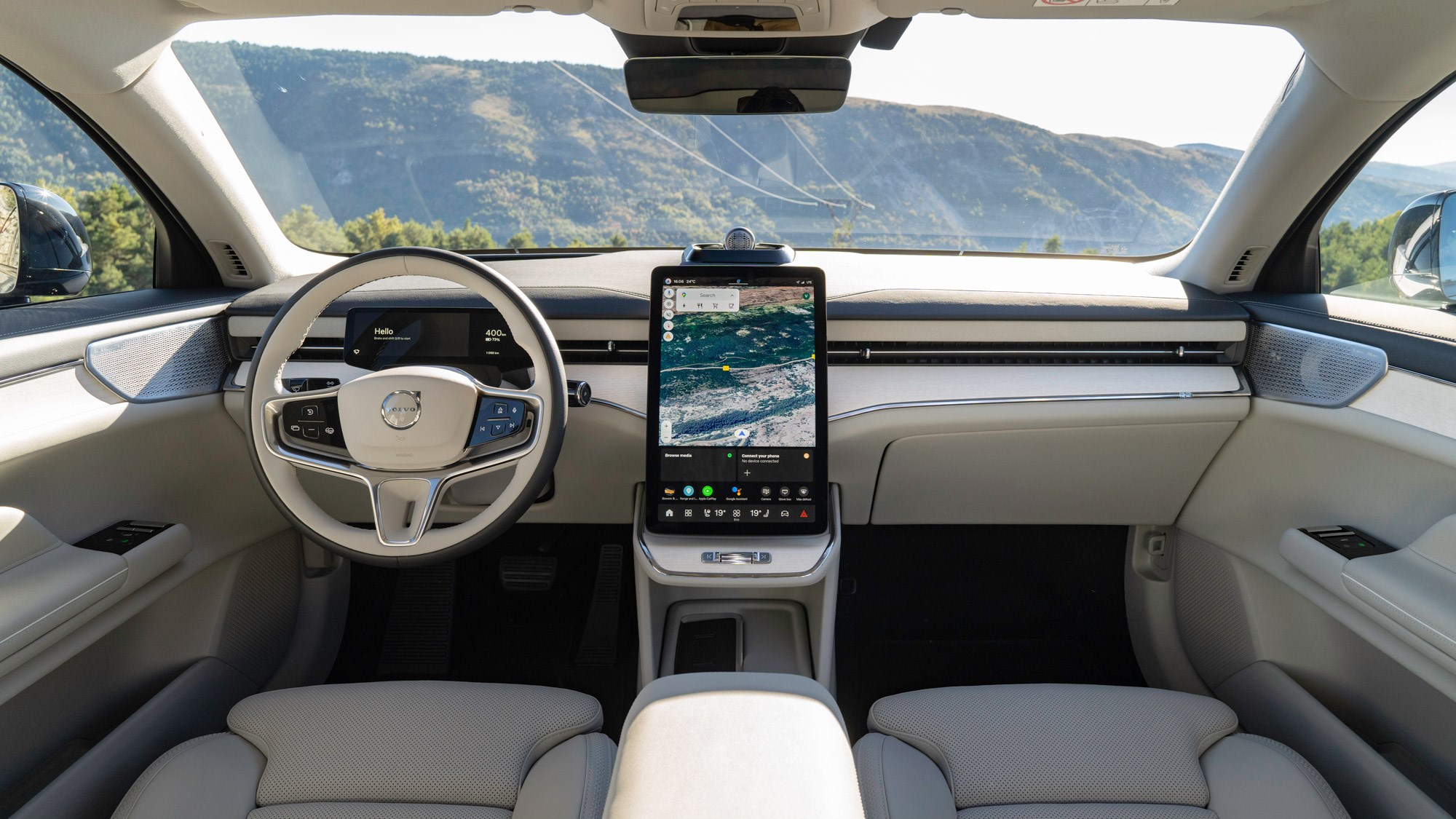
The touchscreen itself, the bane of many of the Volvo EX90’s software gremlins, worked faultlessly on our test car, with top-notch graphics and excellent Google integration. But it all falls short when it comes to usability. I’ll list a few examples of things that shouldn’t be controlled with it that are – the glovebox, the steering wheel adjustment, the electric mirrors, the sunroof blind, the climate control… I could continue.
Also, for some reason Volvo has followed VW in only giving the car two electric window controls, rather than four, and having a front and rear setting, only somehow it’s even less intuitive than an ID.3. I still find it utterly baffling for a car company that has prided itself on safety for so long.
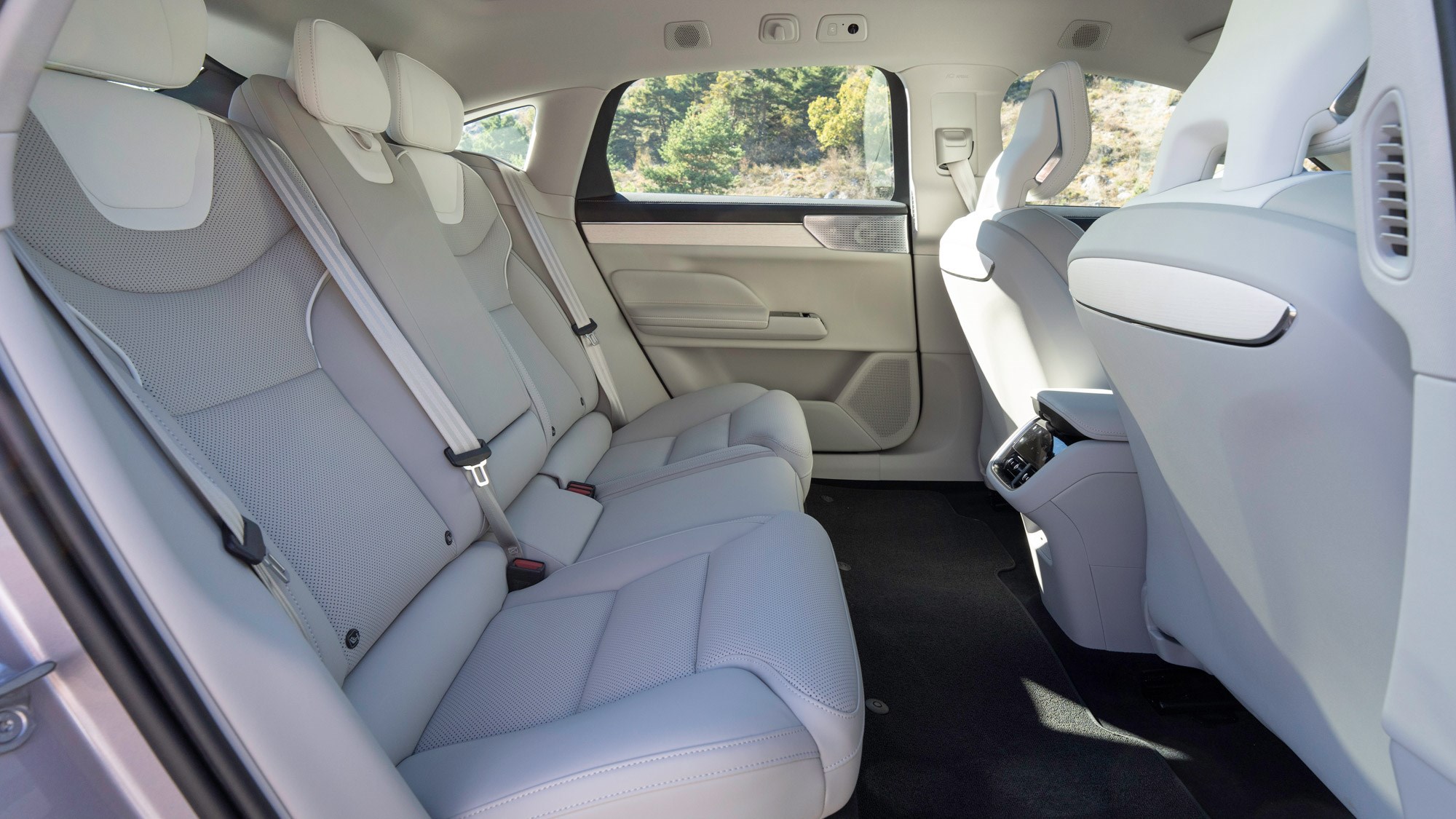
On a better note, however, is the ES90’s rear space. That longer wheelbase makes the rear space feel more S-Class than E-Class with masses of legroom especially. The floor in the ES90’s rear is completely flat, though is quite high because of the size of the battery it has to accommodate. Top-spec Ultra models also feature a full foldown armrest and electrically reclining backrest for the full lux experience.
The boot floor is quite high and shallow, with its 424 litres of space lagging behind the Audi and BMW. The rear seats do fold individually but the space is small and quite awkward to access. A 22-litre frunk does provide space to keep the charging cables out of the way, however.
Before you buy (trims and rivals)
Prices for the ES90 start from a snippet under £70,000, making it a touch more expensive than the A6 e-tron and BMW i5, though the standard kit list is far more generous.
The UK doesn’t take the entry-level Core trim, so the choice is between Plus and Ultra. Plus still gets laden with kit, such as a 360-degree camera system, 20-inch alloy wheels, a fixed panoramic sunroof, heated front and rear seats and three years of servicing included. The Plus model is only available with the rear-wheel-drive version, too.

Ultra trim adds aair suspension, 21-inch alloy wheels and soft closing doors, along with a dimmable electrochromatic sunroof. Further features include a 25-speaker Bowers & Wilkins sound system, massaging and ventilated front seats and more advanced pixel lighting. The Ultra trim commands an almost £10,000 premium, starting from £79,160, with the Dual Motor available from £83,360 and £87,960 for the Performance variant.
As for rivals, we’ve touched on the Audi A6 e-tron and BMW i5, but as a wildcard we’d also recommend a look at the Genesis Electrified G80. There’s also the Mercedes EQE, but it’s tough to recommend in this competition.
Verdict
Volvo’s first foray into the electric executive car market is largely a success. With supreme refinement and a long-distance electric range, it ticks the two key boxes required for a car like this. Its rear space is also vast and, when combined with its plush material quality and generous equipment levels, in many ways feels more like a car from the class above.
But the touchscreen-dominated interior is its biggest mistake. Volvo has simply put too many features into it, to the point day-to-day usability is compromised to the point it makes it hard to recommend. Combined with its atrocious rear visibility and fairly expensive pricing, it puts the ES90 behind the BMW i5 and Audi A6 e-tron, though, granted, it does feel a lot posher than either of those cars.